What Is AI’s Water Footprint and Why It Matters in 2026
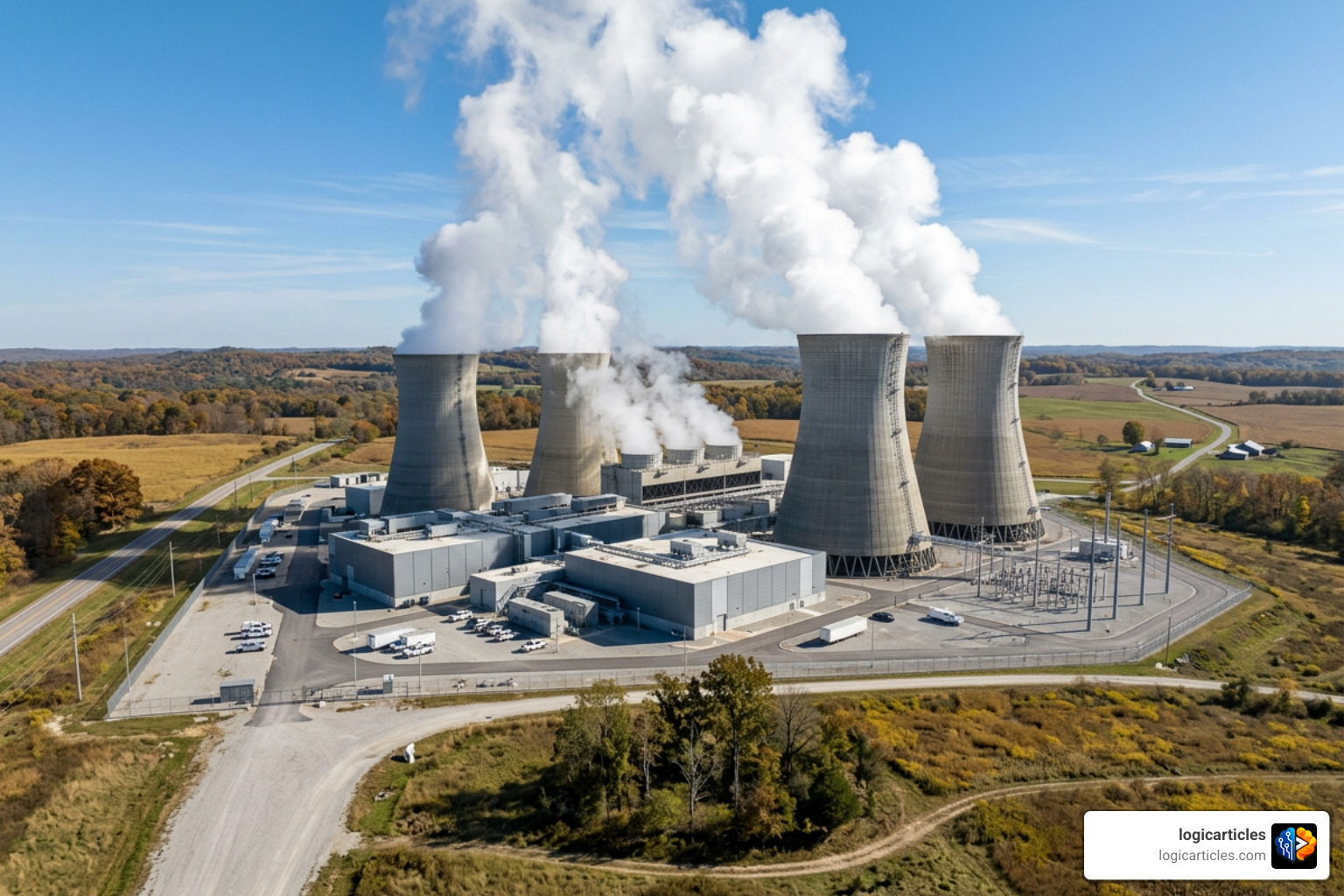
How does AI use water? Here’s the short answer:
AI uses water in three main ways:
- Direct cooling — Data centers pump water through cooling towers to remove heat from servers. Most of this water evaporates into the air.
- Electricity generation — Power plants that supply data centers use water to produce steam or cool equipment, adding a large indirect water cost.
- Chip manufacturing — Fabricating the semiconductors inside AI servers requires millions of gallons of ultrapure water per day.
These three pathways add up faster than most people expect.
Training a single large language model — like GPT-3 — can directly evaporate around 700,000 liters of freshwater. And that’s just the on-site portion. Factor in the water used by power plants and chip factories, and the total climbs much higher.
Everyday queries add up too. Researchers estimate that a 100-word AI prompt uses roughly 519 milliliters of water — about one standard water bottle.
By June 2026, AI-driven demand has pushed U.S. data center water consumption to levels that rival small cities. Some large facilities consume up to 5 million gallons per day — equivalent to a town of 10,000 to 50,000 people. And roughly 40% of U.S. data centers sit in areas already facing high or extreme water stress.
This guide breaks down exactly where that water goes, why it’s so hard to replace, and what’s being done about it.
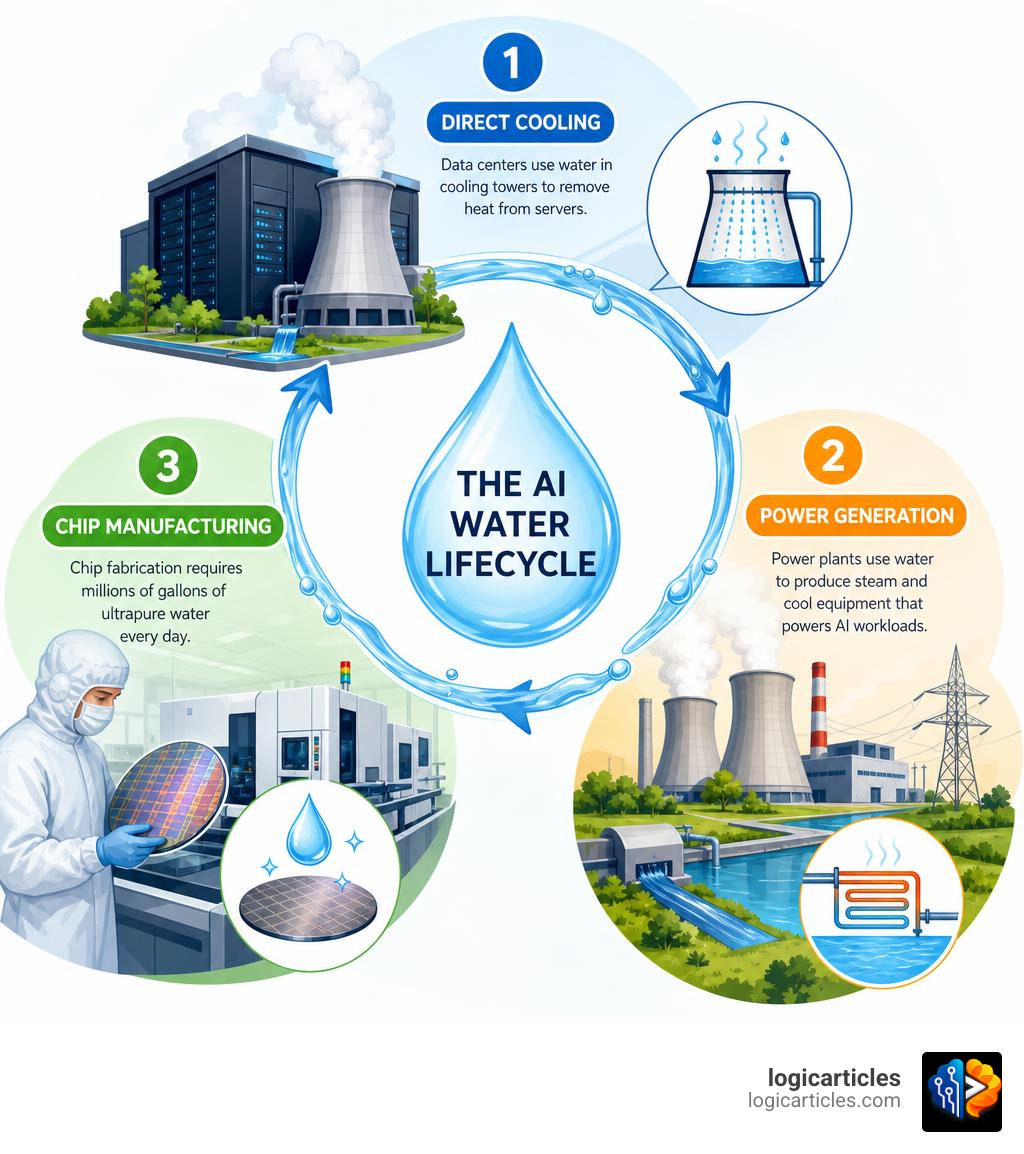
The Three Scopes: How Does AI Use Water?
To understand the true scale of AI’s environmental impact, we have to look beyond the server room. Environmental scientists categorize water footprints into three distinct “scopes” or streams. This framework helps us map out the entire lifecycle of an AI model, from the physical silicon chips to the final output on your screen.
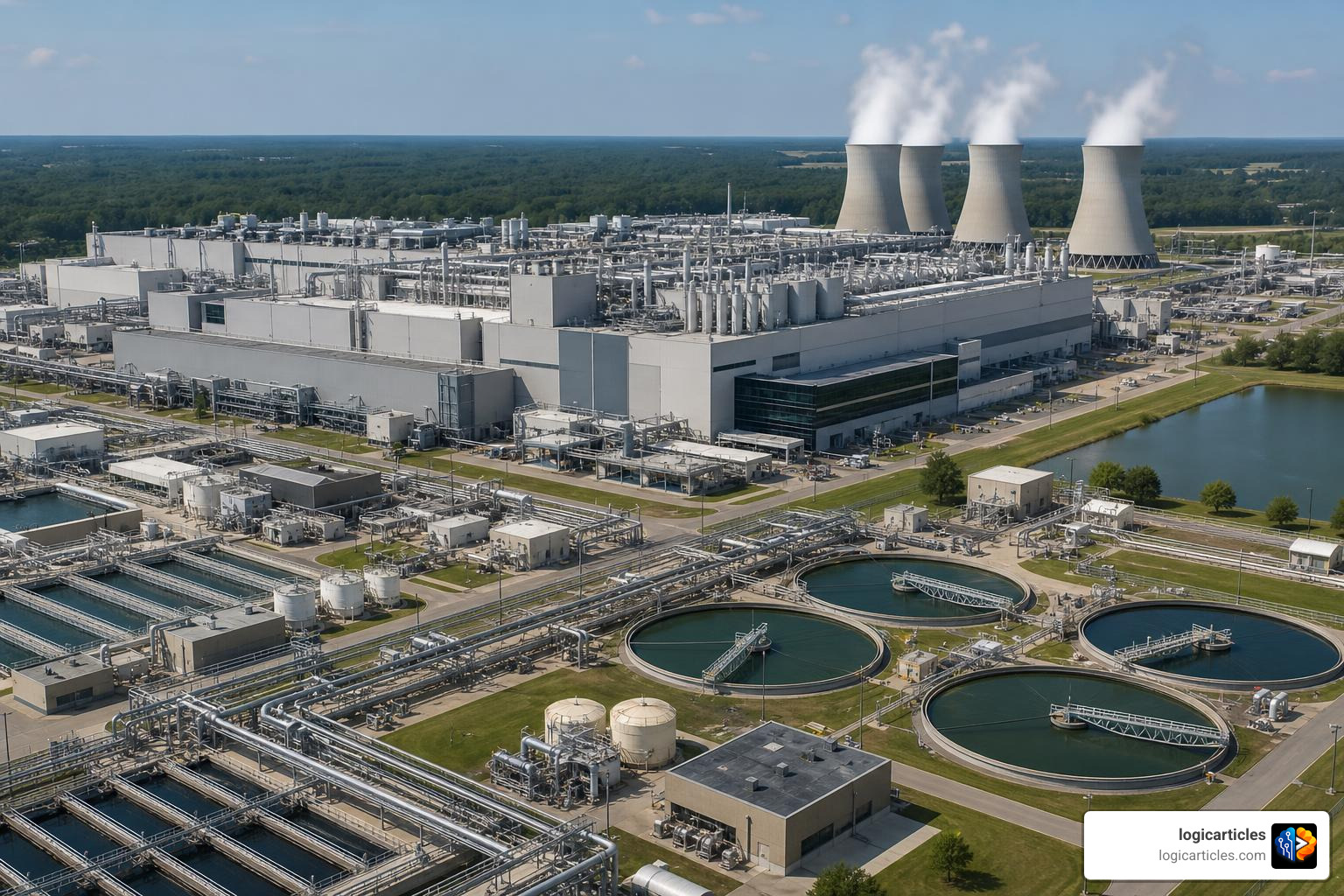
When we look at the full lifecycle of AI, we see that its thirst is distributed across three main areas:
- Scope 1 (Direct Water Use): This is the water consumed on-site at the data center itself, primarily through evaporative cooling towers and humidity control systems designed to keep high-performance graphics processing units (GPUs) from melting.
- Scope 2 (Indirect Electricity Water Use): This represents the water consumed by the power plants generating the massive amounts of electricity required to run those servers.
- Scope 3 (Indirect Supply Chain Water Use): This is the “embodied” water used to manufacture the hardware—specifically the highly complex microchips and servers.
To fully grasp how these scopes interact, we can look to Scientific research on AI’s water footprint, which reveals that ignoring any single scope leads to a massive underestimation of AI’s real ecological footprint.
For instance, consider the hardware manufacturing stage (Scope 3). Producing a single microchip requires 2.1 to 2.6 gallons of water just to cool machinery and ensure wafer sheets are free of even the microscopic contaminants. At scale, an average chip manufacturing facility (or “fab”) consumes approximately 10 million gallons of ultrapure water per day.
Creating ultrapure water (UPW) is itself an incredibly resource-intensive process. It requires roughly 1,500 gallons of municipal or piped water to yield just 1,000 gallons of UPW. This pure water is used to wash silicon wafers during the fabrication process, meaning the physical infrastructure of AI is incredibly “thirsty” long before a single line of code is executed.
Scope 1: Direct Cooling and How Does AI Use Water On-Site
The most visible way data centers consume water is through on-site thermal management. AI workloads are highly computationally intensive. Unlike traditional cloud computing tasks—like hosting a website or storing files—running deep learning models pushes GPUs to their absolute physical limits. This intense processing generates a massive amount of heat.
To keep these systems operational and prevent hardware failure, data centers rely heavily on evaporative cooling towers. In a typical setup:
- Warm water is pumped from the server racks to a cooling tower.
- The hot water is sprayed or exposed to outside air.
- A fraction of this water evaporates, which naturally cools the remaining water.
- The cooled water is then cycled back into the facility to absorb more heat.
While highly effective and energy-efficient, this process relies on the physical evaporation of freshwater. Approximately 80% of the water withdrawn by data centers for cooling evaporates directly into the atmosphere, meaning it is permanently removed from the local watershed. The remaining 20% to 30% is eventually discharged as wastewater (often called “blowdown” water) once it becomes too concentrated with minerals to be safely recirculated.
Scope 2 and 3: Indirect Electricity and Manufacturing Footprints
While Scope 1 gets the most media attention, Scope 2—the indirect footprint from electricity generation—is often the largest contributor to AI’s total water consumption.
Data centers are massive energy hogs. As of June 2026, U.S. data centers make up about 4.4% of electricity consumption nationwide, up from 1.9% in 2018. Analysts predict this number could climb to 12.0% by 2028.
Most electricity grids still rely on thermal power generation (such as coal, natural gas, and nuclear energy). These power plants require steam to spin turbines and vast quantities of cold water to cool their systems.
- Coal plants require approximately 19,185 gallons of water per megawatt-hour (MWh).
- Natural gas plants consume around 2,800 gallons per MWh.
Because of this, the indirect water consumption footprint of data centers in the United States reached roughly 211 billion gallons (approx. 800 billion liters) in 2023. If we look at the entire U.S. data center grid, the indirect water footprint is heavily tied to the local energy mix. Siting a data center in a region powered by wind and solar dramatically reduces its Scope 2 water footprint, whereas a fossil-fuel-reliant grid dramatically inflates it.
Water Withdrawal vs. Water Consumption in AI Infrastructure
When reading reports about data center water use, it is easy to get confused by two terms that sound identical but mean very different things: water withdrawal and water consumption.
- Water Withdrawal: This is the total volume of water diverted or taken from a source (like a river, lake, or municipal aquifer).
- Water Consumption: This is the portion of the withdrawn water that is lost to the local watershed—usually through evaporation, incorporation into products, or contamination.
In a data center, this distinction is critical. If a facility withdraws 1 million gallons of water but returns 300,000 gallons of treated wastewater back to the local utility, its consumption is 700,000 gallons.
The water that is returned is often called cooling tower blowdown. As water evaporates in cooling towers, dissolved solids and minerals (like calcium and magnesium) build up in the remaining liquid. To prevent scale buildup and corrosion, this highly concentrated water must be periodically drained (blown down) and replaced with fresh water.
While this wastewater is returned to municipal systems, it cannot be immediately reused without extensive treatment.
| Metric | Water Withdrawal | Water Consumption |
|---|---|---|
| Definition | Total water taken from a source (aquifer, river, municipal supply). | Water withdrawn but not returned to the source (lost to evaporation). |
| Fate in Data Centers | recirculated through cooling loops or discharged as blowdown. | Evaporated into the atmosphere to dissipate heat. |
| Average Ratio | 100% of incoming water. | Typically 70% to 80% of withdrawn water is consumed. |
| Impact | Temporary local resource draw. | Permanent loss to the local watershed. |
Understanding this trade-off is vital for local communities. Even if a data center promises to “return” 30% of its water, the remaining 70% is lost to the sky, directly competing with local agricultural and drinking water needs.
Quantifying the Thirst: Water Per Query and Training Run
Just how much water does a single AI model “drink”? Let’s look at the numbers.
At the macro scale, training a frontier model is incredibly resource-intensive. Training the GPT-3 language model in Microsoft’s state-of-the-art U.S. data centers is estimated to have directly evaporated 700,000 liters of clean freshwater. If that training had occurred in a hotter region or during the summer, that figure could have easily doubled.
But what about daily use? To make this relatable, researchers have broken down the math to a per-query level.
According to a detailed Analysis of AI water consumption metrics, every time you have a brief conversation with an AI model, you are indirectly evaporating water. A standard 100-word prompt uses roughly 519 milliliters of water—which is almost exactly the volume of a standard single-serving plastic water bottle.
If you ask a highly complex reasoning model like DeepSeek-R1 a question, the water footprint can be significantly higher due to the increased compute time. In contrast, smaller, highly optimized models like LLaMA-3.2-1B require far less energy (0.07 Wh per query compared to DeepSeek-R1’s 23.8 Wh), resulting in a water footprint that is up to 200 times smaller.
How Does AI Use Water During Model Training vs. Daily Inference?
It is helpful to separate AI’s lifecycle into two phases: training and inference.
[Training Phase]  --> One-time, massive spike in energy & water use (e.g., 700,000L for GPT-3)
[Inference Phase] --> Ongoing, continuous water use scaled by billions of daily user queries
While training a model creates a massive, one-time spike in water usage, the inference phase (the ongoing run-time usage when millions of users query the model daily) quickly eclipses the training footprint.
According to Data on global AI water footprints, while training GPT-3 was a major environmental event, the billions of queries processed by ChatGPT since its launch have consumed exponentially more water. If an AI service handles 10 million queries a day, it translates to roughly 150,000 liters of daily water consumption just from inference. Over a year, this continuous run-time footprint dwarfs the initial training cost.
The Cooling Dilemma: Why Freshwater Remains Irreplaceable
A common question is: Why can’t we just use fans, air conditioning, or saltwater to cool these systems?
The answer lies in the physics of heat transfer and the chemistry of data center hardware.
- Why Air Cooling Falls Short: Air is a poor conductor of heat compared to water. As chip power densities rise (with modern GPUs drawing upwards of 700 to 1,000 watts each), air cooling simply cannot move heat away fast enough. Relying solely on massive air conditioning units dramatically increases electricity consumption, which in turn spikes the indirect (Scope 2) water and carbon footprint.
- The Saltwater Problem: Ocean water is highly corrosive. Pumping saltwater through delicate heat exchangers would rapidly destroy the equipment through scale buildup and rust. Desalinated ocean water is an option, but desalination plants are incredibly energy-intensive, creating a massive secondary power demand.
- The Water-Energy Trade-off: This is the core dilemma of data center design. If you choose to save water by using dry air-cooling systems, your electricity usage shoots up. If you choose to save electricity by using evaporative cooling, your water usage shoots up.
To break this cycle, modern facilities are transitioning to newer cooling architectures:
- Closed-Loop Systems: These systems recirculate a set volume of water through sealed pipes, using external dry coolers to lower the liquid’s temperature. This can reduce freshwater consumption by up to 70% compared to open evaporative towers, though it requires slightly more electricity.
- Direct-to-Chip Liquid Cooling: Instead of cooling the entire server room, chilled liquid is piped directly to a cold plate resting on top of the GPU. This targets the heat source precisely and allows for higher operating temperatures, reducing the need for evaporative cooling.
- Immersion Cooling: Servers are completely submerged in a bath of non-conductive, dielectric fluid. The fluid absorbs heat directly from the components, circulating it to an external heat exchanger. This virtually eliminates on-site water evaporation.
Regional Impacts and the Siting of AI Data Centers
While carbon emissions have a global impact, water consumption is a deeply localized issue. A gallon of water evaporated in wet, humid Ireland has a very different ecological cost than a gallon evaporated in arid Arizona.
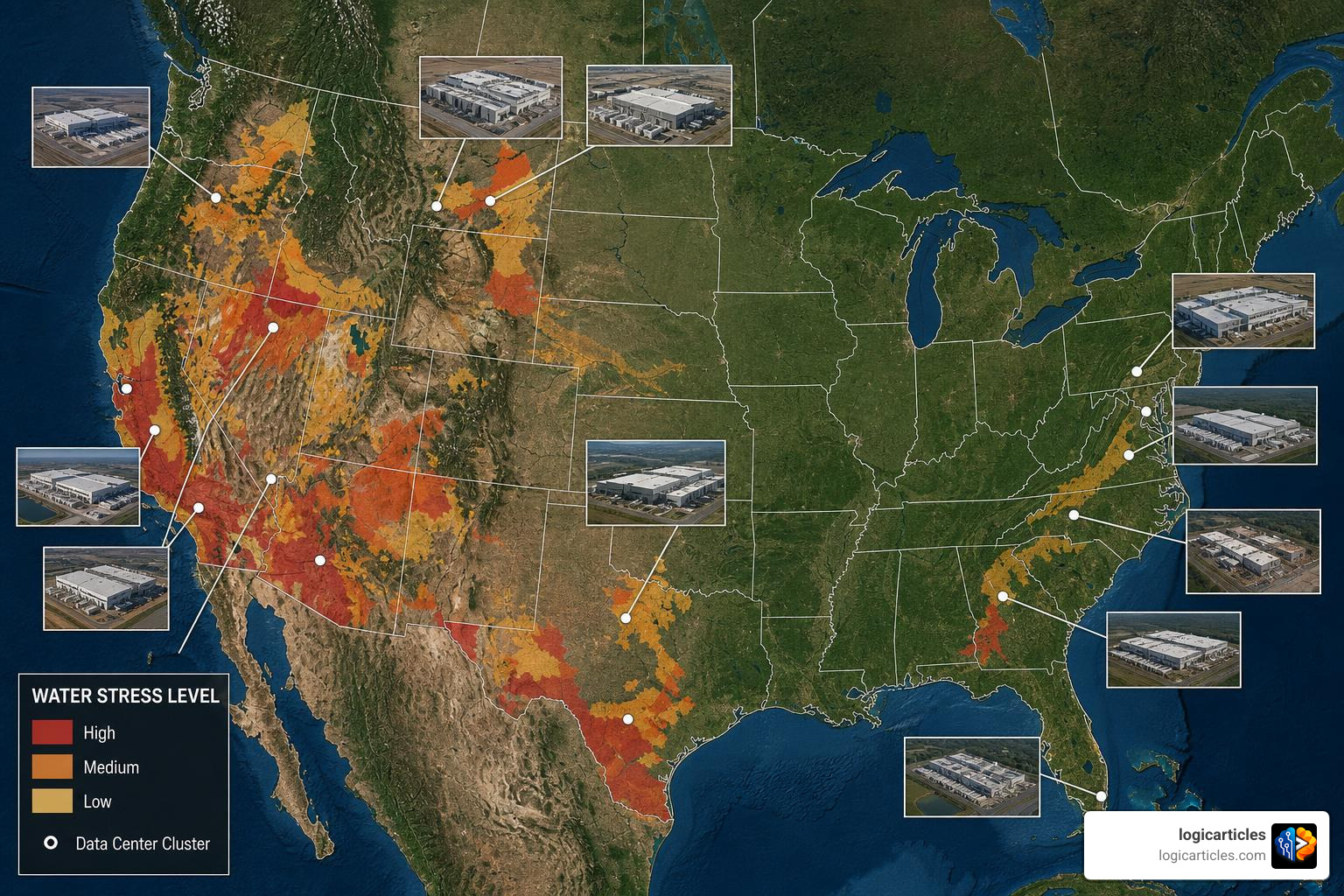
Unfortunately, data center developers often prioritize cheap land, tax incentives, and robust fiber-optic networks over local water security. Because of this, about 40% of U.S. data centers are located in areas of high or extreme water stress.
Let’s look at some key regional hot spots:
- Northern Virginia (Loudoun County): Known as the data center capital of the world, this region hosts roughly 200 operational facilities. In 2023, all data centers in Northern Virginia consumed close to 2 billion gallons of water—a staggering 63% increase from 2019. Loudoun County alone supplied around 900 million gallons of municipal water to these facilities in 2023.
- Texas: The state’s booming tech sector has placed a massive strain on the local grid and aquifers. Data centers in Texas are projected to use 49 billion gallons of water in 2025, with that number potentially climbing to 399 billion gallons by 2030.
- Georgia: A single Meta data center in Newton County, Georgia, uses roughly 500,000 gallons of water per day—accounting for a whopping 10% of the entire county’s water consumption.
When data centers draw heavily from local municipal water systems, they compete directly with local residents, agriculture, and natural ecosystems, sometimes leading to local water table depletion and rising utility rates for communities.
Mitigation Strategies and Future Policy Tools
Addressing AI’s growing thirst requires a combination of corporate accountability, technological innovation, and smart public policy.
Many hyperscalers have made ambitious corporate pledges to be “water positive” by 2030. This means they promise to replenish more water into local watersheds than they consume. They aim to achieve this by funding local wetland restoration, investing in agricultural water-efficiency projects, and upgrading municipal piping systems to prevent leaks.
However, relying solely on corporate goodwill is not enough. Communities and policymakers are beginning to leverage advanced technologies and planning tools to manage this growth.
For example, municipal planners are exploring the use of Digital twin frameworks for water management. By creating real-time virtual models of local watersheds and municipal water systems, cities can simulate the exact impact of a proposed data center before granting construction permits.
Additionally, we are seeing a shift toward:
- Mandatory Transparency: Forcing operators to publicly report their Water Usage Effectiveness (WUE) metrics.
- Siting Criteria: Encouraging the construction of new data centers in cooler, wetter climates where “free cooling” (using outside air) can be utilized year-round.
- Reclaimed Water Mandates: Requiring facilities to use non-potable, recycled municipal wastewater for cooling rather than tapping into precious local drinking water supplies.
For developers and startups looking to optimize their digital footprint, choosing highly efficient software infrastructure is another way to help. By leveraging optimized Category/Ai Tools, organizations can minimize unnecessary API calls and compute cycles, indirectly reducing the water required to power their operations.
Frequently Asked Questions about AI Water Usage
How much water does a single ChatGPT query use?
A single 100-word prompt on a model like GPT-3 or GPT-4 is estimated to consume roughly 519 milliliters of water (about one standard water bottle). If you engage in a longer conversation of 20 to 50 queries, you are effectively evaporating a full bottle of freshwater on-site, with even more water consumed indirectly at the power plant supplying the data center.
Why can’t data centers use ocean water for cooling?
Ocean water contains high levels of salt and minerals that cause rapid corrosion and scaling inside industrial cooling loops. To use saltwater, data centers would either have to build incredibly expensive, corrosion-resistant piping or rely on desalination. Desalination requires immense amounts of electricity, which would dramatically increase the indirect water footprint at local power plants, defeating the environmental benefit.
What does “water positive by 2030” actually mean?
“Water positive” is a corporate pledge where a company promises to return more freshwater to global watersheds than it consumes through its operations. This is achieved by reducing on-site water use (using recycled water and closed-loop systems) and funding local water replenishment projects—such as restoring dry wetlands, recharging over-drafted aquifers, and improving irrigation systems for local farmers.
Conclusion
As we navigate the rapid expansion of the digital frontier in 2026, finding a sustainable balance between bytes and drops is one of our greatest environmental challenges. AI has the potential to solve incredibly complex global problems, but we must ensure that the physical infrastructure supporting this intelligence does not come at the cost of our most precious natural resource.
By demanding greater transparency, adopting closed-loop cooling technologies, and making smarter siting decisions, the tech industry can mitigate its impact on local communities.
If you are looking to build a more efficient, sustainable digital workflow for your business, we invite you to Explore productivity tools that help you streamline your operations and make every compute cycle count.