Toyota Recalls in 2026: Which Models Are Affected Right Now?
If you’re wondering what Toyota models are currently being recalled, here is a quick summary of the active recalls as of June 2026:
| Toyota Model | Model Years Affected | Recall Reason |
|---|---|---|
| Tundra | 2024-2025 | Load capacity label error |
| Tundra Hybrid | 2024-2026 | Load capacity label error |
| Tundra (engine) | 2024 | Engine bearing failure (V35A) |
| Tacoma | 2024-2025 | Load capacity label error |
| Tacoma Hybrid | 2024-2025 | Load capacity label error |
| RAV4 Hybrid | 2024-2025 | Load capacity label error |
| RAV4 | 2025 | Seat bracket weld defect |
| Land Cruiser Hybrid | 2024-2025 | Load capacity label error |
| Sequoia Hybrid | 2025 | Load capacity label error |
| Crown Signia | 2025 | Load capacity label error |
| Grand Highlander | 2025-2026 | Load capacity label error |
| Grand Highlander Hybrid | 2025-2026 | Load capacity label error |
| Highlander / Highlander Hybrid | 2021-2024 | Second-row seat lock failure |
| Lexus GX550 | 2024-2025 | Load capacity label error |
| Lexus TX500 Hybrid | 2025 | Load capacity label error |
| Lexus NX350 Hybrid | 2025 | Load capacity label error |
| Lexus TX350 | 2025-2026 | Load capacity label error |
| Lexus LX | 2022-2024 | Seat frame / airbag system defect |
Toyota is not alone in issuing frequent safety recalls — but the scale and variety of its current 2026 recalls are worth paying close attention to.
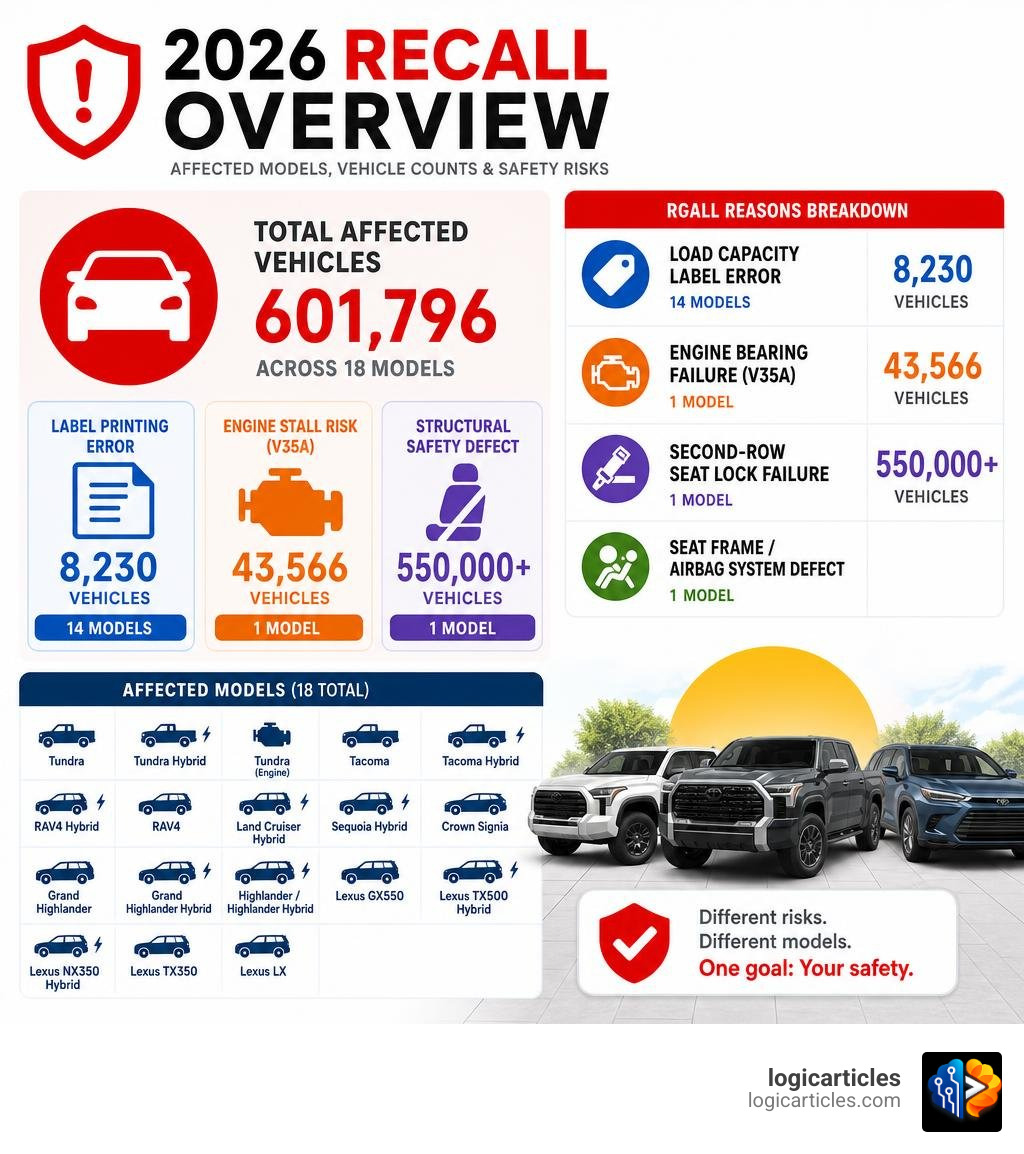
The recalls range from a minor label printing error affecting 8,230 vehicles across 14 models, to a major structural safety defect affecting over 550,000 Highlander models. One recall involves a potential engine stall risk in 43,566 Tundra trucks. The defects span multiple Federal Motor Vehicle Safety Standards (FMVSS), including rules on tire loading, airbag deployment, and occupant restraint.
Not all of these recalls carry the same level of urgency — but every one of them is worth checking if you own an affected model.
What Toyota models are currently being recalled?
Understanding what Toyota models are currently being recalled can feel like trying to untangle a massive web of technical jargon. As of June 2026, Toyota has initiated several distinct recall campaigns. These campaigns range from software glitches to critical structural safety concerns.
To help you understand the landscape of these safety campaigns, we have broken down the active recalls by their official National Highway Traffic Safety Administration (NHTSA) filings, affected models, and the root causes behind them.
Below is a detailed breakdown of the primary recall campaigns active right now:
2026 Load Capacity Label Recall (FMVSS 110)
A total of 8,230 vehicles are affected by a recall addressing inaccurate load carrying capacity modification labels. While a paper label might sound like a minor issue, it actually represents a 100% defect rate across the identified vehicles. Because of this error, the affected vehicles fail to comply with Federal Motor Vehicle Safety Standards (FMVSS) number 110, “Tire Selection and Rims.”
If a vehicle is modified by adding accessories prior to its first sale, the dealer or manufacturer must apply a label indicating how much the carrying capacity has been reduced. Due to a system software error at the factory, the total weight of these added accessories was miscalculated. As a result, the labels understate the reduction in capacity by more than 1% of the actual added weight.
The models affected by this specific issue span across the 2024, 2025, and 2026 model years:
- 2024-2025 Toyota Tundra, Tacoma, Tacoma Hybrid, RAV4 Hybrid, and Land Cruiser Hybrid
- 2024-2026 Toyota Tundra Hybrid
- 2025 Toyota Sequoia Hybrid, Crown Signia, and Grand Highlander
- 2025-2026 Toyota Grand Highlander Hybrid
- 2024-2025 Lexus GX550
- 2025 Lexus TX500 Hybrid and NX350 Hybrid
- 2025-2026 Lexus TX350
The safety risk here is simple: if drivers rely on the incorrect label, they may overload their vehicles. Overloading can lead to tire failure, poor handling, and an increased risk of a crash. Toyota began mailing official owner notification letters on May 9, 2026. For complete technical details, you can read the Part 573 Safety Recall Report 26V179.
2026 Toyota Tundra Engine Bearing Failure Recall
A much more severe mechanical issue affects 43,566 Toyota Tundra vehicles from the 2024 model year equipped with specific V35A twin-turbo V6 engines. During manufacturing at the Toyota Motor Manufacturing Alabama plant between February 7, 2024, and August 5, 2024, engine machining debris may not have been fully cleared from the engine during assembly.
This leftover debris can contaminate the crankshaft main bearings. Over time, under high load conditions, this contamination can lead to progressive bearing wear, engine knocking, rough running, a failure to start, or a sudden engine stall while driving. A sudden loss of motive power at high speeds significantly increases the risk of a crash.
This campaign follows previous related actions for similar V35A engine issues. If you own a 2024 Tundra, you should pay close attention to any unusual engine noises. You can review the official manufacturer filing via the Part 573 Safety Recall Report 26V320.
2026 Highlander Second-Row Seat Lock Defect
The largest single recall campaign currently active for Toyota in 2026 affects an estimated 550,007 vehicles. This massive recall involves 2021-2024 Toyota Highlander and Highlander Hybrid models.
The issue lies within the second-row seat slide rails. Due to a design or manufacturing defect, the second-row seat backs may fail to lock securely into position. In the event of a crash, an unsecured seat back cannot properly restrain occupants, dramatically increasing the risk of severe injury. Owners of affected Highlanders are urged to have their vehicles inspected by an authorized dealer as soon as possible.
Lexus LX Seat Frame Assembly Noncompliance (FMVSS 208)
Toyota has also recalled 15,264 Lexus LX vehicles (model years 2022-2024) due to a manufacturing defect in the front passenger seat frame assembly. An incorrectly positioned welding jig at a supplier plant caused the seat frame to be welded out of specification.
This misalignment can cause the Occupant Classification System (OCS) sensor to misread the weight of the front passenger. Under FMVSS No. 208, vehicles must accurately classify front-seat occupants to ensure proper airbag deployment. If the sensor misidentifies an adult passenger as a child (or vice versa), the airbag may deploy with incorrect force—or fail to deploy at all—during a crash. For more information, see the Part 573 Safety Recall Report 26V180.
Toyota RAV4 Seat Bracket Weld Defects
While some recalls affect hundreds of thousands of vehicles, others are incredibly small but highly critical. Toyota issued a recall for just four (4) units of the 2025 Toyota RAV4 produced between November 28, 2025, and December 1, 2025.
Due to damaged welding robots and faulty tip-dressing equipment at a Tier 2 supplier, these vehicles were built with missing or structural “cold” welds on the driver and front passenger seat brackets. In a collision, these weak welds could break, causing the seats to detach from the floor and failing to restrain the occupants. If you are one of the very few owners affected, Toyota will inspect and replace the seat frames free of charge. You can view the details in the Part 573 Safety Recall Report 26V256.
Safety Risks and Manufacturer Remedies
Understanding the Risks of What Toyota models are currently being recalled?
When considering what Toyota models are currently being recalled, it is vital to understand the real-world safety implications. Recalls are not just administrative paperwork; they represent genuine hazards to you, your passengers, and other drivers on the road.
- Vehicle Overloading: Underestimating the weight of factory-installed accessories can easily lead to exceeding the vehicle’s Gross Vehicle Weight Rating (GVWR). Overloading strains the suspension, brakes, and tires, potentially causing a high-speed tire blowout.
- Engine Stall: A sudden loss of engine power on a busy highway leaves you without power steering and power brakes, making it incredibly difficult to navigate to safety.
- Airbag Malfunction: If the OCS sensor in a Lexus LX miscalculates passenger weight, the front airbag might not deploy in a severe crash, leaving the passenger vulnerable to striking the dashboard.
- Seat Lock and Weld Failures: Seats and seat backs must remain rigid during a crash. If a weld breaks or a lock slips, the seat belt system cannot do its job, and occupants can suffer severe impact injuries.
Free Dealer Repairs and Software Updates
By federal law, all safety recall repairs must be performed by authorized dealerships completely free of charge to the vehicle owner.
Depending on the specific campaign, Toyota’s remedies include:
- Label Replacements: For the load capacity recall, dealers will simply apply a corrected printed label over the inaccurate one.
- Engine Inspections and Replacements: For Tundras affected by machining debris, dealers will inspect the engine bearings. If damage or debris is found, a replacement engine or bearing kit will be installed.
- Seat and Frame Replacements: Affected Highlander and Lexus LX models will receive structural inspections, and dealers will replace faulty slide rails or seat frame assemblies.
- Weld Repairs: For the highly specific RAV4 weld defect, the dealer will inspect the seat brackets and perform necessary structural repairs to ensure the seat is securely anchored.
How to Check If Your Vehicle Is Affected
Step-by-Step VIN Lookup for What Toyota models are currently being recalled?
If you own any of the models listed above, you do not have to wait for a letter to arrive in your mailbox. You can check your vehicle’s safety status instantly using your unique 17-digit Vehicle Identification Number (VIN).
Follow these simple steps to verify your vehicle:
- Locate your VIN: You can find this 17-digit alphanumeric code printed on a metal plate on the driver’s side dashboard (visible through the windshield) or on the safety certification label on the driver’s side door jamb. It is also listed on your vehicle registration card and auto insurance documents.
- Visit the official portal: Go to the Look up Safety Recalls & Service Campaigns by VIN | Toyota Owners website.
- Enter the code: Type your VIN into the search bar. The tool will instantly display any open safety recalls, Special Service Campaigns, or Limited Service Campaigns associated with your specific vehicle.
- Contact a dealer: If an active recall is found, contact your local authorized Toyota or Lexus dealer to schedule a service appointment. They will order the required parts and complete the repair for free.
If you prefer to speak to a human, you can also contact Toyota Brand Engagement Center customer service directly at 1-800-331-4331.
Frequently Asked Questions About Toyota Recalls
Can I still drive my Toyota if it has an active recall?
It depends entirely on the severity of the defect. For minor issues like the load capacity label recall, it is perfectly safe to drive your vehicle, provided you avoid packing it to its absolute weight limit until the label is replaced. However, for critical safety recalls—such as the Tundra engine bearing failure or the Highlander seat lock defect—we strongly recommend scheduling an appointment immediately. If you experience engine knocking, rough idling, or loose seats, park the vehicle and contact your dealer for towing options.
What should I do if I never received a recall letter?
If you bought your vehicle used, or if you recently moved, the manufacturer’s notification letter may have been sent to a previous address or the prior owner. Recall campaigns remain active for the vehicle itself, regardless of ownership changes. Simply run your VIN through the official database to see if your car needs work, and schedule the repair with any local dealer.
How often should I check my vehicle for new recalls?
We recommend checking your vehicle’s recall status at least twice a year. New recalls can be issued at any time, often years after a vehicle was manufactured, as real-world driving data and safety audits reveal previously unknown defects.
Conclusion
Staying on top of safety recalls is one of the easiest ways to protect yourself and your family on the road. Whether your vehicle requires a simple sticker replacement or a major engine inspection, addressing these issues promptly ensures your Toyota remains as safe and reliable as the day you bought it.
At logicarticles, we are dedicated to keeping you informed with clear, accurate, and actionable consumer news. If you want to see how we use advanced technology to compile and simplify complex information like this, Explore our AI tools and resources to learn more!