
What software is used in regulatory affairs depends on the specific workflow you need to support. Here is a quick overview of the main categories:
| Category | Purpose | Example Tools |
|---|---|---|
| Regulatory Information Management (RIM) | Manage registrations, submissions, and health authority interactions | Veeva Vault RIM, ArisGlobal LifeSphere, IQVIA RIM Smart |
| eCTD Publishing & Submission | Compile, publish, and validate electronic submissions | LORENZ docuBridge, EXTEDO eCTDmanager, Freyr SUBMIT PRO |
| Compliance Validation | Verify technical compliance before dispatch | IQVIA eSubmission Validator, EURSvalidator |
| Regulatory Intelligence | Monitor global regulatory changes and guidance updates | Cortellis (Clarivate), RegDesk, Freyr RegIntel |
| Medical Device & IVD Compliance | Manage device classifications, registrations, and market access | RAMS by Emergo by UL, REGULA™ |
| AI-Native Compliance Platforms | Automate content checks, logic validation, and workflow tasks | Assyro AI, ArisGlobal LifeSphere (GenAI/Agentic AI) |
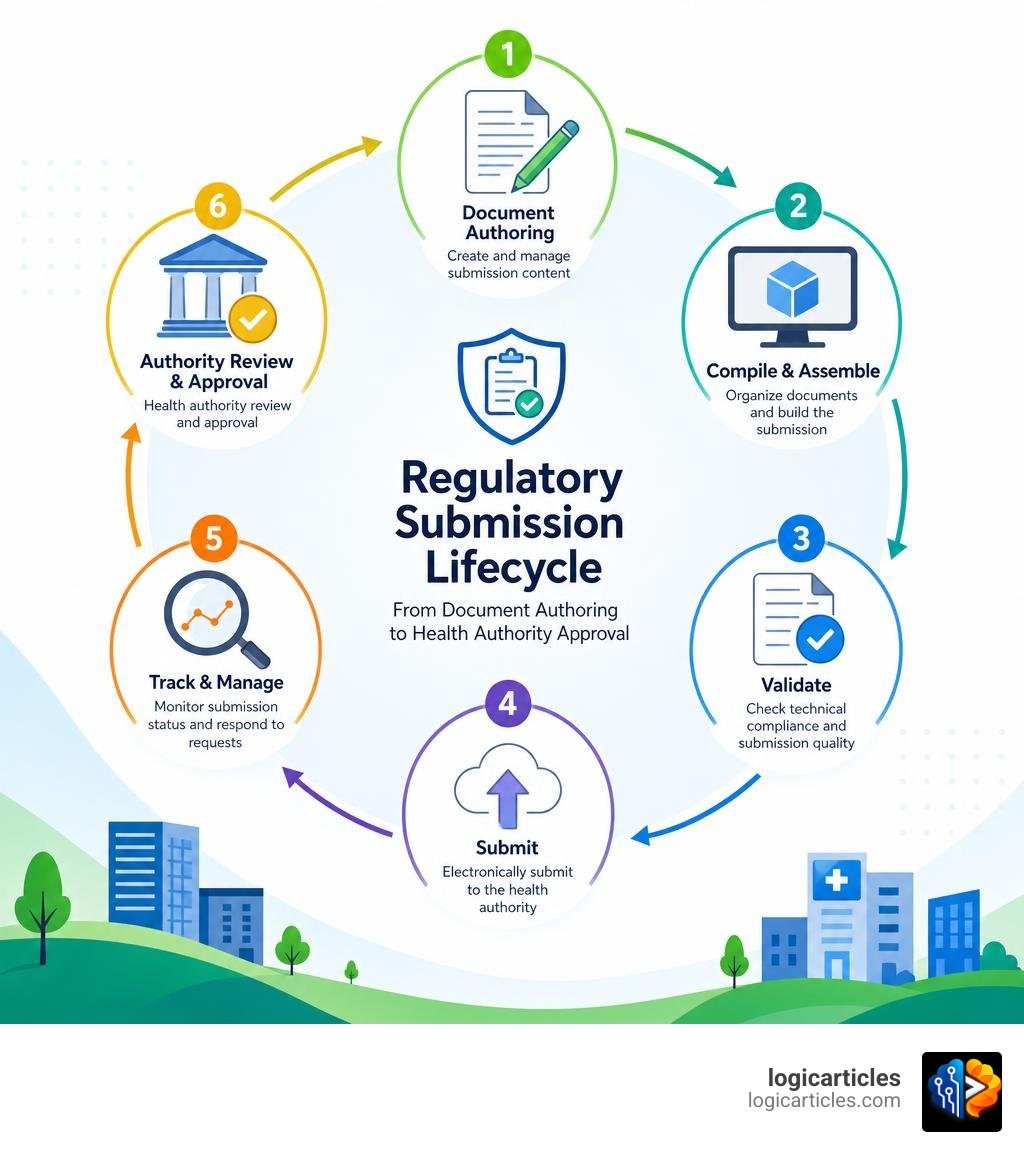
Regulatory affairs is not a single job — it is a collection of overlapping, high-stakes processes. Teams need to author documents, publish submissions, track registrations, monitor global rule changes, and prove compliance to health authorities like the FDA, EMA, and Health Canada.
No single tool does all of this equally well.
Most organizations end up running a custom stack — combining an enterprise suite for core RIM with specialized tools for publishing or intelligence. The challenge is knowing which problem to solve first, and which tool actually solves it.
This guide breaks down every major category of regulatory affairs software, compares the leading platforms, and gives you a practical framework for choosing the right stack for your size, product type, and submission volume.
What Software Is Used in Regulatory Affairs?

When we look at the modern regulatory landscape in 2026, the question of what software is used in regulatory affairs is best answered by looking at how data flows through a life sciences organization. Managing compliance is no longer a matter of keeping PDFs in shared network folders. It requires a highly coordinated, validated ecosystem of software categories.
The software used in this field must handle everything from the initial drafting of clinical protocols to the long-term tracking of active drug registrations across dozens of countries. Document management systems (DMS) act as the secure repository where teams author, review, and approve files under strict GxP guidelines. Submission tracking software monitors where each application stands, ensuring that critical deadlines for Investigational New Drug (IND) or New Drug Applications (NDA) are never missed.
To understand how these tools fit together, we can compare broad enterprise suites with specialized publishing software:
| Comparison Metric | Enterprise RIM Suites | Specialized Publishing Tools |
|---|---|---|
| Primary Focus | End-to-end data harmonization, global registration tracking, cross-department visibility | Rapid compilation, formatting, validation, and dispatch of eCTD sequences |
| Typical Users | Global regulatory operations, clinical coordinators, executive stakeholders | Dedicated publishing specialists, regulatory operations power-users |
| Data Model | Relational databases linking products, substances, applications, and health authority interactions | Sequence-based file structures, XML trees, and strict folder hierarchies |
| Validation Burden | High; requires extensive configuration and continuous validation across multiple modules | Moderate; focused heavily on output format compliance and validation rules |
Core Categories of What Software Is Used in Regulatory Affairs?
To build an effective regulatory stack, we must first break down the market into its core functional pillars. Evaluating these tools as a single, interchangeable category is a common pitfall that often leads to poor purchasing decisions.
- eCTD Publishing and Submission: This is the engine room of regulatory operations. Software in this category compiles hundreds of individual documents into the strict electronic Common Technical Document (eCTD) format required by global agencies. A prime example of an advanced, scalable platform in this space is Regulatory Submission Management for eCTD Publishing and More | LORENZ docuBridge, which allows teams to compile, import, and review complex submission sequences.
- Submission Tracking and RIM: Regulatory Information Management (RIM) tools manage the entire product lifecycle. They track active registrations, health authority correspondence, and commitment deadlines. Centralized suites like EXTEDOpulse bring planning, document management, registration, submission, and safety management under a single umbrella to drive next-level organizational synergy.
- Regulatory Intelligence: Staying compliant requires knowing when global regulations change. Regulatory intelligence software continuously monitors health authorities worldwide, flagging updates that impact your product portfolio.
- Compliance Validation: Before sending any dossier to an agency, it must pass rigorous technical checks. Validation software checks the folder structure, hyperlinks, and XML backbone of the submission. To streamline this process, tools like the IQVIA Regulatory Templates tool provide over 320 pre-defined shell documents defined by regulatory agencies and the ICH (International Council for Harmonization) to ensure documents are formatted correctly from the very start.
Specialized Tools vs. All-in-One Enterprise Suites
One of the most critical decisions a regulatory department faces is whether to invest in an all-in-one enterprise suite or to assemble a modular stack of specialized tools.
Enterprise suites (such as Veeva Vault RIM or ArisGlobal LifeSphere) offer a “single source of truth.” They connect clinical, quality, and regulatory data on a single platform. This eliminates data silos and reduces IT overhead. However, they are often incredibly complex, expensive, and require months of configuration.
On the other hand, specialized tools excel at specific workflows. A small clinical-stage biotech may not need a massive registration tracking database; they simply need an intuitive, lightweight tool to publish an ad-hoc IND submission. By matching your software selection to your organization’s workflow maturity, you avoid overpaying for features you will not use.
If your team is managing simple, internal operational tasks alongside these heavy compliance workflows, integrating your regulatory tools with the Best Task Management Software In 2026 Tested can help bridge the gap between day-to-day productivity and formal regulatory milestones.
Key Features and Global Compliance Capabilities

The primary value of regulatory software lies in its ability to reduce human error. When a single broken hyperlink or an incorrect file format can result in a Refusal to File (RTF) from the FDA, the features of your software act as your safety net.
Modern regulatory platforms rely on three core pillars:
- Automation: Automatically generating tables of contents, converting Word documents to compliant PDFs, and auto-populating metadata fields.
- Lifecycle Management: Tracking document versions from initial draft to final approved submission, and monitoring subsequent amendments or variations.
- Collaboration: Allowing clinical, CMC (Chemistry, Manufacturing, and Controls), and regulatory teams to work on documents simultaneously without version control conflicts.
To make sure your team has instant access to submission guidelines, templates, and standard operating procedures (SOPs), we highly recommend pairing your core regulatory systems with the Best Knowledge Base Software In 2026 to keep your internal compliance knowledge centralized and searchable.
Meeting Global Submission Standards and eCTD v4.0
Global health authorities are in the midst of a major technological shift. The transition from eCTD v3.2.2 to eCTD v4.0 represents the largest structural change in regulatory submissions in over two decades.
Unlike the older format, which relies on rigid folder structures, eCTD v4.0 is built on a two-way XML message exchange. This allows sponsors to easily replace, delete, or reuse documents across different submissions without duplicating files.
Because of this transition, regulatory software must be capable of supporting both formats simultaneously during regional transition periods. Cloud-native platforms like the Cloud-Based Regulatory Information Management System | Kivo are designed to handle these evolving standards out of the box, providing structured submission templates that align with the latest FDA ESG, EMA IRIS, and Health Canada gateways.
Medical Device and IVD Compliance Software
While pharmaceutical companies focus heavily on eCTD formats, medical device and In Vitro Diagnostic (IVD) manufacturers have entirely different regulatory pathways. They must comply with standards like ISO 13485 and compile technical documentation using formats like STED (Summary Technical Document).
Software designed for Medtech must support product classification, registration tracking, and warning management for expiring certificates. For instance, the REGULA™ – Regulatory Affairs Software | ISS AG platform is a database-backed application built specifically for Medtech and IVD compliance, helping companies standardize their regulatory structures and track approvals globally.
The scale of this specialized market is massive: RAMS (Regulatory Affairs Management Suite) is trusted by over 15,000 medical device companies to navigate changing global regulations, illustrating just how critical purpose-built software is for keeping devices on the market.
AI, Automation, and the Future of Regulatory Software
Generative AI (GenAI) and Agentic AI are rapidly transforming regulatory affairs from a manual, administrative function into an automated, proactive strategy. Historically, regulatory specialists spent hundreds of hours manually checking documents for formatting errors, cross-referencing data points, and writing summaries.
Today, cognitive computing engines can read massive clinical study reports and draft regulatory documents in a fraction of the time. To explore this shift in detail, you can read about how companies are utilizing these tools in Discover How GenAI Has Changed Regulatory Affairs | ArisGlobal. AI is no longer a futuristic concept; it is an active tool used to automate adverse event intake, track real-time regulatory changes, and predict health authority questions based on historical approval data.
Evaluating AI-Native Tools and What Software Is Used in Regulatory Affairs?
As more vendors add “AI” to their marketing materials, buyers must look past the buzzwords and carefully evaluate what these tools can actually deliver. True AI-native regulatory software focuses on content and logic checks, rather than just technical document formatting.
When evaluating these platforms, it is crucial to verify:
- Validation and GxP Compliance: Can the AI’s decision-making process be audited and validated according to FDA 21 CFR Part 11?
- Data Security: Is your proprietary clinical data used to train public AI models, or is it kept entirely secure within your private cloud environment?
- Accuracy and Hallucination Prevention: Does the software provide clear source citations for every regulatory recommendation or document summary it generates?
Many organizations rely on advanced systems like Regulatory Information Management Software (RIM) | LifeSphere Regulatory to automate complex planning and tracking workflows while keeping their data completely secure. To understand how to properly test and validate these highly complex software integrations, check out our guide on Software Testing Strategies Compared 2026 Guide to ensure your systems remain bug-free and compliant.
Implementation Challenges, Validation, and Selection Criteria
Implementing new regulatory affairs software is not a simple “plug-and-play” process. It is a highly structured project that typically takes anywhere from 3 to 9 months, depending on the complexity of your data migration and validation requirements.
Because these systems manage data used to approve life-saving drugs and medical devices, they are subject to strict software validation requirements. Under FDA 21 CFR Part 11 and EU Annex 11, companies must prove that their software operates exactly as intended, maintains a complete and unalterable audit trail, and secures electronic signatures.
To prevent catastrophic system failures, data loss, or regulatory non-compliance during a software rollout, we recommend consulting our detailed guide on What Is Testing In Zillexit Software 2026 Guide To Prevent Bugs Downtime Data Loss.
The standards for regulatory validation are incredibly high. For example, ComplianceWire® has been used by the U.S. Food and Drug Administration (FDA) since 1999 to train more than 40,000 investigators, proving that the tools used to enforce compliance must be as thoroughly validated as the systems being inspected.
A Weighted Selection Framework for Buyers
To avoid making an emotional or purely cost-driven purchasing decision, organizations should use a structured evaluation framework. The standard selection framework for evaluating pharma regulatory software weights regulatory compliance as the highest priority at 25%.
Here is how the complete selection framework breaks down:
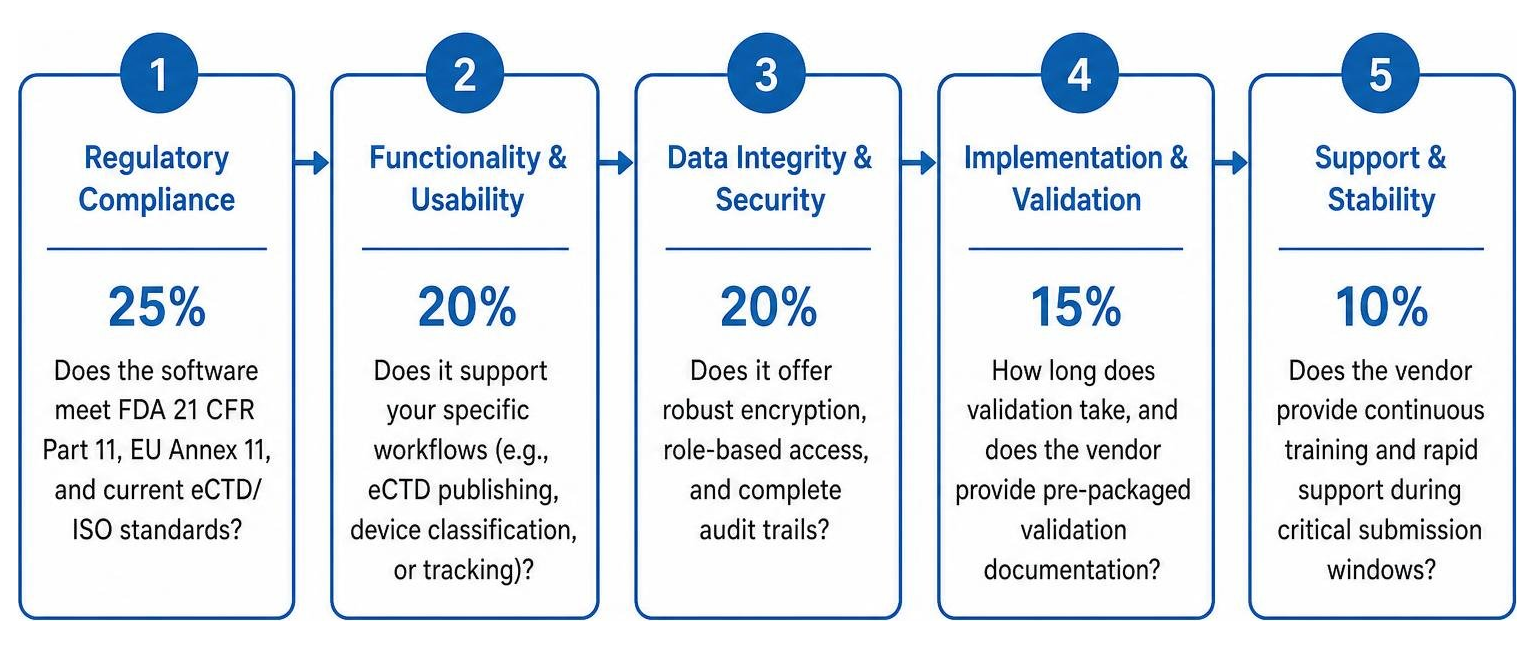
- Regulatory Compliance (25%): Does the software meet FDA 21 CFR Part 11, EU Annex 11, and current eCTD/ISO standards?
- Functionality & Usability (20%): Does it support your specific workflows (e.g., eCTD publishing, device classification, or tracking)?
- Data Integrity & Security (20%): Does it offer robust encryption, role-based access, and complete audit trails?
- Implementation & Validation (15%): How long does validation take, and does the vendor provide pre-packaged validation documentation?
- Support & Stability (10%): Does the vendor provide continuous training and rapid support during critical submission windows?
- Scalability & Product Roadmap (5%): Will the software grow with your pipeline and adapt to future standards like eCTD v4.0?
- Total Cost of Ownership (5%): Does the pricing model (licensing, migration, and maintenance) fit your budget?
If you are a smaller organization trying to balance regulatory software costs with other back-office expenses, you can optimize your overall software budget by reviewing our guide on the Best Hr Software For Small Businesses to streamline your administrative overhead.
Frequently Asked Questions about Regulatory Software
What is the difference between RIM and regulatory affairs software?
Regulatory affairs software is an umbrella term that covers any digital tool used in the regulatory lifecycle, including document authoring templates, eCTD publishing systems, compliance validators, and regulatory intelligence databases.
Regulatory Information Management (RIM) is a specific subset of regulatory affairs software. RIM systems focus primarily on managing global product registrations, tracking submission sequences, and archiving health authority correspondence to provide a centralized “source of truth” for a company’s regulatory footprint.
How does eCTD v4.0 impact existing regulatory software?
eCTD v4.0 completely changes the structural backbone of electronic submissions, moving away from static folder structures to dynamic XML message exchanges. If your existing regulatory software does not support eCTD v4.0, your team will not be able to submit applications to agencies like the FDA or EMA once the transition periods end. Buyers must ensure that any software they purchase offers native, backward-compatible support for both v3.2.2 and v4.0 formats.
Can small businesses use lightweight regulatory software?
Yes! Small, clinical-stage biotechs and venture-backed startups do not need to buy massive, multi-million dollar enterprise RIM suites. Lightweight, cloud-based RIM systems are designed specifically to offer out-of-the-box compliance, pre-configured templates, and rapid implementation without the high cost and complexity of traditional enterprise software.
If your small business is looking for ways to scale its digital presence while keeping software costs low, you can also check out our recommendations for the Best Content Marketing Software to drive growth efficiently.
Conclusion
Choosing the right regulatory affairs software is one of the most critical operational decisions a life sciences company can make. Whether you need a highly specialized eCTD publishing tool to get an upcoming IND submission over the finish line, or a comprehensive, AI-powered RIM platform to manage a global portfolio of medical devices, the right software stack will save your team thousands of hours and dramatically reduce the risk of a technical rejection.
At LogicArticles, we help organizations navigate the complex world of enterprise technology. To find deep-dive reviews, comparisons, and expert guides on the leading software platforms across every major business category, explore our comprehensive selection of resources on the LogicArticles Best Software Category.