Why Real Estate Investment Accounting Software Is a Game-Changer for Investors

Real estate investment accounting software is a specialized financial tool designed to help property investors, fund managers, and REITs track income, manage expenses, handle multi-entity structures, and stay tax-compliant — all in one place.
Quick answer for what it does:
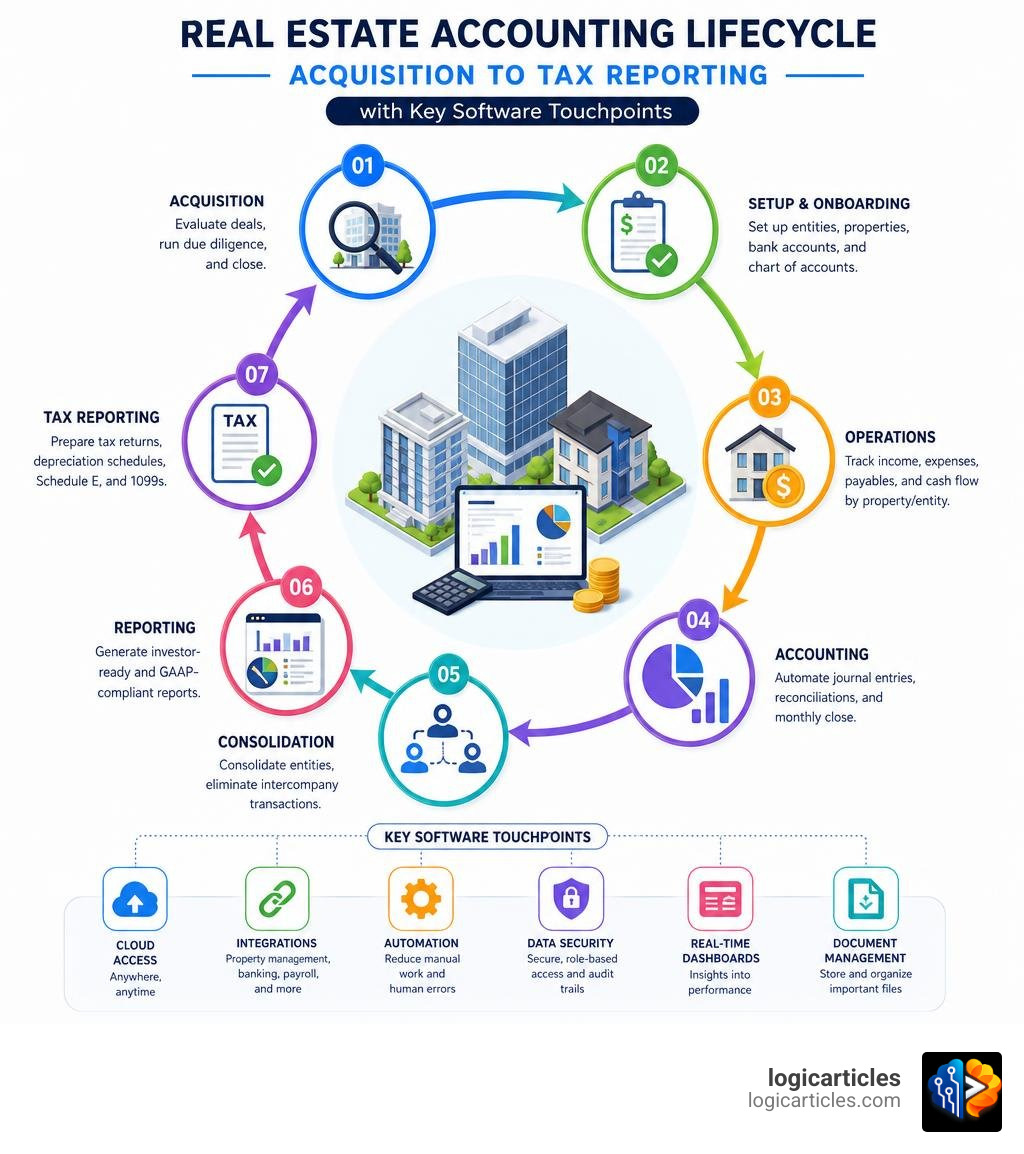
- Tracks income and expenses at the property, entity, and portfolio level
- Automates multi-entity consolidations and intercompany eliminations
- Generates investor-ready reports including GAAP-compliant financial statements
- Supports tax preparation with depreciation schedules, Schedule E, and 1099 tracking
- Integrates with property management systems to keep your general ledger in sync
If you’ve ever tried managing even a handful of rental properties in a spreadsheet, you already know the problem. Rent payments come in from multiple sources. Expenses hit different bank accounts. Each property might sit inside its own LLC. And tax season turns into a scramble.
Now multiply that across 10, 50, or 200 properties.
The numbers get messy fast — and the stakes are high. Real estate investors collectively lose an estimated $16.4 billion every year from missed tax deductions alone. That’s not a rounding error. That’s real money left on the table because the financial tracking wasn’t sharp enough.
Generic accounting tools like spreadsheets — or even small-business software not built for real estate — simply weren’t designed for this level of complexity. They lack native support for things like waterfall distributions, cost segregation, 1031 exchange tracking, and fund-level reporting.
That’s exactly the gap that real estate investment accounting software fills.
The market for these tools is growing quickly — from around $100 million in 2022 to a projected $214.37 million by 2030 — which tells you how many investors are recognizing the need.
This guide walks you through everything: what the software does, what features actually matter, how leading platforms compare, and how to pick the right one for your portfolio size and goals.
Understanding Real Estate Investment Accounting Software
To understand why specialized software is so critical, we first need to look at how real estate accounting operates. It is not just about recording transactions. It is a dual-layered discipline that combines daily bookkeeping with strategic, long-term asset management.
Standard bookkeeping is transactional: you record rent payments received and write checks for repairs. Real estate accounting, however, takes those numbers and translates them into strategic insights. It deals with asset valuation (how property values fluctuate over time), depreciation schedules, debt amortization, and cash flow forecasting.
In real estate, your cash flow is highly dynamic. You have standard operating income, capital expenditures (CapEx) that must be depreciated over years, and potential tax-deferred transactions like 1031 exchanges. If you are using general software, you will quickly find yourself buried in manual workarounds to track these elements. Specialized platforms handle these complexities natively, giving you property-level and portfolio-level financial clarity. For those focusing primarily on tenant relations and rent collection, finding the right core platform is the first step, which you can explore in our guide to the Best Rental Property Software.
Accounting vs. Property Management Software
A common point of confusion for newer investors is the difference between property management software (PMS) and dedicated accounting software.
- Property Management Software is operational. It manages the tenant lifecycle: handling lease agreements, processing maintenance requests, screening applicants, and facilitating rent collection.
- Real Estate Investment Accounting Software is financial. It houses the general ledger, tracks entity-level equity, processes complex tax deductions, automates multi-entity consolidations, and manages investor distributions.
While some all-in-one platforms attempt to do both, larger portfolios and institutional funds typically separate these functions. They use a dedicated PMS to keep operations running smoothly at the ground level, and integrate it with a robust general ledger to handle complex corporate and investor-level accounting. If you manage commercial assets, you can see how these operational tools compare in our breakdown of the Best Commercial Property Management Software.
Key Features of Real Estate Investment Accounting Software
When evaluating these tools, look for several specialized features that general ledger software simply cannot provide:
- Customized Chart of Accounts (COA): Real estate has unique accounts, such as tenant security deposits, capital reserves, and specific operating expenses. A real estate-specific COA ensures your books are structured correctly from day one.
- Schedule E and Tax-Ready Reporting: The software should automatically map your income and expenses to Schedule E categories, reducing the time and money spent on year-end CPA preparation.
- Depreciation and Amortization Tracking: Property structures and capital improvements depreciate at different rates. Specialized systems automate these calculations so you never miss out on tax write-offs.
Platforms like Real Estate Investment Accounting Software | RealPage are built to handle these precise requirements, offering enterprise-grade general ledgers tailored specifically to the nuances of property investment.
Key Benefits of Specialized Financial Tools
The most immediate benefit of adopting specialized software is the reduction of manual administrative overhead. For example, users of automated systems like Sage Intacct report saving over 36 hours per month on their financial close, with some organizations slashing their monthly close times by up to 70%.
Beyond time savings, the financial impact is substantial. As we mentioned, real estate investors miss out on billions in tax deductions annually. By automatically categorizing expenses, tracking mileage, and flagging cost-segregation opportunities, specialized software ensures you capture every legal write-off.
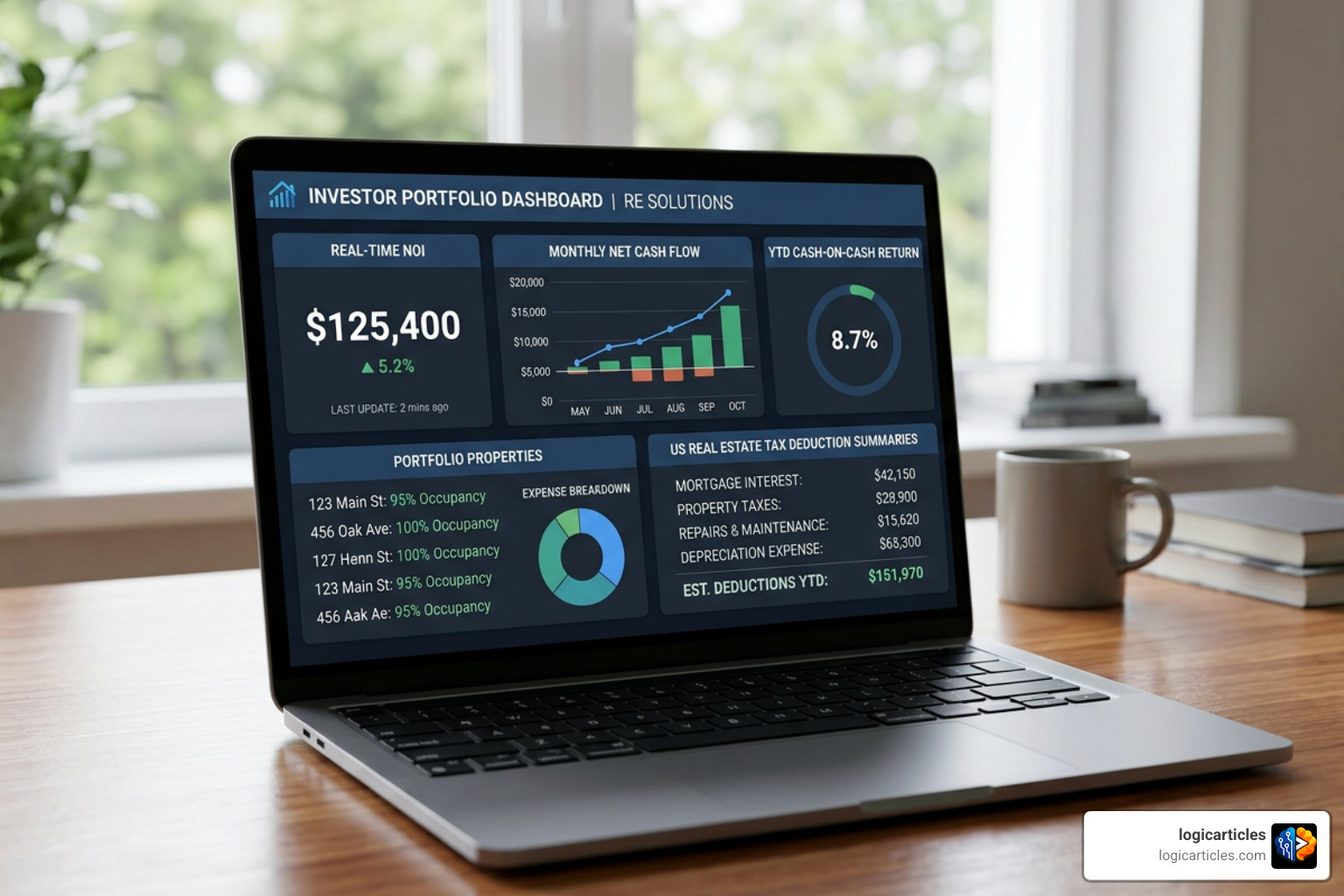
Modern solutions are also introducing artificial intelligence to automate these workflows. For instance, platforms like Revenli – AI Accounting for Real Estate Investors use AI agents to autonomously close monthly books, find missed tax deductions, and prioritize financial actions based on their estimated dollar impact.
Automating Multi-Entity Consolidations
As real estate portfolios grow, investors typically set up separate legal entities (usually LLCs) for each property to limit liability. While this is excellent for risk management, it is an absolute nightmare for accounting.
Without specialized software, consolidating these entities requires exporting multiple trial balances to spreadsheets, manually eliminating intercompany transactions, and adjusting for fractional ownership.
Dedicated real estate platforms offer continuous, real-time multi-entity consolidation. They allow you to maintain separate ledgers for every single property while instantly generating consolidated balance sheets and P&L statements. If you are managing investments on behalf of a single wealthy client or family, this level of multi-entity complexity is standard, as we discuss in our guide to the Best Family Office Accounting Software.
Streamlining Investor Reporting and Compliance
If you manage third-party capital, your investors expect professional, transparent, and timely reporting. They want to know their exact cash-on-cash return, net operating income (NOI), and equity growth.
Specialized investment accounting systems automate:
- Waterfall Distributions: Calculating complex tiered profit splits and promote structures based on preferred returns.
- Capital Calls and Distributions: Managing the workflow of requesting capital from limited partners (LPs) and distributing profits.
- GAAP and Audit Compliance: Creating immutable audit trails and role-based permissions that satisfy institutional lenders and auditors.
For enterprise-level fund managers and REITs, solutions like CRE Investment Accounting Software | Yardi Investment Management offer fully connected ecosystems that link investor portals directly to property-level asset operations.
How to Choose the Right Platform for Your Portfolio
Choosing the right software depends heavily on your current portfolio size, your growth plans, and the complexity of your ownership structures.
If you own fewer than 10 residential properties, a highly complex enterprise resource planning (ERP) system is overkill. You are better served by a lightweight, landlord-specific tool that focuses on bank feed integrations and automated Schedule E generation. However, if you are managing syndications, multiple funds, or commercial portfolios, you need a platform that supports multi-entity consolidation, automatic intercompany eliminations, and multi-currency transactions.
| Feature / Capability | General Accounting Software (e.g., QuickBooks, Zoho) | Specialized Real Estate Accounting Software |
|---|---|---|
| Setup Complexity | High (requires manual customization of charts of accounts) | Low (pre-built for real estate) |
| Multi-Entity Consolidation | Manual or requires expensive add-ons | Automated in real time |
| Tax-Specific Reports | Basic P&L (no native Schedule E mapping) | Native Schedule E, 1099, and depreciation |
| Investor Management | None | Built-in waterfall calculations, capital calls |
| Integration with PMS | Limited (often relies on third-party connectors) | Native or robust API integrations |
Integrating Real Estate Investment Accounting Software with Other Tools
No software should operate in a vacuum. Your accounting platform should integrate seamlessly with your bank accounts, your loan servicers, and your property management tools.
Modern systems leverage open APIs to sync data in real time. When a tenant pays rent via an online property portal, that transaction should instantly flow into your general ledger, reconcile against the bank feed, and update your cash flow dashboard. To see how these integrations fit into a broader asset management strategy, check out our guide on the Best Real Estate Portfolio Management Software in 2026.
Planning and Scenario Modeling
Real estate is a capital-intensive business where timing is everything. Investors constantly face critical decisions: Should we hold this property and refinance, sell it and execute a 1031 exchange, or perform a capital improvement project to boost rents?
Advanced real estate financial tools help model these exact scenarios. For example, platforms like Leveridge — The Real Estate Planning Platform for Financial Advisors extract property data directly from tax returns to model hold, sale, or exchange scenarios, translating complex real estate metrics into clear, planning-ready financial projections.
Overcoming Common Real Estate Accounting Challenges
Real estate portfolios are uniquely prone to accounting errors due to the sheer volume of transactions and the complexity of property-level operations. Common challenges include:
- Reconciliation Delays: Matching hundreds of rent payments across different bank accounts and properties.
- Depreciation Miscalculations: Failing to properly track capital improvements versus standard repairs.
- Audit Vulnerability: Lacking clean, digital audit trails for tax returns or lender packages.
Specialized software mitigates these risks by creating automated, rules-based workflows. It ensures that every transaction is itemized, mapped to the correct property, and fully documented with digital receipts.

To scale without exponentially growing your back-office headcount, modern teams are moving toward intelligent ledgers. Systems like Asseta AI – Intelligent Real Estate Suite | Unify Properties & Accounting allow multi-entity finance teams to close their books in hours instead of days by automating intercompany eliminations and handling partial ownership rules down to the basis point.
Managing Complex Ownership Structures
In commercial real estate and larger residential syndications, ownership is rarely simple. You might have joint ventures, GP/LP splits, or multi-tier LLC structures where one entity owns a percentage of another.
Managing these structures in spreadsheets is a recipe for manual calculation errors. Specialized software features built-in partial ownership engines that automatically split income, expenses, and equity distributions based on your legal agreements. If your portfolio includes active development or heavy construction phases, these ownership dynamics get even more complex, which is why we recommend exploring the Best Construction Financial Management Software to keep development budgets aligned with your corporate ledgers.
Ensuring Tax Readiness and Deduction Tracking
The ultimate goal of real estate accounting is to keep your business profitable and tax-compliant. When tax season rolls around, your CPA shouldn’t have to spend hours cleaning up your books.
By using dedicated tools like Home | Kestrel Real Estate Investor Software, you can automatically audit property management reports, catch billing errors, and generate property-by-property P&L statements categorized directly to Schedule E line items with a single click.
Frequently Asked Questions about Real Estate Accounting
Navigating real estate finance can be daunting. Here are some of the most common questions we hear from investors looking to upgrade their accounting processes.
What is the difference between real estate accounting and bookkeeping?
Bookkeeping is the administrative process of recording daily financial transactions, such as rent collections and utility payments. Real estate accounting takes that transactional data and analyzes it to assess the strategic financial health of your portfolio, managing long-term assets, liabilities, depreciation schedules, and tax strategies.
Can general accounting software handle multi-entity real estate portfolios?
While general software like QuickBooks can be customized to handle multiple entities, doing so requires highly complex workarounds, manual consolidations, and external spreadsheets. As your portfolio grows, this manual work increases the risk of errors and limits your real-time visibility.
How does software help with real estate tax deductions?
Specialized software automatically maps your expenses to tax-deductible categories (like Schedule E), calculates depreciation on structural components and capital improvements, and tracks 1099 payments to contractors, ensuring you never miss a deduction.
Conclusion
At the end of the day, your financial records are the heartbeat of your real estate business. Relying on outdated spreadsheets or generic software not only wastes valuable hours every month, but it also exposes you to costly compliance errors and missed tax savings.
By upgrading to a dedicated real estate investment accounting software platform, you gain the clarity, automation, and confidence needed to scale your portfolio. Whether you are a first-time landlord or managing a complex multi-entity fund, the right software ensures your books are always accurate, audit-ready, and optimized for growth.
Ready to streamline the rest of your business workflows? Explore Productivity Software Solutions to find the best tools to optimize your daily operations.