Why Investment Accounting Software Is Replacing Spreadsheets Fast

Investment accounting software is a purpose-built platform that tracks, calculates, and reports on investment portfolios at a transaction and lot level — something general accounting tools simply can’t do well.
Quick answer: What is investment accounting software?
| Feature | What It Does |
|---|---|
| Lot-level tracking | Records every purchase/sale by specific tax lot for accurate cost basis |
| Multi-basis accounting | Supports GAAP, IFRS, STAT, and tax bases simultaneously |
| Automated reconciliation | Matches positions against custodian records without manual work |
| Carried interest & waterfalls | Calculates complex profit-sharing structures automatically |
| Multi-currency support | Converts and reports across currencies in real time |
| Regulatory reporting | Produces GIPS, GAAP, and IFRS-compliant outputs |
If you manage investment portfolios — whether you’re an asset manager, insurance company, private equity firm, or institutional investor — general accounting tools leave dangerous gaps.
Think about what’s at stake. One real estate investment firm reduced report creation time from three weeks to under two hours simply by switching to purpose-built investment accounting software with automated trial balance mapping.
That’s not a rare outcome. It’s what happens when the right tool replaces the wrong one.
The private capital space has grown enormously over recent decades. Portfolios are more complex. Regulations are stricter. And investors expect faster, more accurate reporting than ever before.
This guide breaks down exactly how investment accounting software works, which platforms lead the market in June 2026, and how to choose the right one for your firm.
Understanding Investment Accounting Software
To understand why specialized software is so critical, we have to look under the hood of how investments are actually processed. Unlike standard business expenses, investments are dynamic. They split, merge, yield dividends, accrue interest, and change value by the millisecond.
At its core, investment accounting software acts as a sub-ledger designed to supervise investments and make calculations at a lot level. It ensures proper accounting checks and validation on every transaction.
Lot-Level Tracking
If you buy 1,000 shares of a stock in January and another 1,000 in March, those are two distinct “lots” with different cost bases. When you sell 500 shares in September, which ones did you sell? The tax and performance implications depend entirely on how you track those lots (e.g., FIFO, LIFO, or specific identification). Specialized systems maintain this granular detail automatically, preventing “hanging receivables” or miscalculated tax liabilities.
Dual-Record Accounting
Modern platforms use dual-record accounting. This provides natural cross-checks between your internal records and external custodian data. If a trade is executed but a settlement fee is missed, the system flags the discrepancy immediately rather than letting it slip into the monthly close.
Knowledge Date vs. Business Date Architecture
Have you ever had to backdate a transaction because a custodian statement arrived late? In a standard ledger, backdating can ruin historical reports. Modern investment systems solve this with a dual-time dimension:
- Business Date (or Trade Date): When the transaction actually occurred in the market.
- Knowledge Date: When your system actually learned about the transaction.
This architecture enables dynamic historical reporting across time dimensions, allowing you to run a report “as of” a past date while still preserving a perfect audit trail of when the data was entered.
Whether you are looking for highly specialized family office accounting solutions or scalable, SaaS-based investment accounting solutions for multi-billion dollar funds, having these structural foundations is non-negotiable.
Key Differences: General Ledger vs. Investment Accounting Software
A common mistake we see growing firms make is trying to force-fit a standard general ledger (GL) or basic fund accounting system into an investment management workflow. While they sound similar, they serve entirely different masters.
- General Ledger (GL) Software: Tracks the operational health of a business (rent, payroll, utilities, invoices). It operates on a simple double-entry system but has no concept of a “security master,” market price feeds, or tax lot tracking.
- Fund Accounting Software: Focuses on the fund level, tracking investor capital accounts, allocations, subscriptions, and redemptions. It calculates the Net Asset Value (NAV) but doesn’t necessarily track the underlying instrument-level mechanics.
- Investment Accounting Software: Focuses on the assets themselves. It calculates cost bases, tracks corporate actions, processes accruals, and feeds the clean asset data back to both the GL and the fund accounting system.
| Capability | General Accounting (GL) | Fund Accounting | Investment Accounting |
|---|---|---|---|
| Primary Focus | Company operations & overhead | Investor capital & NAV calculation | Underlying asset performance & tax lots |
| Asset Class Support | Cash, accounts receivable/payable | Fund-level cash & equity balances | Equities, fixed income, private debt, derivatives |
| Tax Lot Tracking | None | Limited | Comprehensive (FIFO, LIFO, Specific Lot) |
| Multi-Basis Support | Single basis (usually GAAP or IFRS) | Single basis | Multi-basis (GAAP, IFRS, STAT, Tax simultaneously) |
| Reconciliations | Manual bank feeds | Cash and share balances | Transaction, position, and custodian level |
Using a standard GL for complex portfolios is like trying to build a skyscraper with a hammer. It might work for a tiny, static portfolio, but the moment you add private debt, derivatives, or multi-currency trades, the system breaks.
If your core operations focus on other niches, you might already know this pain. Just as specialized sectors require tools like nonprofit financial management software or construction financial management software, investment managers need systems built specifically for financial markets.
Core Features of Modern Systems
If you are evaluating software in June 2026, there are several core capabilities you should expect as standard.
1. Automated Accruals and P&L Calculations
For fixed-income assets, loans, and private debt, interest accrues daily. Modern platforms calculate these accruals automatically, updating your profit and loss (P&L) statements in real time. This eliminates the need for manual end-of-month spreadsheet calculations.
2. Cash Flow Forecasting
To manage liquidity, you need to know exactly when cash is coming in and going out. The software should analyze coupon payment schedules, bond maturities, and projected dividend distributions to provide a clear, forward-looking view of your cash positions.
3. Automated Reconciliations
Instead of matching rows in Excel, modern platforms connect directly to global custodians and prime brokers. They pull transaction and position data daily, automatically flagging exceptions (such as price mismatches or missing trades) through an automated exception manager.
For an in-depth look at how these workflows are structured at scale, reviewing a comprehensive investment accounting brochure can help visualize how data flows through a modern architecture. Furthermore, integrating these insights with broader CFO software tools ensures that your firm’s executive leadership always has a unified view of both operational and investment capital.
Advanced Calculations and Asset Class Support
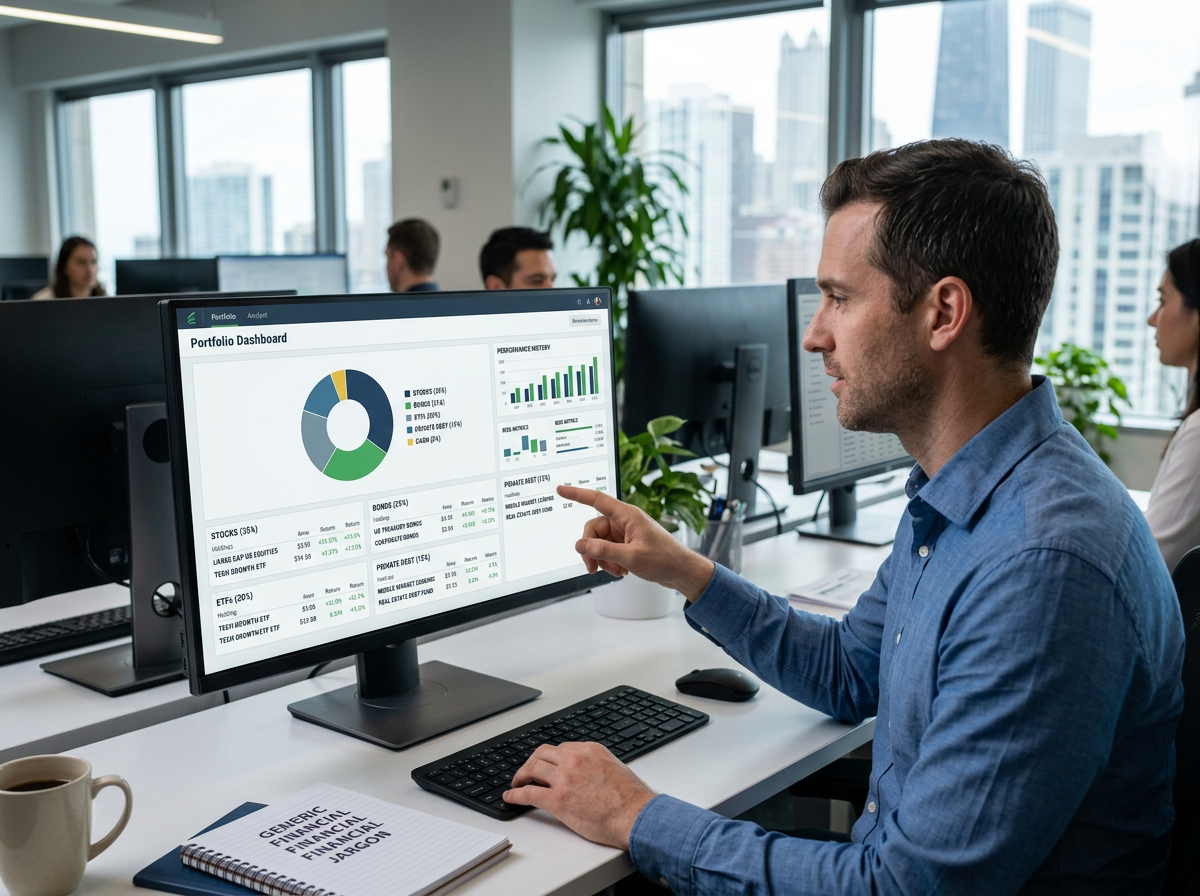
As investment strategies diversify, the variety of assets in a single portfolio can become dizzying. Modern investment managers frequently run hybrid strategies, holding public equities alongside private debt and structured credit.
Your software must support a broad ecosystem of asset classes, including:
- Public Equities & ETFs
- Fixed Income: Corporate bonds, municipal bonds, and mortgage-backed securities (MBS)
- Private Capital: Private equity, joint ventures, and real estate
- Private Credit: Broadly syndicated loans, direct lending, and private debt
- Derivatives: Swaps, options, futures, and forwards
To manage these effectively, firms use advanced portfolio reporting and accounting software that can handle the unique accounting treatments required for each asset class. For instance, a municipal bond requires tax-exempt interest tracking, while a private debt loan requires tracking principal payments, PIK (payment-in-kind) interest, and amortization schedules.
Managing these complex revenue streams is highly specialized, which is why many institutional players align their systems with the best revenue management software in 2026 to maintain absolute precision over fee structures and yield calculations.
Handling Complex Debt and Equity Instruments
When dealing with private capital, calculating returns is rarely straightforward. You have to account for:
- Carried Interest Waterfalls: Automatically processing complex equity distributions between general partners (GPs) and limited partners (LPs).
- Performance Fees: Calculating high-water marks and hurdle rates across different share classes.
- Amortization & Accretion: Handling premium and discount calculations for fixed-income instruments.
Using dedicated investment management systems allows you to automate these calculations. This reduces the risk of costly calculation errors that can damage investor trust or invite regulatory scrutiny.
Managing Multi-Currency and Multi-Basis Accounting
If you operate globally, you have to report your financial position to different stakeholders using different rules. A global insurer, for instance, might need to report:
- GAAP for public shareholders
- STAT (Statutory Accounting Principles) for state insurance regulators
- IFRS for international entities
- Tax Basis for local tax authorities
 +--------------------------+
 | Single Transaction |
 +------------+-------------+
 |
 +------------+-------------+
 | | |
 v v v
+-----------------+  +-----------------+  +-----------------+
|   GAAP Ledger   |  |   STAT Ledger   |  |   IFRS Ledger   |
+-----------------+  +-----------------+  +-----------------+
Modern multi-basis accounting solutions allow you to process a single transaction and have it automatically post to multiple ledgers simultaneously, applying the correct accounting rules for each basis in real time.
System Integration and Technology Architecture
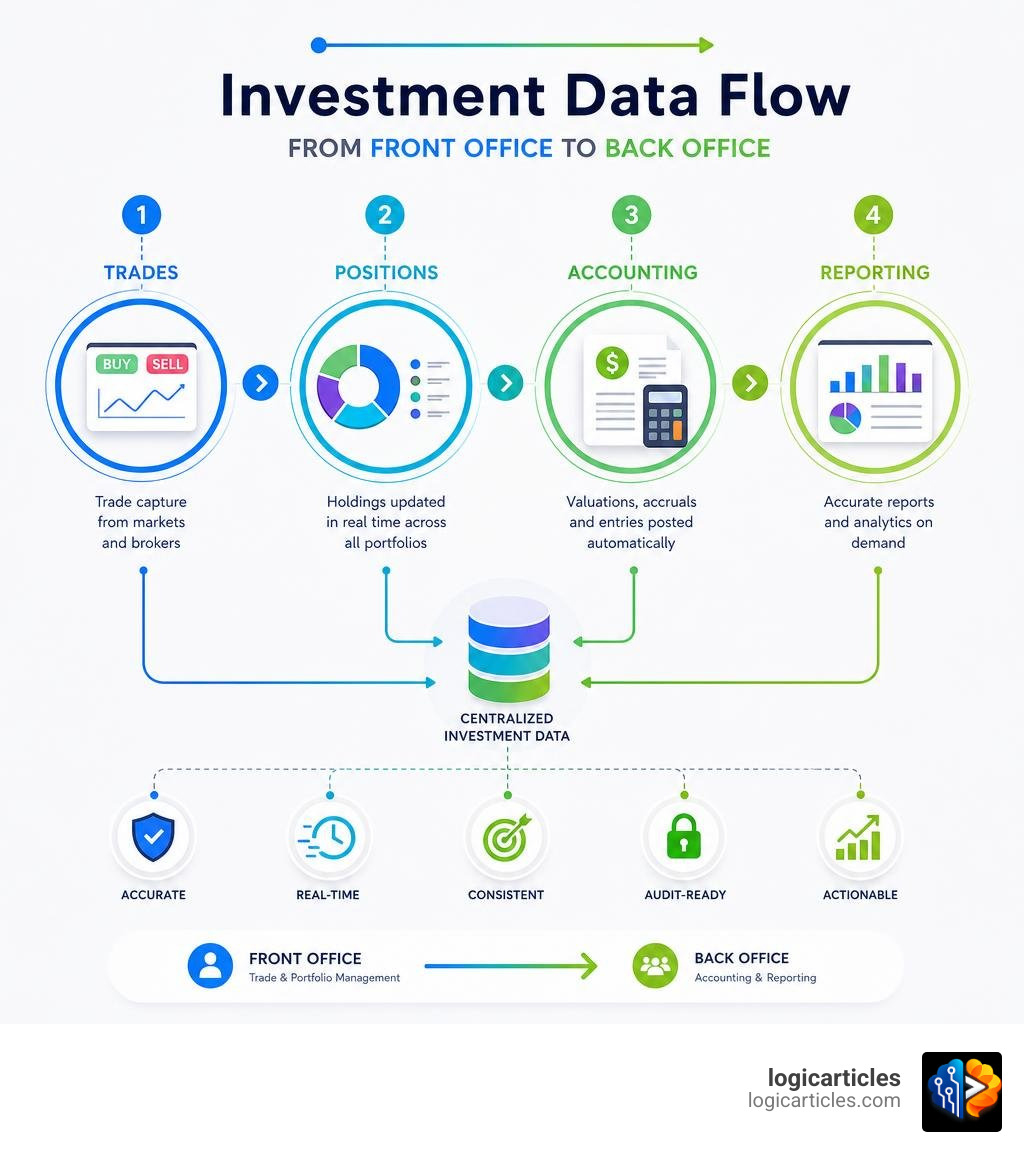
A modern investment accounting platform cannot exist on an island. It must integrate seamlessly with your front-office (portfolio management and trading), middle-office (risk and compliance), and back-office (fund administration and investor portals) systems.
This is where advanced accounting software for investment management shines. By utilizing cloud scalability and RESTful APIs, modern platforms act as a centralized data repository, delivering near-real-time views of holdings, cash positions, and transactions across your entire business ecosystem.
Connecting IBOR, ABOR, and PBOR
To achieve operational efficiency, your platform should unify three critical books of record:
- IBOR (Investment Book of Record): The front-office view. It focuses on real-time, trade-date positions, giving portfolio managers an accurate view of what they own and what cash is available to trade right now.
- ABOR (Accounting Book of Record): The back-office view. It focuses on settled positions, historical cost bases, tax lots, and official financial statements.
- PBOR (Performance Book of Record): The risk and performance view. It calculates official returns, benchmarks performance, and tracks GIPS compliance.
Unifying these books of record on a single platform ensures that everyone in your firm—from the head trader to the chief compliance officer—is looking at the exact same “golden source” of data.
Why Spreadsheets Fail Compared to Investment Accounting Software
We all love Excel. It is flexible, familiar, and great for quick calculations. But as a primary ledger for investment portfolios, it is a ticking time bomb.
- No Audit Trail: In a spreadsheet, anyone can overwrite a cell without leaving a trace. In a dedicated system, every action is logged with a permanent audit trail.
- Data Silos: Spreadsheets live on local drives or shared folders. They don’t update automatically when a corporate action occurs or a bond coupon is paid.
- Lack of Scalability: As your portfolio grows from 50 assets to 5,000, your spreadsheets will slow down, crash, and become impossible to reconcile.
- Key Person Risk: If the person who built your complex macro-enabled workbook leaves the company, your entire accounting operation goes with them.
Frequently Asked Questions about Investment Accounting
What is the difference between fund accounting and investment accounting?
Fund accounting tracks the fund entity itself, focusing on investor allocations, capital calls, redemptions, and the overall Net Asset Value (NAV). Investment accounting tracks the underlying holdings within the fund (such as individual stocks, bonds, or loans), managing tax lots, corporate actions, and daily valuations.
How is GIPS compliance managed in these systems?
Global Investment Performance Standards (GIPS) require rigorous, standardized calculations of investment performance. Modern software automates this by calculating Time-Weighted Rate of Return (TWR) or Internal Rate of Return (IRR), managing composite memberships, and generating GIPS-compliant reports that are ready for third-party verification.
What are the benefits of cloud-based platforms?
Cloud-based SaaS platforms offer real-time data access from anywhere, automatic regulatory and software updates, robust security protocols, and seamless API integrations with market data providers and custodians. They also eliminate the need for expensive on-premises IT infrastructure and maintenance.
Conclusion
The investment landscape of June 2026 demands speed, accuracy, and absolute transparency. Relying on manual spreadsheets or legacy systems to manage complex, multi-asset portfolios is no longer a viable strategy.
By upgrading to a modern investment accounting platform, you can eliminate manual errors, automate complex calculations, and give your team the real-time data they need to make informed decisions.
Ready to discover the perfect tools to power your operations? We invite you to explore the best software categories to find the ideal solutions for your firm’s digital transformation journey.