Why EMR Software Development Matters for Modern Healthcare

EMR software development is one of the fastest-growing areas in healthcare IT — and if you’re trying to find the right development approach or partner, here’s what you need to know right away:
Quick answer: What is EMR software development?
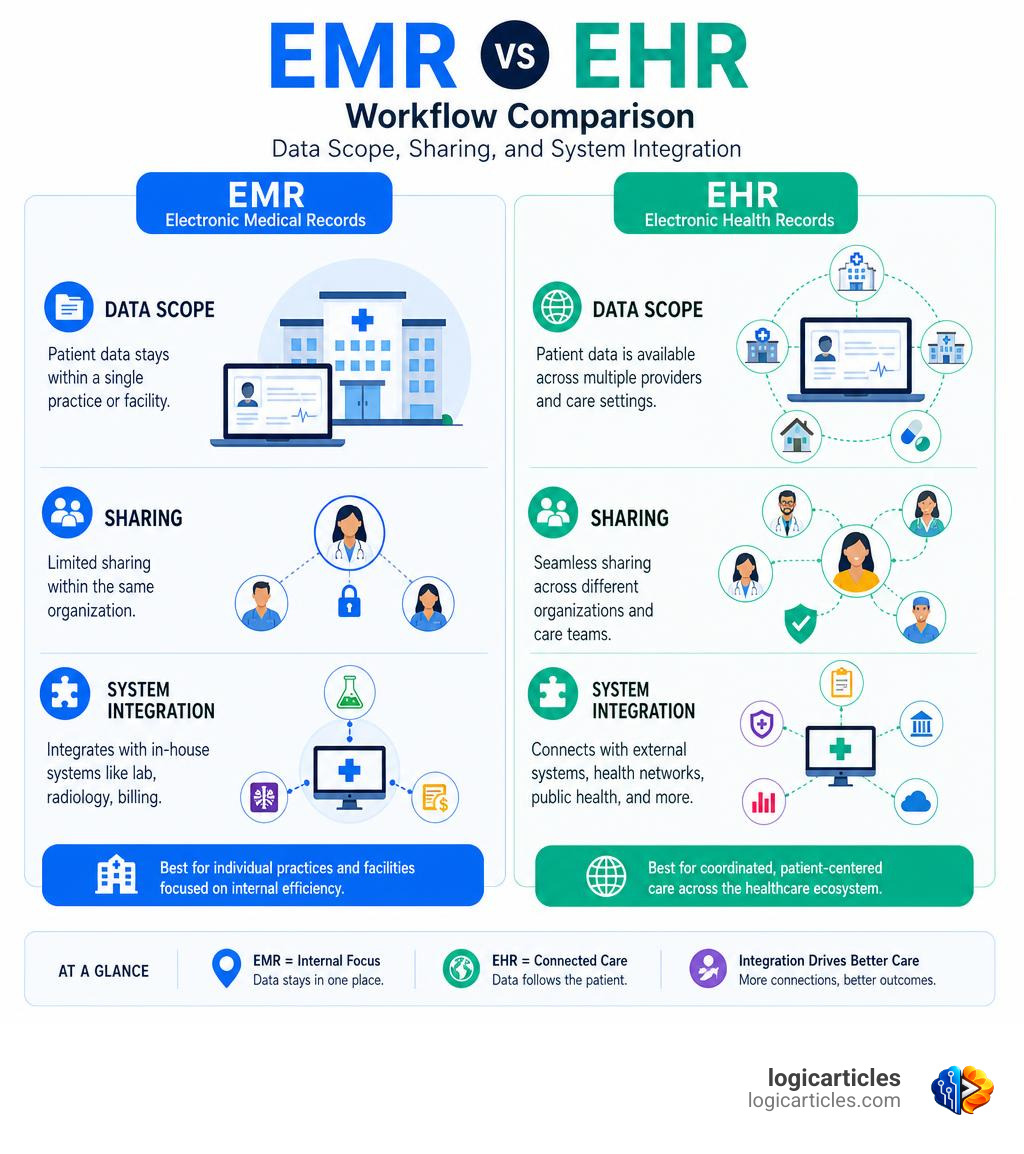
- EMR (Electronic Medical Records) software digitizes patient charts within a single facility
- EHR (Electronic Health Records) software extends that data across multiple providers and care settings
- Custom development lets you build a system tailored to your exact clinical workflows
- Off-the-shelf platforms (like Epic or Cerner) are faster to deploy but often force you to adapt your workflows to their software
- The global EHR/EMR market is projected to reach $63.8 billion by 2030, growing at 8.9% annually
Development costs typically range from $50,000 to $500,000 for custom builds, with timelines of 6 months to 3 years depending on complexity.
Despite near-universal adoption in US hospitals, many healthcare providers remain frustrated with their current systems. A Yale University study found that a significant share of providers are dissatisfied — largely because many legacy EHR platforms were designed by non-clinical teams unfamiliar with real hospital workflows. The result? Bloated dashboards, slow interfaces, and doctors who still prefer pen and paper.
The good news: well-built EMR software can reduce medication errors by 30%, cut documentation time by up to 40%, and meaningfully improve care coordination.
This guide walks you through everything — from core features and compliance requirements to build-vs-buy decisions and AI-powered enhancements.
The Strategic Value of Custom EMR Software Development
Transitioning from traditional paper-based records to a customized electronic medical record system is more than just a technology upgrade; it is a fundamental shift in how modern practices deliver care. Traditional paper charts are static, easily misplaced, and highly susceptible to administrative bottlenecks. They require physical storage space, manual filing, and hours of tedious sorting just to retrieve a patient’s historical lab results.
Custom emr software development addresses these limitations by creating a dynamic, searchable, and highly secure digital bedside chart. It optimizes clinical workflows, maximizes clinical productivity, and returns valuable time to physicians and nurses.
One of the biggest strategic advantages of custom software development is complete data ownership. With off-the-shelf platforms, your clinical data is often locked inside a vendor’s proprietary database, making custom reports difficult to run and migrations incredibly expensive. When you build your own system, you control the database architecture, the user experience (UX), and the integration pathways. This level of flexibility is highly valuable for specialized clinics (like oncology, pediatrics, or chiropractic care) that have unique documentation needs that general platforms fail to address.
Furthermore, custom EMR software can be built to integrate directly with other specialized digital platforms. For example, modern healthcare organizations often coordinate their digital medical records with insurance claims systems. If your organization is navigating the complex world of medical underwriting and claims processing, understanding the principles of Insurance Software Development can help you bridge the gap between clinical documentation and automated insurance verification.
To understand the core differences between EMR and EHR systems, consider the breakdown below:
| Feature/Metric | Electronic Medical Record (EMR) | Electronic Health Record (EHR) |
|---|---|---|
| Primary Scope | Digital patient chart within a single clinic or facility | Holistic, multi-provider health record of the patient |
| Data Portability | Intended to stay within the originating practice | Designed to be shared securely across multiple healthcare organizations |
| Patient Access | Typically inaccessible to patients directly | Integrates with patient portals for direct, self-service access |
| Core Value | Optimizes internal clinical workflows and documentation | Enhances cross-provider care coordination and health information exchange (HIE) |
| Typical Deployment | Historically on-premise, though increasingly cloud-based | Predominantly cloud-native to support widespread interoperability |
Core Features and Integrations of Modern EMR Platforms
A modern EMR platform must act as the operational brain of a healthcare facility. To achieve high clinical adoption, developers must prioritize minimal-click interfaces designed for high-stress environments. Doctors should not have to navigate through endless nested menus just to renew a prescription.
To build a highly functional EMR platform, several core modules must be included:
- Clinical Documentation & Charting: Highly flexible templates that match specific specialty workflows. Integrating dynamic, drag-and-drop form builders (such as SurveyJS libraries) allows non-technical administrators to easily create and update patient registration forms, progress notes, and discharge summaries without writing new code.
- e-Prescriptions (eRx): Direct integration with pharmacy networks (like Surescripts) to allow clinicians to send prescriptions and manage refills with a single click.
- Patient Portals & Self-Service: Secure portals where patients can fill out intake paperwork, view lab results, pay bills, and schedule appointments.
- Billing & Revenue Cycle Management (RCM): Features that automate medical coding (using ICD-10 and CPT standards), validate claims before submission, and track patient payments.
Because financial operations in healthcare require specialized billing, payment gateways, and accounting tools, EMR developers often look to financial technology frameworks for inspiration. Working with a specialized partner, such as the Best Fintech Software Development Company, can assist in building highly secure, compliant, and automated payment architectures within your patient portal and RCM modules.
Essential Integrations in EMR Software Development
No EMR platform can operate in isolation. To provide a comprehensive view of patient health, the software must connect with external systems through secure API connections and standardized communication protocols.

- HL7 and FHIR Protocols: Fast Healthcare Interoperability Resources (FHIR) and Health Level Seven (HL7) are the gold standards for healthcare data exchange. They ensure your EMR can transmit clinical data to other platforms without friction.
- Laboratory Information Systems (LIS): Integrating with external labs allows doctors to order tests directly from the EMR chart and receive automated results in real-time, reducing manual entry errors.
- Pharmacy Networks: Seamless connection to pharmacies ensures drug-to-drug interaction alerts trigger automatically when a new medication is prescribed.
- Telehealth Modules: Built-in video conferencing and remote patient monitoring (RPM) integrations allow clinicians to treat patients in rural areas and pull wearable sensor data directly into the electronic chart.
Compliance, Security, and Cloud Infrastructure Standards
When dealing with Protected Health Information (PHI), security cannot be an afterthought. It must be baked directly into the system’s architecture.
To launch a compliant healthcare platform, your EMR must adhere to several strict regulatory standards:
- HIPAA (Health Insurance Portability and Accountability Act): For the US market, this requires end-to-end encryption (both in transit and at rest), multi-factor authentication (MFA), automatic logouts, and detailed audit logs that record every single time a user accesses or edits a patient record.
- GDPR (General Data Protection Regulation): For European markets, this ensures patients have the “right to be forgotten” and complete control over their personal data.
- ONC Certification: To prove secure patient data handling and qualify for government incentives in the US, custom EMR systems must be certified by an ONC-Authorized Testing Laboratory (ONC-ATL).
- Business Associate Agreements (BAA): You must sign a BAA with your software development vendor and cloud hosting providers to legally ensure the protection of electronic PHI (ePHI).
Cloud Infrastructure for EMR Software Development
Modern EMR platforms generate massive, petabyte-scale datasets consisting of patient histories, medical imaging, and real-time remote monitoring logs. Managing this scale of big data requires robust cloud pipelines and analytics infrastructure.
To build, visualize, and debug these complex data pipelines, healthcare developers rely on managed big data environments. For example, Amazon EMR Studio | Managed IDE Environment | Amazon Web Services provides a fully managed Jupyter Notebook environment that allows data engineers to run large-scale analytics across active clusters.
To streamline this process, developers can use the awslabs/amazon-emr-vscode-toolkit to manage, test, and deploy Spark big data jobs directly from their local VS Code environment to Amazon EMR clusters. This combination of big data infrastructure and secure cloud databases ensures that your EMR can handle advanced clinical analytics, predictive modeling, and population health reporting without slowing down the primary clinical application.
Build vs. Buy: Choosing the Right Path for Your Practice
Choosing between building a custom EMR system and buying an off-the-shelf product is a major strategic decision. While off-the-shelf software has lower upfront costs, it often comes with expensive licensing fees, rigid interfaces, and vendor lock-in.
The table below breaks down the long-term trade-offs of both options:
- Custom Build: High upfront investment ($75,000+), but zero licensing fees, 100% workflow alignment, complete data ownership, and a high long-term ROI.
- Off-the-Shelf: Low initial cost, but high ongoing subscription fees, limited customization options, and potential vendor roadmap delays.
If you are a clinical administrator trying to balance these development budgets, managing software expenses is critical. Utilizing the Best CFO Software Tools for Small Business can help you track development costs, model your ROI, and make an informed financial decision for your practice.
Frequently Asked Questions about EMR Systems
How long does custom emr software development take?
The typical timeline to develop and deploy a custom EMR system ranges from 6 months to 3 years. A basic Minimum Viable Product (MVP) containing core charting and scheduling features can often be launched within 12 to 24 weeks. However, full enterprise implementations that require extensive third-party integrations (such as labs, billing networks, and pharmacies) and complex data migrations from legacy systems will take longer.
What is the average cost of emr software development?
The cost of custom EMR software development typically ranges from $50,000 to $500,000 for mid-sized practices. For large, multi-specialty hospital networks requiring custom database architectures, enterprise integrations, and advanced AI modules, the cost can exceed $1,000,000 to $2,000,000. While the upfront cost is higher than a subscription-based off-the-shelf platform, the elimination of per-user licensing fees often results in a lower total cost of ownership over a 5-to-10-year period.
How can AI and machine learning enhance emr software development?
AI is revolutionizing how clinicians interact with EMR software. Key enhancements include:
- Ambient AI Scribes: Listening to patient visits and automatically generating structured clinical notes, reducing documentation time by up to 40%.
- Predictive Analytics: Analyzing patient data to identify early signs of deterioration, sepsis, or medication errors before they occur.
- Automated Medical Coding: Using natural language processing (NLP) to read clinical notes and automatically suggest highly accurate billing codes (ICD-10), reducing claim denials.
Conclusion
Embarking on an emr software development journey is a powerful step toward digital transformation in healthcare. By choosing custom development over rigid, off-the-shelf platforms, your practice gains complete data ownership, optimized clinical workflows, and a system built specifically for your providers.
At logicarticles, we are committed to providing the practical, logic-driven insights that help organizations navigate complex software decisions. If you are looking to explore more software reviews, comparisons, and technical guides, check out our Best Software Category to find the right tools for your business.