Why Productivity Software Is Now a Business Essential
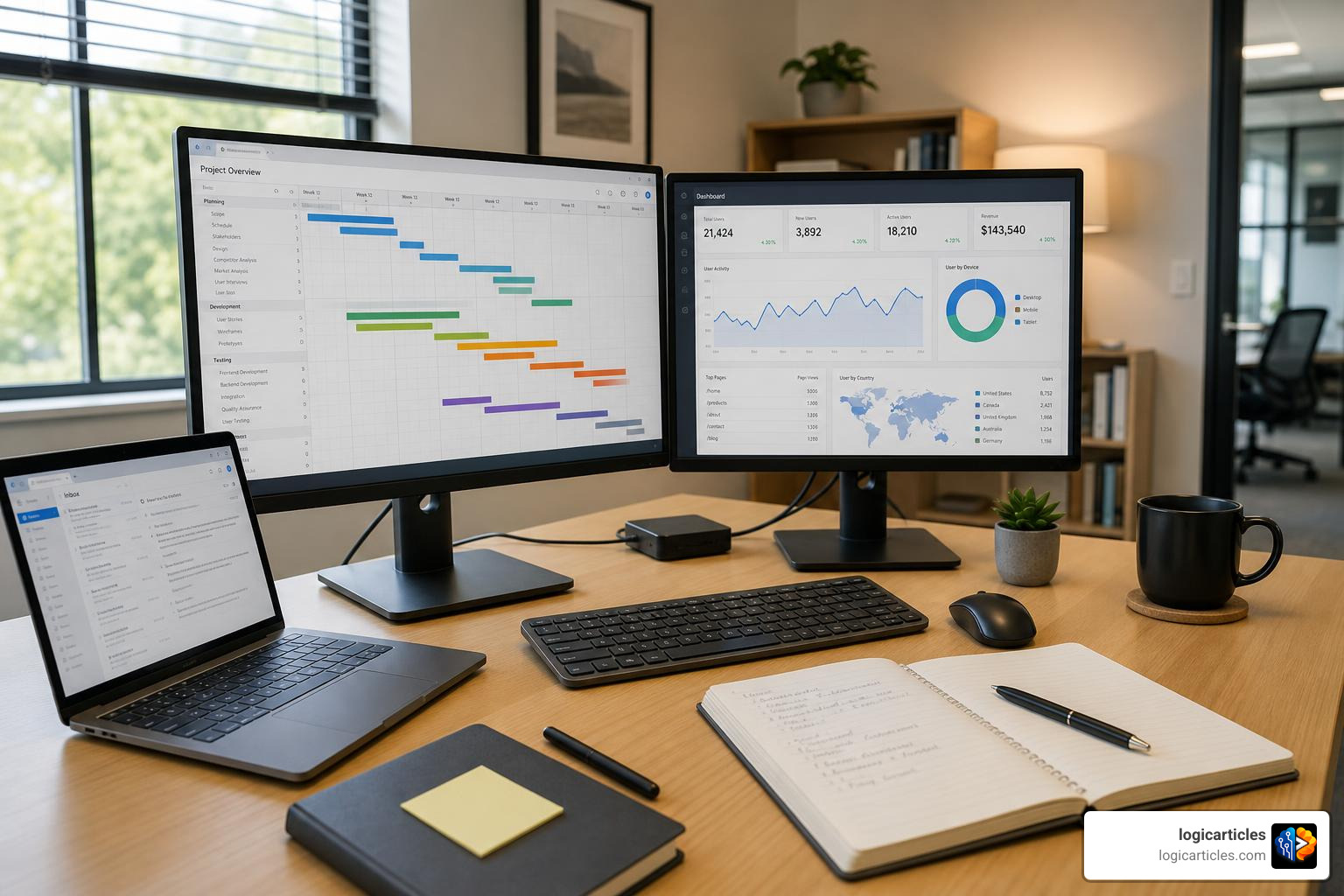
What is productivity software? Here’s the short answer:
Productivity software is any application designed to help individuals or teams create documents, manage data, communicate, collaborate, and complete work tasks more efficiently.
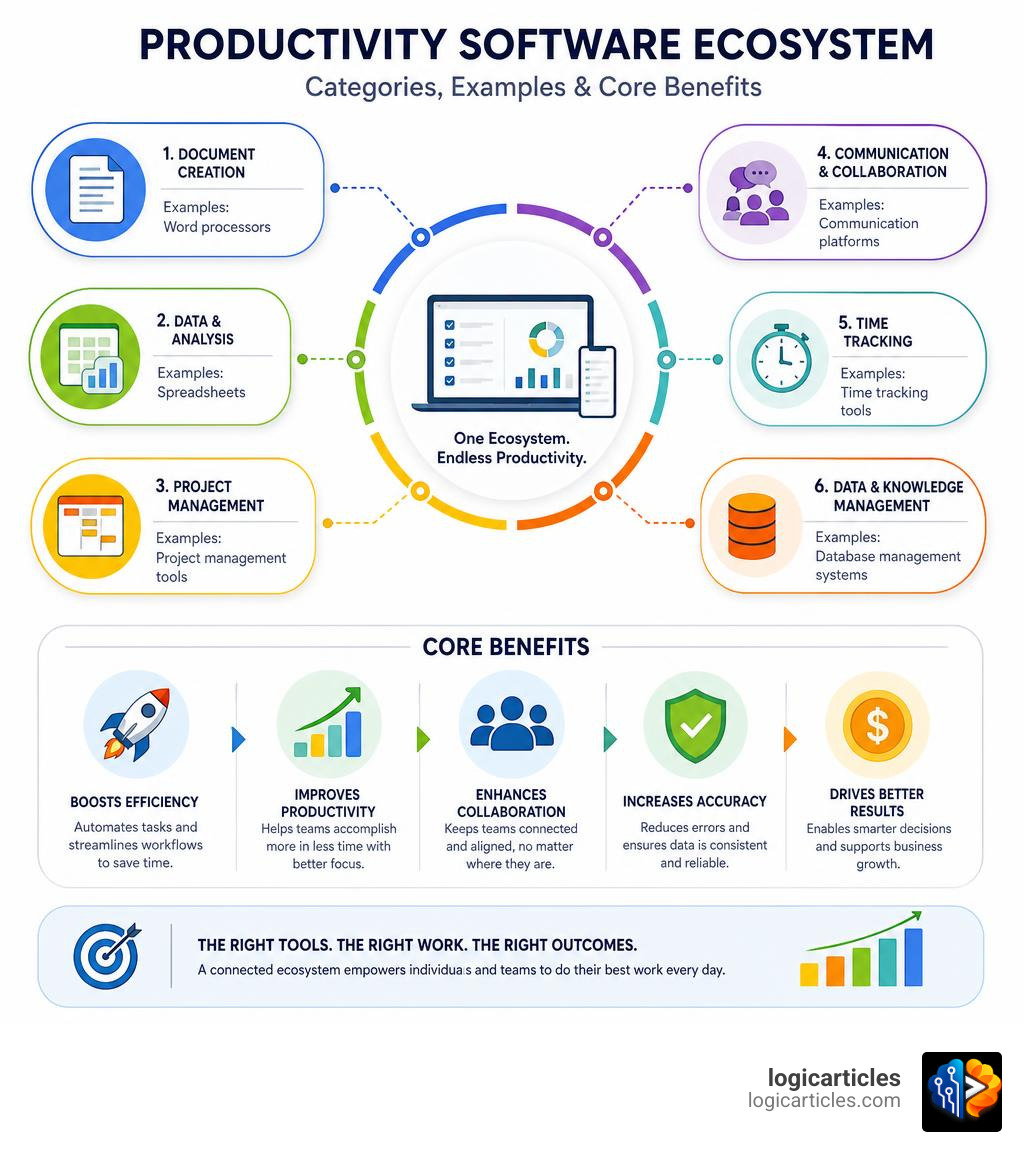
Common examples include:
- Word processors – Google Docs, Microsoft Word
- Spreadsheets – Excel, Google Sheets
- Project management tools – Asana, Trello
- Communication platforms – Slack, Microsoft Teams
- Time tracking tools – Toggl, Clockify
- Database management systems – Airtable, Notion
Think about how much time gets lost at work every single day.
Research shows that less than 60% of work hours actually go toward productive tasks. For every 100 employees, organizations lose an estimated $1.7 million per year to wasted time alone.
That’s not a small problem. That’s a crisis.
Productivity software exists to close that gap. It replaces slow, manual processes with faster, more organized ways of working. What started as basic word processors and spreadsheets in the 1980s has grown into a vast ecosystem of tools — covering everything from document creation to AI-powered workflow automation.
And the need is real. As of 2015, 78% of middle-skill jobs in the US already required workers to use productivity software. That number has only grown since.
Whether you’re running a small team or managing enterprise operations, the right productivity tools shape how fast you work, how well you collaborate, and ultimately, how competitive your business stays.
What is Productivity Software?
To build a solid digital strategy, we must first dive into the formal PRODUCTIVITY SOFTWARE definition and meaning | Collins English Dictionary. In its most fundamental form, productivity software refers to application programs that help users produce information such as documents, databases, graphs, worksheets, and presentations.
Historically, these tools were called “office productivity software” because they were specifically designed to replace physical office mainstays: the typewriter, the paper filing cabinet, and the handwritten ledger. According to What is productivity software?, the scope of these tools has expanded dramatically. Today, they do not just help us produce static assets; they help us orchestrate the entire flow of work across distributed organizations.
At its core, this software category is defined by its ability to:
- Automate repetitive work through templates and built-in rules.
- Synthesize complex data into visual formats (like turning massive datasets into charts).
- Establish a central repository for institutional knowledge.
Because these tools are so central to modern work, they have become a foundational workforce skill. When we look back at the historical data, even over a decade ago in 2015, over three-quarters of middle-skill occupations required proficiency in basic office suites. Today in 2026, that requirement is virtually 100% across all knowledge-work industries.
Understanding What Is Productivity Software in Modern Business
In the modern enterprise landscape, the definition of Productivity software has undergone a major paradigm shift. It is no longer just about an individual worker typing a document on a local desktop. Instead, it serves as the digital orchestration layer of the modern business.
With the rise of hybrid teams and distributed workforces, productivity tools have transitioned from isolated programs to highly connected, dynamic ecosystems. Modern business productivity software must solve the challenges of:
- Asynchronous Collaboration: Enabling team members in different time zones to work on the exact same project without sending endless email attachments back and forth.
- Contextual Interoperability: Allowing your task manager to talk to your database, which talks to your communication channels, ensuring data flows smoothly without manual copy-pasting.
- Unified Workspaces: Consolidating disparate tools so employees don’t experience “context switching”—the cognitive drain of jumping between dozens of open browser tabs.
Modern productivity tools are designed to facilitate digital transformation. They democratize data access and give leadership clear visibility into operational bottlenecks, helping teams work smarter rather than just working longer hours.
The Evolution of Office Suites and Creation Tools
To understand where we are in 2026, it helps to look at where we started. The history of productivity software is a fascinating journey of technological democratization:
- The 1980s (The Desktop Revolution): Early office suites like StarBurst emerged, bringing word processing, basic spreadsheets, and relational databases to personal computers. This period revolutionized the office by eliminating manual typewriters and paper ledger sheets.
- The 1990s (The Suite Bundling Era): Software licensing changed forever. Instead of buying individual applications, businesses bought bundled suites. According to Productivity software, by 1994, more than 60% of Microsoft Word sales and 70% of Microsoft Excel sales were part of bundled office suites.
- The 2010s (The Cloud Migration): The launch of cloud-native platforms like Google Workspace and Microsoft 365 shifted our work from local hard drives to the cloud. Real-time co-authoring became the gold standard, and the freemium model allowed startups to scale their tool stacks rapidly.
- The 2020s to 2026 (The AI-Augmented Composable Era): Today, we are in the era of composable architectures and AI-native platforms. We no longer rely on rigid, pre-built applications. Instead, we use low-code and no-code tools to build custom workspaces, while integrated AI assistants write code, summarize documents, and automate workflows on our behalf.
Core Categories of Productivity Tools
When building your organization’s software stack, it helps to break down the vast landscape of productivity tools into manageable categories. While some platforms try to do a little bit of everything, most tools excel in one of several key areas.

Document Creation and Database Management Systems
The bedrock of any productivity suite is the ability to create, store, and organize information. This category includes:
- Word Processing Applications: Tools designed to write, edit, and format text documents. Modern word processors prioritize cloud collaboration, allowing multiple team members to edit simultaneously and leave inline feedback.
- Spreadsheet Software: Programs that allow users to store, manipulate, and analyze numerical data. Spreadsheets are incredibly powerful; a single modern sheet can hold more than 15 million cells of data, allowing startups and enterprises alike to build financial models, visualize experimental data, and run complex calculations.
- Database Management Systems (DBMS): Advanced tools used to store, retrieve, and analyze structured data. Modern tools have bridged the gap between spreadsheets and databases, allowing non-technical users to build relational databases with drag-and-drop interfaces.
- Presentation Software: Programs used to create visual slide decks. These tools have evolved to support rich multimedia integration, interactive elements, and collaborative design templates.
To learn more about how specific tools classify these structures, check out the technical taxonomy in the Productivity Software-Application – GM-RKB resource.
Project Management and Collaboration Platforms
While document editors help you create information, project management and collaboration platforms help you organize how that information gets turned into finished projects.
If you are looking to optimize your team’s day-to-day operations, we have compiled a detailed review of the Best Task Management Software in 2026 Tested. These platforms allow teams to assign tasks, set deadlines, visualize project timelines (using Gantt charts or Kanban boards), and track progress in real time.
Furthermore, these tools are essential for cross-departmental alignment. For example, did you know that alignment between sales and marketing teams alone can boost revenue by more than 200%? Collaboration tools act as the bridge between these departments, making sure everyone is working toward the same goals.
For fast-growing companies looking to scale their operations quickly, choosing the right digital infrastructure is half the battle. To see how these platforms fit into a broader growth strategy, explore our curated list of the Best Startup Growth Tools for 2026.
Key Features to Look For in Productivity Software
Choosing the right software can feel overwhelming. To avoid making an expensive mistake, we recommend focusing on several essential features that ensure high adoption rates and a strong return on investment.
Determining What Is Productivity Software Capability and Integration
When evaluating a new tool, look past the flashy marketing pages and focus on its core capabilities as outlined in the Productivity Software Definition & Examples framework:
- Reliability and Security: A tool is only useful if it is up and running when your team needs it. Prioritize platforms with proven uptime records and enterprise-grade security certifications (such as GDPR, HIPAA, and SOC 2 compliance).
- API Extensibility and Integrations: Your productivity tools should not exist on isolated digital islands. Look for software that offers native integrations or robust APIs to connect seamlessly with your existing CRM, ERP, and HRIS systems.
- Multi-Platform Compatibility: Your team works from laptops, tablets, and smartphones. The software must offer a consistent, high-performance experience across Windows, macOS, iOS, and Android.
- Asynchronous Collaboration Features: Real-time editing is great, but asynchronous features—like threaded comments, task mentions, and video recordings—are what keep distributed teams aligned without meeting fatigue.
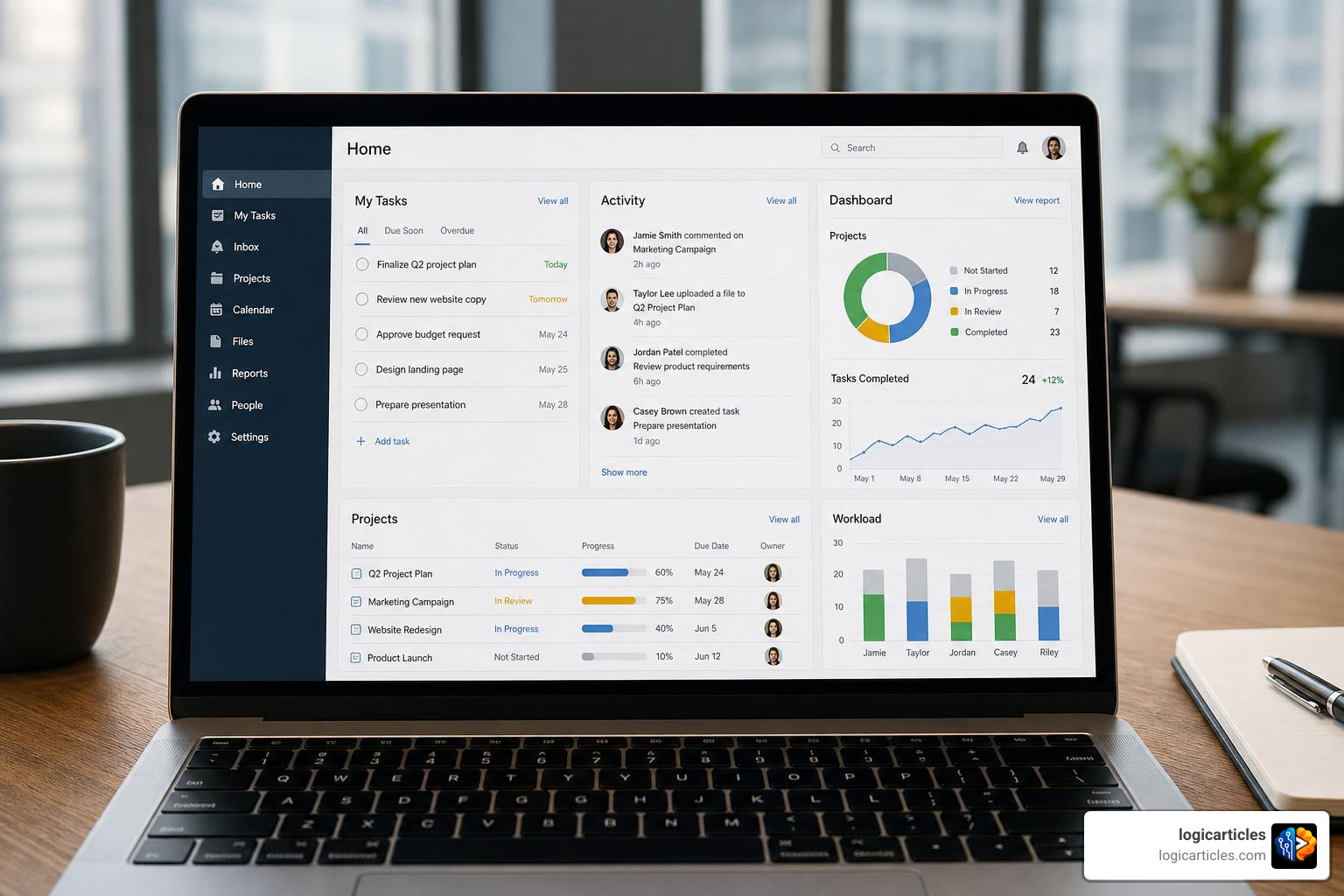
- Analytics and Reporting: You cannot improve what you do not measure. Choose platforms that provide built-in dashboards to track task completion rates, project timelines, and workload distribution.
AI and Automation Features in 2026
By 2026, artificial intelligence is no longer a futuristic add-on—it is a core component of any competitive productivity platform. When shopping for software, look for these AI-driven capabilities:
- Generative Writing Assistants: AI tools that can draft emails, summarize long document threads, and adjust the tone of your copy in seconds.
- Smart Scheduling Algorithms: Calendar tools that analyze team availability, time zones, and meeting preferences to automatically find the perfect meeting slot without the back-and-forth email dance.
- Predictive Workflow Triggers: Automation systems that recognize repetitive patterns (e.g., “Every time a contract is signed, create a new onboarding folder”) and build the automation rules for you using natural language prompts.
- Intelligent Data Analysis: Spreadsheet and database assistants that allow you to ask questions in plain English (e.g., “Which marketing campaign had the highest ROI last quarter?”) and instantly generate the corresponding charts and formulas.
Benefits and Challenges of Implementing Productivity Tools
While the advantages of productivity software are clear, implementing new systems always comes with a set of trade-offs. Let’s look at a balanced comparison of the benefits and challenges:
| Key Benefits | Potential Challenges |
|---|---|
| Boosted Efficiency: Automating administrative work allows employees to focus on high-value, creative tasks. | Tool Fatigue & Cognitive Load: Introducing too many single-purpose apps can overwhelm employees and cause digital burnout. |
| Improved Collaboration: Centralized workspaces break down departmental silos and keep distributed teams aligned. | Technology Dependence: Over-reliance on cloud systems means work can grind to a halt during internet outages or server downtime. |
| Greater Flexibility: Cloud-native and mobile-friendly tools allow employees to work securely from anywhere in the world. | IT Support & Complexity: Complex tools require ongoing administrative support, configuration, and employee training. |
| Enhanced Data Accuracy: Automated calculations, validation rules, and templates reduce human error. | Shadow IT Risks: If official tools are too difficult to use, employees may adopt unauthorized apps, creating security risks. |
Frequently Asked Questions About Productivity Software
What is the primary purpose of productivity software?
The primary purpose of productivity software is to make users more efficient and effective in their daily work. It achieves this by automating repetitive tasks, organizing complex workflows, facilitating real-time communication, and providing pre-built templates that allow projects to start faster and with fewer errors.
How do organizations measure the ROI of productivity tools?
Organizations should measure the return on investment (ROI) across three main categories:
- Time Savings: Calculating the hours saved by automating tasks, reducing meeting times, and speeding up project delivery. (For example, tool consolidation has been shown to reduce project delivery times by up to 40%).
- Cost Avoidance: Tracking the reduction in IT support tickets, lower training costs through contextual support, and the consolidation of overlapping software licenses.
- Strategic Enablement: Measuring qualitative improvements such as faster employee onboarding times, higher employee retention rates, and improved decision-making speed.
What are the security risks associated with productivity software?
The main security risks include unauthorized data access, lack of compliance with regional data privacy laws (like GDPR or CCPA), and “Shadow IT” (when employees use unapproved software to get their work done). Organizations can mitigate these risks by choosing vendors with strong encryption, enforcing Single Sign-On (SSO), and establishing clear software governance policies.
Conclusion
Productivity software has evolved far beyond the simple word processors and calculators of the past. Today, it serves as the digital connective tissue of the modern enterprise—enabling hybrid teams to collaborate effortlessly, automating manual workflows, and turning raw data into strategic business decisions.
However, simply buying more software won’t automatically make your business more efficient. True workplace agility comes from choosing the right mix of integrated tools, establishing strong governance, and ensuring your team has the training they need to succeed.
If you are ready to optimize your workflows and build a more productive, resilient organization, explore our deep-dive guides and software reviews in our dedicated Category: Productivity hub. Let’s build a smarter way to work, together!