The Growing Challenge of Software Stack Management in 2026

Software stack management is the process of tracking, governing, optimizing, and securing all the software tools your organization uses — from core business applications to cloud services and AI-powered platforms.
Here’s a quick overview of what it involves:
- Inventory and visibility — knowing every tool in use across every team
- Cost control — eliminating waste from unused licenses and duplicate tools
- Governance — defining who can buy, approve, and retire software
- Security — ensuring every tool meets compliance and data protection standards
- Optimization — continuously aligning your stack with actual business needs
If you’ve ever wondered why your company keeps paying for tools nobody uses, or why IT has no idea what software marketing just bought — you’re already dealing with a software stack management problem.
And it’s extremely common.
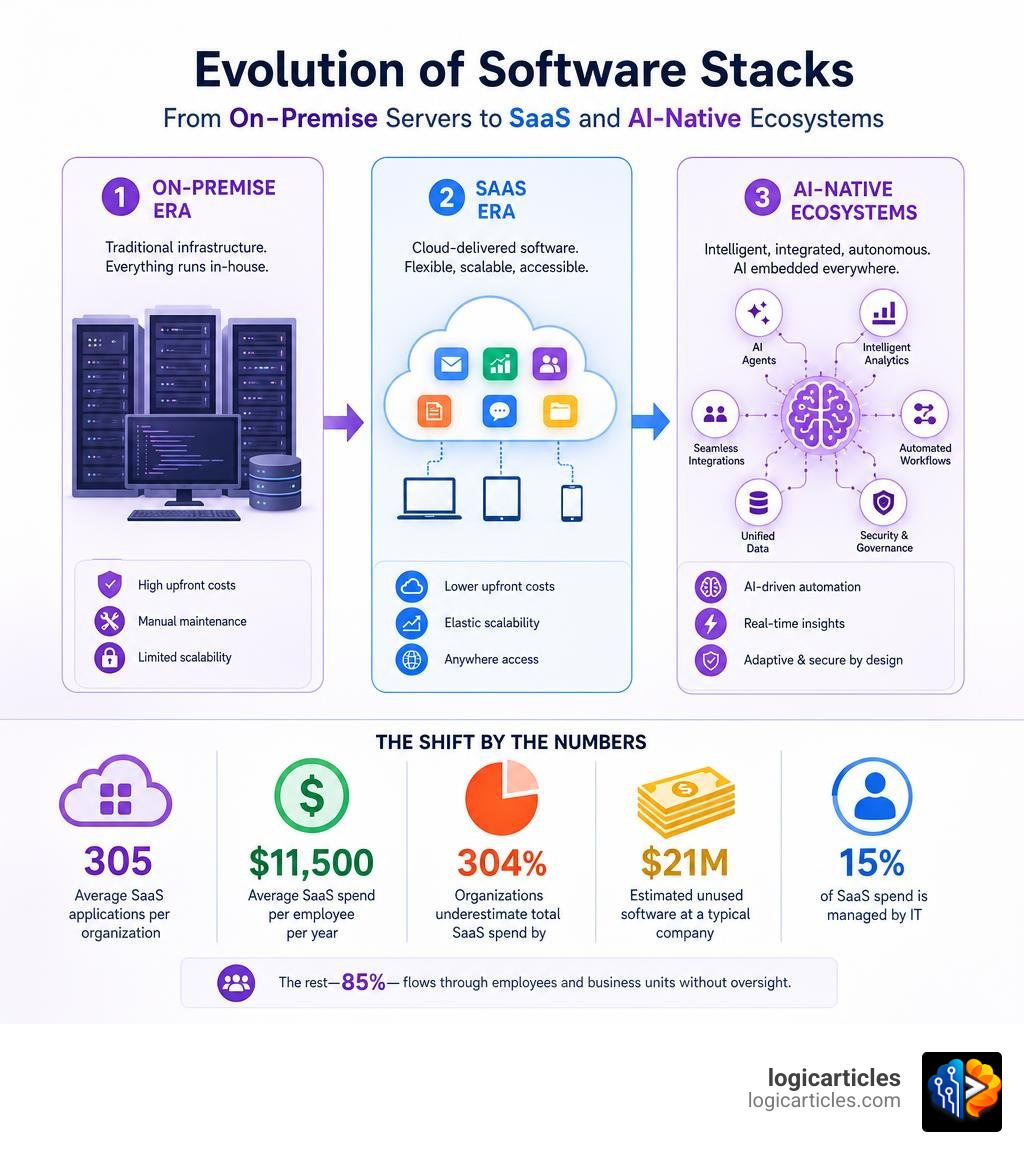
The average organization now runs 305 SaaS applications, spending over $11,500 per employee per year on software. Yet organizations underestimate their total SaaS spend by 304% on average — leaving an estimated $21 million in unused software sitting on the books at a typical company.
Making things worse, only 15% of SaaS spend is actually managed by IT. The other 85% flows through individual employees and business units, often without oversight, security review, or budget approval.
The result? Bloated stacks. Redundant tools. Security blind spots. And finance teams left guessing.
This guide breaks down exactly how to take back control.
Defining the Software Stack in the Era of Cloud and AI
To manage a software stack effectively, we first have to understand how its very definition has shifted. Historically, a software stack was a rigid, highly technical combination of operating systems, databases, web servers, and programming frameworks running on physical servers in a basement.
Today, the concept has exploded. A modern software stack is a dynamic, highly interconnected ecosystem of SaaS applications, cloud infrastructure, and AI-powered tools. It is no longer just the domain of developers; it is the digital nervous system of the entire business.
Every department, from marketing to finance, builds its own micro-stack of specialized applications to drive daily workflows. Understanding What is Productivity Software? is now a foundational requirement for any business leader looking to build a cohesive stack that empowers employees without creating digital clutter.
The Evolution from Local Servers to AI-Native Ecosystems
The journey of the software stack has moved through three distinct eras:
- The Monolithic Era (On-Premises): Software was hosted on physical local servers. Stacks were stable, slow to change, and entirely controlled by IT. If you wanted a new tool, it took six months, a hardware purchase, and a team of systems administrators to deploy it.
- The Cloud and SaaS Era (Decentralized): Monolithic architectures gave way to microservices and API integrations. The rise of cloud computing allowed software vendors to deliver applications over the internet. Anyone with a credit card could purchase a SaaS tool, leading to an explosion of decentralized, department-specific stacks.
- The AI-Native Era (Agentic & Consumption-Based): In 2026, we are firmly in the era of AI-native applications. These tools do not just store or process data; they actively generate code, automate reasoning, and orchestrate workflows. Software is no longer static; it is dynamic, adaptive, and increasingly managed by AI agents.
This rapid evolution has created immense complexity. The average enterprise now manages roughly 660 apps and adds an average of 12 new ones every single month. Keeping up with this pace requires a structured approach to governance.
Software Stack vs. Technology Stack vs. Solution Stack
In IT and procurement meetings, the terms software stack, technology stack, and solution stack are often used interchangeably. However, drawing clear distinctions between them is critical for effective governance, budgeting, and system architecture.
| Concept | Scope | Key Focus | Primary Owners |
|---|---|---|---|
| Software Stack | The collection of software subsystems, applications, and utilities that run on a computer or cloud platform. | Application execution, user interfaces, data processing, and APIs. | Software Engineers, Department Heads, IT Ops |
| Technology Stack | The complete infrastructure, including hardware, operating systems, cloud environments, and physical networks. | Hardware abstraction, cloud hosting, virtualization, and physical infrastructure. | DevOps, Cloud Architects, CTO |
| Solution Stack | A pre-packaged, complete set of software (and sometimes hardware) designed to solve a specific business problem. | End-to-end functionality, platform completeness, and rapid deployment of a single system. | Procurement, Business Units, IT Security |
Understanding these differences helps IT and procurement teams avoid costly communication errors. For instance, when procurement is looking at a new “solution stack” for enterprise resource planning (ERP), they must consult with cloud architects to ensure the underlying “technology stack” is compatible with their existing cloud infrastructure.
The Core Pillars of Modern Software Stack Management
Managing a modern software stack requires balancing agility with control. If you lock down the stack too tightly, you strangle innovation and frustrate employees. If you leave it completely open, your budget will spiral out of control and your data security will look like Swiss cheese.

Why Software Stack Management Matters in 2026
The financial and operational risks of unmanaged software are higher than ever. Gartner predicts that total global software spending will reach a staggering $1.4 trillion in 2026. With annual SaaS spending per organization averaging $55 million, businesses can no longer afford to treat software procurement as an afterthought.
The primary drivers for proactive software stack management include:
- SaaS Sprawl and Duplicate Tools: Without central visibility, different departments frequently buy different tools that do the exact same thing. Marketing might buy one project management tool, while product engineering buys another, and HR signs up for a third.
- License Waste: Unused licenses, underutilized platforms, and forgotten subscriptions account for an average of $21 million in wasted software spend per enterprise annually.
- Security and Compliance Risks: Every unauthorized app introduced to your network represents a potential entry point for cybercriminals. If IT doesn’t know an app is being used, they cannot audit its data security, leading to severe vulnerabilities.
- Budget Optimization: Managing cloud infrastructure costs is just as critical as managing SaaS tools. To keep infrastructure bills under control, organizations frequently turn to the Best Cloud Cost Optimization Tools for 2026: Cut Cloud Bills Fast to identify idle resources and optimize their cloud-native software layers.
Overcoming the Challenges of Decentralized Software Ownership
The root cause of stack chaos is decentralized purchasing. Because 85% of SaaS spending is managed outside of IT, individual business units act as their own software buyers.
To overcome this, leading organizations are moving away from a purely reactive “command-and-control” IT model. Instead, they leverage specialized SaaS management platforms (SMPs) to establish a collaborative governance framework. These platforms integrate with corporate expense systems, single sign-on (SSO) portals, and financial records to automatically discover every software tool in use across the enterprise.
By centralizing visibility while leaving execution in the hands of business units, companies can maintain the agility of decentralized ownership without sacrificing security compliance or financial oversight.
How to Audit, Streamline, and Govern Your Software Assets
Transitioning from a chaotic, reactive software stack to a streamlined, proactive system requires a systematic approach. We recommend a three-step cycle: audit, streamline, and govern.

Conducting a Comprehensive Software Stack Audit
You cannot manage what you do not know exists. A thorough audit is the foundation of stack optimization. Your audit should answer several critical questions:
- What software do we actually own? Compile a master inventory of every application, subscription, and cloud-hosted service.
- Who owns each tool? Identify the specific department, team, or individual responsible for the budget and administration of each application.
- How much are we using it? Analyze actual login data and feature utilization. Are you paying for 500 licenses of a design tool when only 150 employees have logged in over the last 90 days?
- Is there functional overlap? Group tools by category (e.g., communication, task management, file storage) to identify redundant platforms.
- When do contracts renew? Document all renewal dates, notice periods, and contract terms to prevent automatic renewals of unwanted software.
Establishing Proactive Governance and Procurement Workflows
Once your existing stack is cleaned up, you must establish guardrails to prevent chaos from creeping back in. This means designing clear procurement workflows that don’t slow down business units but still enforce necessary checks.
- Establish a Cross-Functional Budget Framework: Bring IT, finance, and department heads together to establish clear budgets for software acquisitions, accounting for both upfront licensing and potential usage-based scaling costs.
- Create a Transparent Software Request Portal: Make it easy for employees to request new tools. If the request process is too bureaucratic, employees will bypass it and use their personal credit cards, fueling shadow IT.
- Implement Standardized Security Vetting: Every new vendor must undergo a risk assessment. Ensure they comply with industry standards (such as SOC 2, GDPR, or HIPAA) and verify how they handle and store your company’s data.
- Define Approval Thresholds: Create a clear chain of command. For example, low-cost, pre-approved productivity tools might only require manager approval, while high-cost enterprise systems require formal sign-offs from the CIO and CFO.
Departmental Blueprints: Structuring Tech Stacks Across the Enterprise
A well-structured tech stack is organized by department but integrated across the entire enterprise. Let’s look at how leading companies structure their software stacks across key operational divisions.
Marketing and Sales Software Stacks
The marketing and sales stacks (often referred to as MarTech and SalesTech) have grown incredibly complex. With over 15,000 marketing technology solutions available on the market, it is easy for these departments to accumulate redundant tools.
- Core CRM: This serves as the single source of truth for all customer data.
- Marketing Automation: Platforms used to run email campaigns, manage social media, and track lead generation.
- Sales Enablement and Prospecting: Tools for email tracking, lead enrichment, and automated outreach.
- Revenue Operations (RevOps): To tie marketing spend directly to sales outcomes, companies rely on the Best Revenue Management Software in 2026 to forecast sales pipelines, track contract values, and optimize pricing models.
HR, Finance, and IT Operations Stacks
Back-office operations require highly secure, reliable, and compliant software systems.
- Human Resources (HR): HR teams must manage employee onboarding, payroll, benefits, and performance tracking. For growing companies, finding the right platform is critical, which is why we often recommend evaluating the Best HR Software for Small Businesses to find a solution that scales.
- Finance and Accounting: Enterprise resource planning (ERP) systems, expense management, and billing platforms form the core of the financial stack.
- IT and Engineering: Developers, system admins, and product managers require tools for version control, continuous integration (CI/CD), and system monitoring. To keep cross-functional development projects on track, teams rely on the Best Task Management Software in 2026 Tested to assign tasks, monitor sprint progress, and coordinate releases.
The Role of AI and Automation in Stack Orchestration
Artificial Intelligence is no longer just an app in the stack; it is becoming the layer that orchestrates the stack itself. However, the rise of AI has introduced unique challenges to software stack management.
AI-native application spending has surged by 108% year-over-year. This gold rush has caught many IT leaders off guard, with 78% reporting unexpected charges due to complex AI consumption models. Furthermore, 93% of IT leaders express serious concerns about security risks, data leakage, and intellectual property exposure related to AI in their SaaS environments.
Managing GPU Clusters and AI Infrastructure
For organizations training their own models or running heavy inference workloads, managing the underlying hardware and software layers is a massive undertaking. To handle this complexity, engineering teams use specialized open-source tools to orchestrate their physical and virtual resources.
For instance, gpustack/gpustack acts as an open-source GPU cluster manager. It automatically configures and orchestrates high-performance inference engines like vLLM and SGLang, allowing companies to run AI models efficiently across diverse hardware.
Similarly, dstackai/dstack provides a unified control plane for provisioning GPU compute. It allows engineers (and autonomous AI agents) to easily run training and inference workloads across multiple cloud providers or on-premises clusters, supporting NVIDIA, AMD, TPU, and Tenstorrent accelerators.
AI-Driven Software Factories and Agentic Workflows
In 2026, we are also seeing the emergence of AI-driven “software factories.” Instead of developers manually writing every line of code, autonomous AI agents are being orchestrated to build, test, and deploy applications.
A prime example of this workflow in action is garrytan/gstack . This project packages an opinionated setup of 23 specialized AI agents that act as a virtual software team—functioning as the CEO, Designer, Engineering Manager, QA Tester, and Release Engineer. By utilizing structured slash commands in markdown, a single human developer can manage 10 to 15 parallel development sprints, shipping production-grade code at an unprecedented scale.
Best Practices for Scaling and Integrating New Technology
Adding new software to your stack shouldn’t feel like playing Jenga. If you pull the wrong block or add a heavy piece without planning, the whole system can come crashing down.
Best Practices for Software Stack Management
To scale your software stack safely and sustainably, keep these best practices in mind:
- Identify a Clear Functional Gap: Before buying a new tool, verify that your existing software stack doesn’t already have the required capabilities. Many SaaS platforms continuously roll out new features that render single-purpose utility apps obsolete.
- Prioritize Integration and API Connectivity: Avoid creating data silos. Ensure any new application can natively integrate with your core platforms (like your CRM, ERP, or primary database).
- Run Structured Pilots: Don’t roll out a new app to the entire company on day one. Run a pilot program with a small group of power users to evaluate usability, adoption rates, and actual business value.
- Enforce Version Control and Dependency Management: For technical stacks, maintaining clean dependencies is vital. In scientific computing, high-performance computing (HPC), and complex development environments, teams use package managers like spack/spack to build and install multiple versions and configurations of software. Spack’s non-destructive design allows multiple versions to coexist, ensuring that updating one package won’t break another.
- Track Performance Post-Adoption: Set clear key performance indicators (KPIs) for every new software tool. If adoption drops below a certain threshold after six months, investigate whether the tool needs to be re-trained, replaced, or retired.
Frequently Asked Questions about Software Stack Management
What is the difference between a software stack and a technology stack?
A software stack refers strictly to the layers of software applications, databases, and utilities that work together to run programs. A technology stack is a broader term that encompasses both the software layers and the physical or virtual hardware infrastructure (such as physical servers, cloud hosting environments, and networking hardware) that supports them.
How do organizations control unexpected AI software costs?
Organizations can control AI costs by watching consumption-based and API usage models. Best practices include setting hard spending limits on API keys, establishing alerts for sudden spikes in usage, and conducting regular audits of AI add-ons within existing SaaS subscriptions.
What is shadow IT and how does it affect stack management?
Shadow IT refers to any software, hardware, or cloud service used within an organization without the explicit approval or knowledge of the IT department. It complicates stack management by creating financial waste through duplicate subscriptions and exposing the company to severe security and compliance vulnerabilities.
Conclusion
Managing your software stack is no longer just an administrative chore; it is a core business strategy. In an era dominated by rapid SaaS expansion and complex AI-native tools, taking a passive approach leads directly to bloated budgets, security vulnerabilities, and frustrated employees.
By implementing structured audits, establishing clear procurement workflows, and aligning your applications across departments, you can transform your technology from a source of chaos into a streamlined engine of growth.
Ready to cut out the noise and optimize your tools? Optimize your productivity stack with LogicArticles to discover expert insights, software reviews, and actionable guides designed to help you build a smarter, faster, and more secure business.