The Commercial Property Management Software Market Is Growing Fast — Here’s What You Need to Know

Choosing the best commercial property management software for your portfolio is one of the most important tech decisions you’ll make as a CRE operator. The right platform can automate complex lease calculations, reduce manual errors, and give you real-time visibility across every asset you manage.
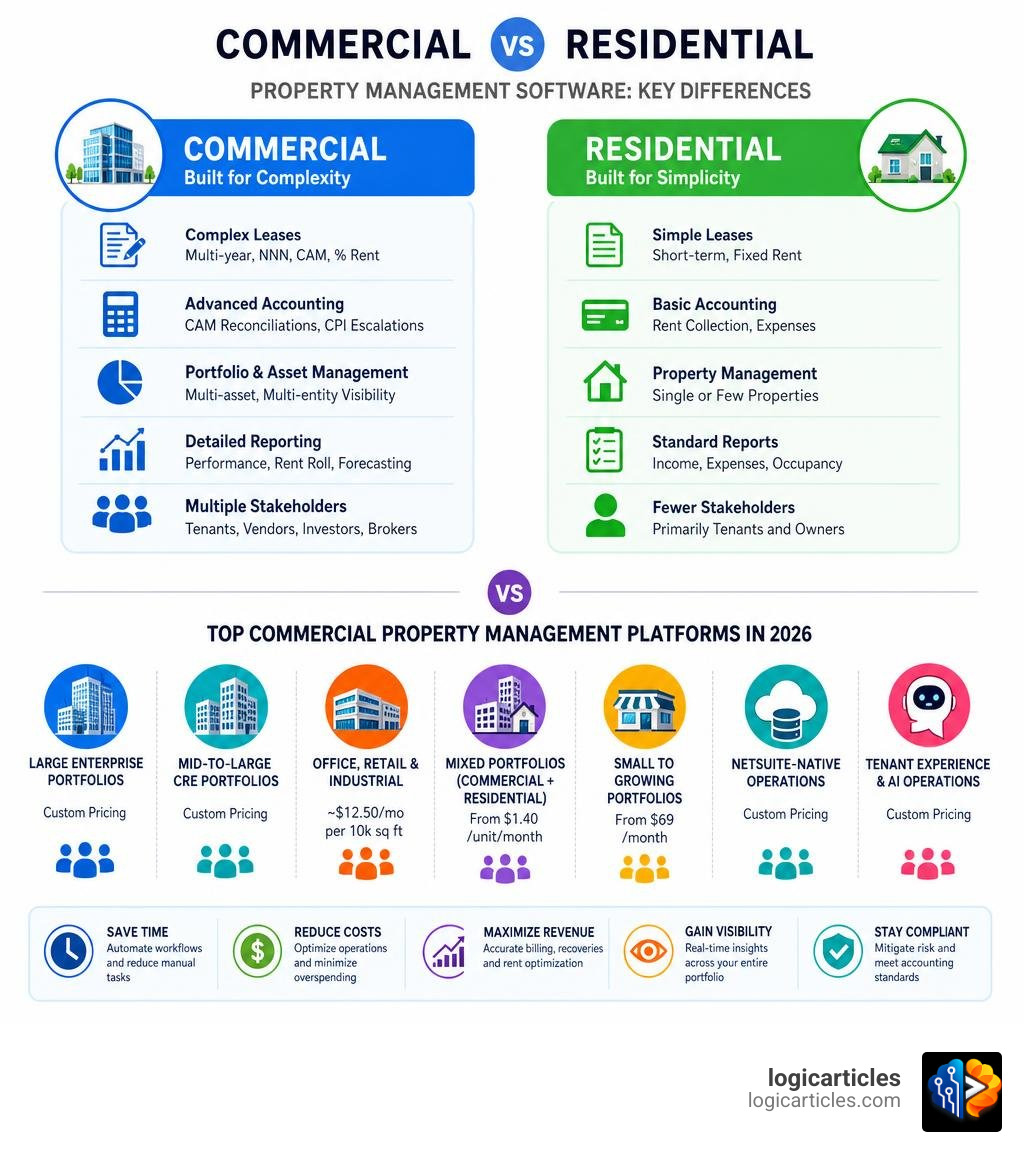
Here are the top commercial property management platforms in 2026:
| Platform | Best For | Starting Price |
|---|---|---|
| Yardi Voyager | Large enterprise portfolios | Custom pricing |
| MRI Software | Mid-to-large CRE portfolios | Custom pricing |
| RealPage Commercial | Office, retail & industrial | ~$12.50/mo per 10k sq ft |
| AppFolio | Mixed portfolios (commercial + residential) | From $1.40/unit/month |
| DoorLoop | Small to growing portfolios | From $69/month |
| Propertese | NetSuite-native operations | Custom pricing |
| Cove | Tenant experience & AI operations | Custom pricing |
Commercial real estate is not simple to manage. Unlike residential properties, commercial leases involve multi-year terms, triple-net (NNN) structures, CAM reconciliations, percentage rent clauses, and CPI-based escalations. A basic property management tool simply won’t cut it.
The numbers reflect how seriously the industry is taking this challenge. The global property management software market was worth $24.18 billion in 2024 and is projected to reach $52.21 billion by 2032 — a compound annual growth rate of 10.1%. Cloud-based solutions already account for 62.6% of that market.
Whether you manage a handful of office buildings or a diversified portfolio spanning retail, industrial, and mixed-use assets, the platform you choose will shape how efficiently your team operates every single day.
Understanding Commercial vs. Residential Property Management
To appreciate why you need dedicated commercial tools, we have to look closely at how commercial property management operates. Residential property management is highly standardized: tenants sign a twelve-month lease, pay a fixed monthly rent, and call the landlord when the sink leaks.
Commercial real estate (CRE) operations are a completely different animal. Commercial leases are highly customized legal documents spanning years, sometimes decades. They feature intricate financial agreements that dictate exactly who pays for what.
The Complexity of Commercial Leases
In the commercial sector, you rarely find two identical leases, even within the same building. Property managers must track:
- Triple Net (NNN) Leases: The tenant agrees to pay their share of the property’s ongoing operating expenses, including real estate taxes, building insurance, and common area maintenance (CAM).
- Percentage Rent: Common in retail environments, where tenants pay a base rent plus a percentage of their gross sales once a threshold is met.
- CPI Escalations: Rent adjustments tied directly to the Consumer Price Index to protect the owner’s yield against inflation.
Manually tracking these variables on a spreadsheet is a recipe for expensive errors and tenant disputes. This is why specialized tech is non-negotiable. If you are managing a diverse set of real estate investments, combining your property management with the best real estate portfolio management software in 2026 is the smartest way to stay ahead of the curve.
Key Differences in Lease Administration
The operational workflows of a commercial building also demand a unique approach. Because tenants are businesses rather than individuals, the stakes of maintenance and vendor management are much higher.
| Feature | Residential Property Management | Commercial Property Management |
|---|---|---|
| Average Lease Term | 1 Year | 3 to 15+ Years |
| Expense Recoveries | Gross leases (included in rent) | Net leases (NNN), CAM, and shared recoveries |
| Maintenance Scope | Standard HVAC, plumbing, cosmetic | Industrial systems, structural, complex vendor contracts |
| Rent Structures | Fixed monthly rate | Base rent, step-ups, CPI indexation, percentage rent |
| Legal Framework | Strong consumer/tenant protection laws | Contract-driven business-to-business agreements |
In a commercial setting, a broken elevator or a failed HVAC system in a retail anchor store can lead to lost business revenue and potential legal liabilities. Property managers must coordinate complex, recurring inspections and manage specialized third-party contractors. To keep this running smoothly, top-tier operators sync their property systems with the best contractor management software to ensure all vendor certificates of insurance (COI) are verified and work orders are completed on schedule.
Evaluating the Best Commercial Property Management SoftwareC
When searching for the best commercial property management softwareC, there is no single platform that fits every business. The right choice depends on your portfolio size, your primary asset classes (office, retail, industrial, or mixed-use), and your existing technology stack.
To help you navigate the landscape, we have broken down the market into three clear categories:
Enterprise-Grade Powerhouses
If you manage millions of square feet across multiple states or countries, you need a heavy-duty solution.
- Yardi Voyager: The absolute gold standard of the industry. It is designed for massive portfolios and offers unparalleled database depth. You can learn more about its core capabilities on the Commercial Real Estate Software | Voyager Platform page.
- MRI Software: Renowned for its open API architecture and flexibility. MRI manages over 4 million commercial leases worldwide and is heavily favored by teams who want to build a highly customized tech stack.
Mid-Market & Mixed Portfolio Leaders
For growing firms that manage a mix of commercial and residential units, or mid-sized commercial portfolios that want modern, user-friendly interfaces.
- RealPage Commercial: A robust, fully integrated system that excels at handling sophisticated lease structures, CAM recoveries, and detailed financial reporting. Discover how it unifies operations on the Commercial Property Management Software | RealPage | RealPage page.
- AppFolio: Excellent for operators who manage mixed portfolios and value an intuitive, clean interface. It simplifies CAM tracking and makes onboarding new team members incredibly fast.
Specialized & Agile Innovators
These platforms target specific operational niches, such as ERP integrations or advanced tenant experience.
- Propertese: A specialized, NetSuite-native application that eliminates the need for complex middleware integrations. You can explore how it unifies your financial ledger with your lease data on the Commercial Property Management Software – NS Propertese page.
- Cove: A modern, AI-powered platform designed to replace fragmented point solutions with a single operational system for owners, managers, and tenants. Check out their unified approach on the Unified Commercial Property Management Software | Cove page.
Core Features of the Best Commercial Property Management SoftwareC
To earn its spot in your tech stack, your commercial software must master several non-negotiable features.
1. Automated CAM Reconciliation
Common Area Maintenance (CAM) reconciliation is the bane of many property managers’ existence. The best commercial property management softwareC automates this entire lifecycle. The system should pull actual expenses directly from your general ledger, allocate them to tenants based on their exact square footage or custom lease rules, and auto-generate year-end “true-up” invoices. This saves hundreds of hours and virtually eliminates billing disputes.
2. Advanced Lease Administration
The platform must handle multi-year step-ups, CPI-based escalations, and percentage rent calculations. It should automatically alert your team to critical upcoming dates, such as renewal options, lease expirations, and insurance policy updates.
3. Self-Service Tenant Portals
Modern commercial tenants expect a B2B consumer-grade experience. A secure tenant portal allows businesses to pay rent online, submit and track detailed maintenance requests, log their monthly sales figures (for percentage rent), and access vital lease documents 24/7.
Advanced Financial and Operational Integrations
A commercial property is, at its heart, a complex financial asset. The software you choose cannot live in an operational silo; it must integrate deeply with your accounting systems.
For enterprise organizations, this means ensuring compliance with rigorous accounting standards such as GAAP and IFRS. Enterprise platforms like Yardi and MRI include full-featured, built-in accounting suites that handle general ledger allocations, recurring journal entries, and multi-entity consolidations.
If your organization manages construction projects, tenant improvements, or major capital expenditures (CAPEX), your property software should communicate directly with your financial planning systems. Linking your property workflows with the best construction financial management software ensures that capital improvements are tracked, depreciated, and budgeted accurately without manual double-entry.
Key Technology Trends Shaping Commercial Real Estate in 2026
The commercial real estate technology landscape is evolving at a breakneck pace in 2026. The shift toward cloud-based solutions is nearly complete, with cloud platforms capturing over 62% of the market. This shift has unlocked real-time data access, allowing property managers to monitor building health and portfolio performance from any device, anywhere.
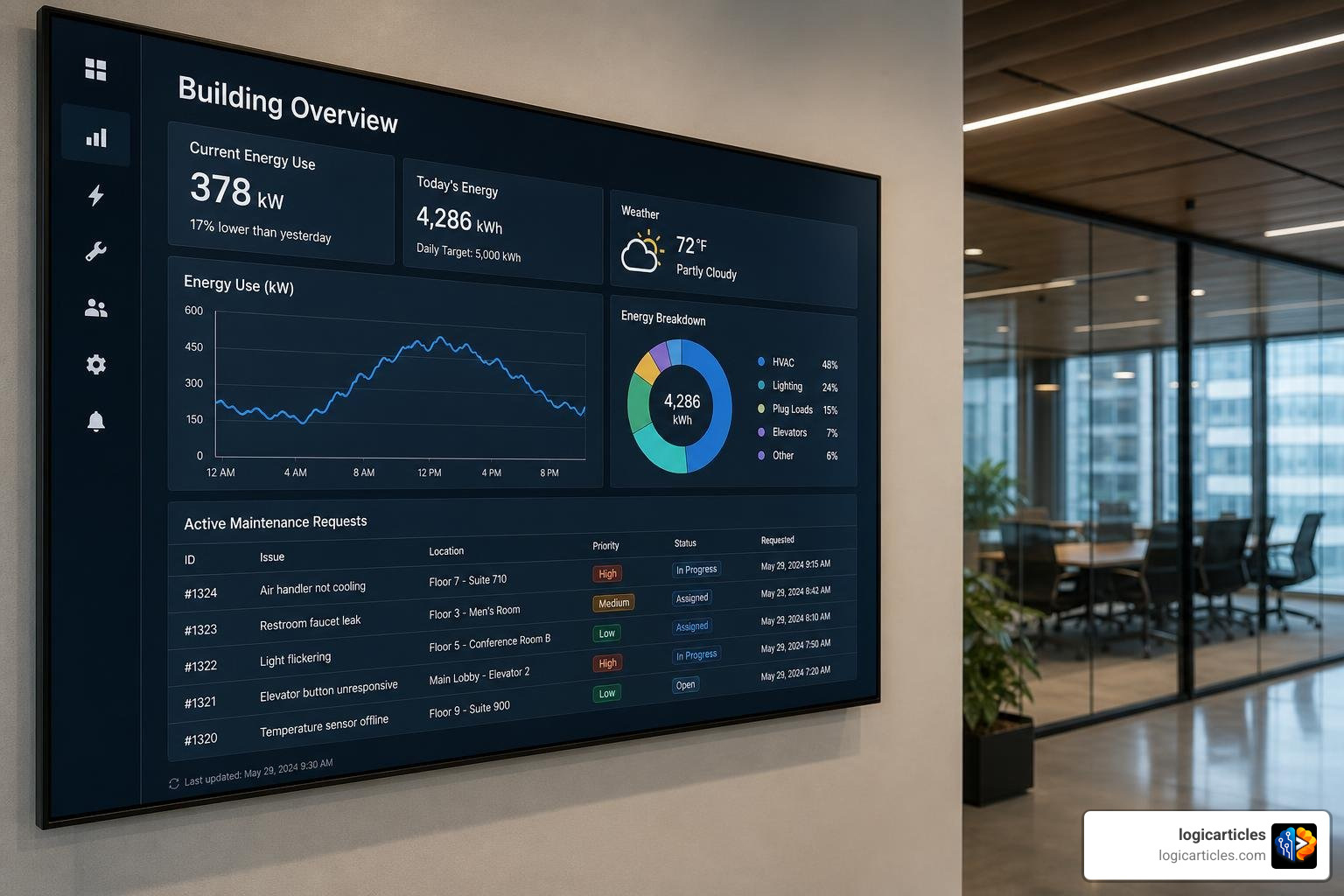
One of the most impactful trends in 2026 is the deep integration of the Internet of Things (IoT) into property management workflows. Smart buildings equipped with connected sensors can now feed real-time utility, HVAC, and occupancy data directly into your management software.
Instead of waiting for a tenant to complain that an office floor is freezing, smart sensors flag anomalies automatically. Your system can then generate a preventive maintenance work order instantly. To keep these rapid-fire tasks organized, modern teams rely on the best task management software in 2026 tested to assign, track, and close out engineering tickets before they escalate into costly emergency repairs.
AI and Automation in Modern Property Operations
Artificial intelligence has moved past the hype cycle and is now delivering real, measurable administrative savings for commercial operators.
AI is transforming everyday property management in several key areas:
- AI-Powered Lease Abstraction: Instead of paying analysts to read through a 100-page lease and manually enter terms into your database, AI engines can instantly read unstructured PDFs. They extract critical dates, rent schedules, and CAM rules with high accuracy, requiring only a quick human sign-off.
- Smart Communication Summaries: Platforms like Cove use built-in AI to turn endless tenant email threads into clear, actionable action items, saving property managers hours of administrative catch-up.
- Automated COI Verification: AI tools can scan incoming vendor Certificates of Insurance, extract the limits and expiration dates, compare them against building requirements, and flag deficiencies automatically.
How to Choose the Best Commercial Property Management SoftwareC for Your Portfolio
Selecting a platform is a long-term commitment. To make the right call, we recommend focusing on these four pillars:
- Scalability: Will this software support your growth if you double your square footage over the next three years? Look for platforms that offer modular add-ons, such as budgeting, forecasting, or construction management suites.
- Ease of Use: A system is only as good as its adoption rate. If the interface is overly complex, your property managers and engineers will slip back into using offline spreadsheets. Take advantage of free trials to test how many clicks it takes to perform common tasks, like creating a new lease or updating a work order.
- Data Security and Compliance: Commercial databases hold highly sensitive financial records, corporate lease agreements, and banking information. Ensure your vendor holds a SOC 2 Type II certification and offers robust role-based access permissions.
- Revenue and Yield Optimization: Ensure the software integrates with the best revenue management software in 2026 to help you analyze market rent trends, occupancy patterns, and optimal lease pricing structures.
Frequently Asked Questions about Commercial Property Management
What is CAM reconciliation and why is it important?
Common Area Maintenance (CAM) reconciliation is the process where landlords calculate the actual costs of operating and maintaining shared spaces (like lobbies, parking lots, hallways, and security) and bill them back to tenants based on their agreed lease terms. It is critical because it ensures the property owner recovers legitimate operating expenses, protecting the asset’s Net Operating Income (NOI).
How does lease abstraction help commercial property managers?
Lease abstraction uses technology (often powered by AI) to scan long, legally complex commercial lease agreements and extract key data points. This includes rent step-ups, renewal options, termination clauses, and maintenance responsibilities. It saves administrative teams up to 80% of their data-entry time and prevents missed critical deadlines.
Can commercial property software handle multi-entity portfolios?
Yes. Enterprise commercial software is built specifically to support complex multi-entity, multi-subsidiary, and multi-currency business structures. It allows organizations to run consolidated financial reports across their entire portfolio while keeping individual property ledgers legally and financially separate.
Conclusion
Finding the best commercial property management software isn’t about choosing the platform with the longest list of features. It is about finding the technology partner that aligns perfectly with your portfolio’s unique operational challenges.
By automating your lease administration, simplifying CAM reconciliations, and leveraging modern AI workflows, you can free your team from tedious administrative tasks. This allows them to focus on what truly matters: building strong tenant relationships, keeping assets in peak physical condition, and driving portfolio growth.
If you are ready to explore more top-tier software comparisons to elevate your business operations, check out our curated guides to the best software across the industry today.