The Growing Need for Contractor Management Software in 2026

Contractor management software has become one of the most critical tools for businesses that rely on independent workers, freelancers, or blended workforces — and the gap between companies that use it and those that don’t is widening fast.
Here’s a quick answer to what it is and why it matters:
Contractor management software is a dedicated platform that helps businesses onboard, schedule, pay, and maintain compliance for non-employee workers — all in one place, replacing scattered spreadsheets, emails, and manual processes.
At a glance — what it covers:
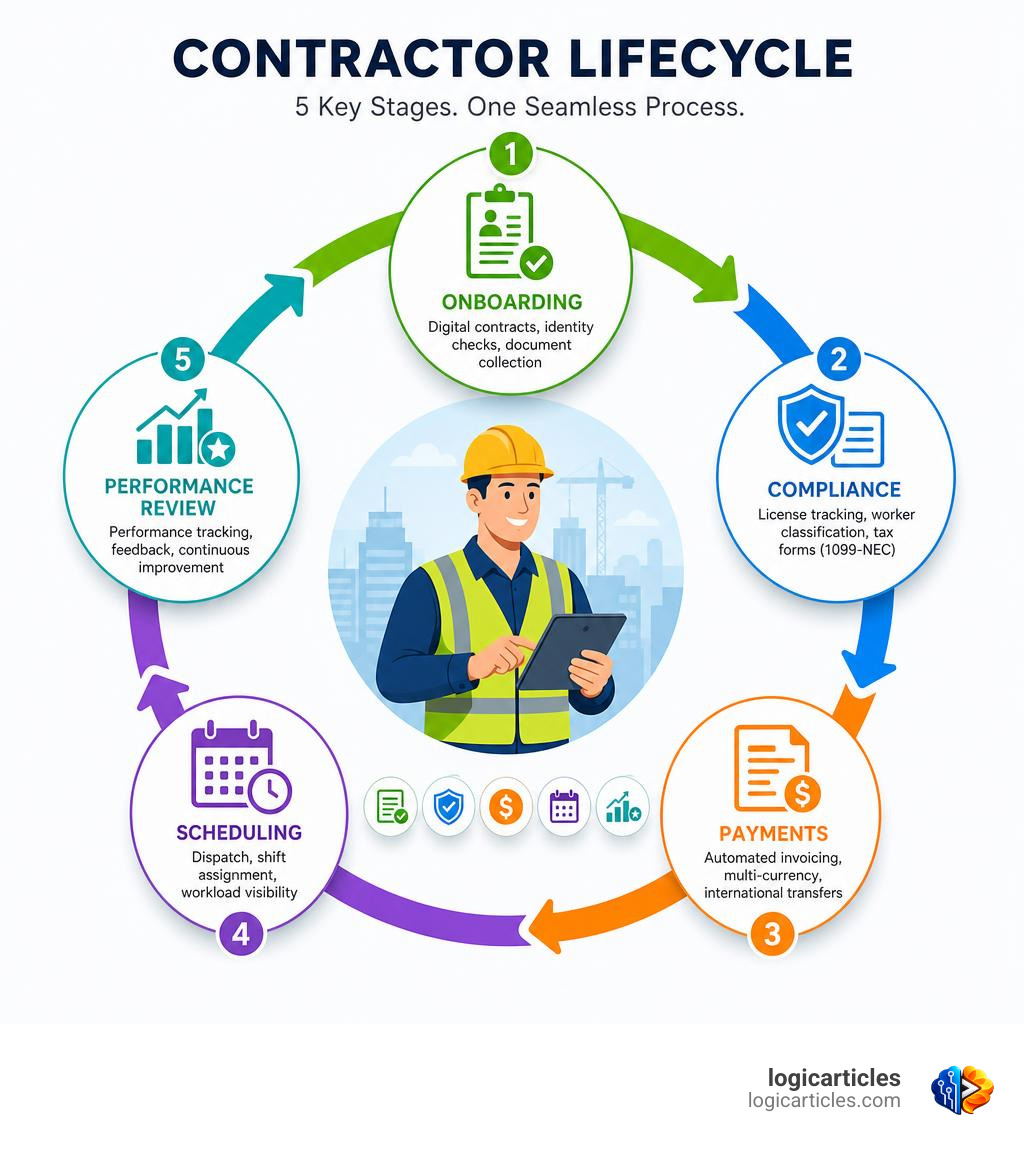
- Onboarding — digital contracts, identity checks, document collection
- Compliance — license tracking, worker classification, tax forms (1099-NEC)
- Payments — automated invoicing, multi-currency, international transfers
- Scheduling — dispatch, shift assignment, workload visibility
- Reporting — audit trails, performance tracking, spend analytics
The stakes are high. A recent MIT study found that 74% of professionals believe effective contractor management is critical to their success — yet only 30% feel prepared to actually do it. Most organizations are still stitching together spreadsheets, phone calls, and email threads to manage their external workforce.
That’s a costly gap.
With global AI-driven construction demand set to triple data center capacity requirements between 2025 and 2030, and investment in structures returning to growth in 2026, the pressure to coordinate large contractor workforces — quickly and compliantly — has never been greater.
This checklist-style guide breaks down everything you need to evaluate, select, and get the most out of a contractor management platform in 2026.
What is Contractor Management Software and Why Do You Need It?
When we look at how businesses manage their teams in 2026, the traditional distinction between “employees” and “external workers” has blurred. Companies increasingly rely on a blended workforce of full-time staff, freelancers, independent contractors, and specialized vendors to stay agile. However, managing this external ecosystem manually comes with significant administrative burdens and compliance risks.
If you are treating your independent contractors like standard W-2 employees in your workflows, you are stepping into a legal minefield. Worker classification is highly scrutinized by tax and labor authorities. Misclassifying an employee as a contractor can lead to severe financial penalties, back taxes, and legal disputes.
To manage this safely, businesses need automated guardrails. While you might use the Best HR Software for Small Businesses for your core internal team, or rely on the Best Task Management Software in 2026 Tested to coordinate daily deliverables, neither of these systems is designed to handle the complex, legally distinct requirements of non-employee talent.
Dedicated contractor management software steps in to solve these exact headaches. It automates document collection (like W-9s, W-8BENs, and certificates of insurance), tracks professional license expirations, and manages variable payment terms—all while keeping your business audit-ready.
How It Differs From Traditional HR and Payroll Tools
It is common to ask: Why can’t I just use my existing payroll or HRIS platform?
The short answer is that traditional HR and payroll tools are structurally built around standard employee-employer relationships. They are optimized for administering employee benefits, tracking standard payroll cycles, and managing internal career paths.
Contractors, on the other hand, are independent business entities. The operational math is fundamentally different:
- Variable Timelines: Contractors operate on project-based timelines, statements of work (SOWs), or milestone-driven deliverables rather than open-ended employment contracts.
- Invoicing vs. Payroll: Contractors submit invoices that must be matched against completed deliverables, whereas employees receive regular salaries or hourly wages.
- Tax Reporting: Instead of W-2 tax forms, contractors require 1099-NEC filings (in the US) or localized international tax reporting.
- No Direct Control: HR tools often track employee behavior, hours, and performance reviews in ways that, if applied to contractors, could legally signal an employer-employee relationship—triggering misclassification audits. Dedicated contractor tools keep a clear, compliant separation.
Core Features of Modern Contractor Management Software
When evaluating a platform, we recommend looking for these essential modules to ensure you are getting a complete solution:
- Self-Service Onboarding: Contractors should be able to upload their own credentials, sign localized agreements, and complete identity verification through customizable, automated workflows.
- Automated Compliance & Verification: Built-in verification tools that automatically check tax IDs, monitor expiration dates of licenses or liability insurance, and pause scheduling if a document lapses.
- Flexible Payment & Invoicing: Systems that can automatically generate invoices upon milestone approval, support multiple payment methods (ACH, wire, credit cards), and route payments globally.
- Scheduling & Dispatch: A unified dispatch console that allows managers to assign shifts, dispatch field workers, and track project milestones in real-time.
- Time Tracking & Job Costing: GPS-enabled or biometric time tracking that links contractor hours directly to specific project budgets for precise financial tracking.
Key Benefits of Centralizing Your External Workforce
Consolidating your external workforce into a single system of record dramatically improves administrative efficiency. Instead of toggling between multiple screens, your dispatchers, HR managers, and finance teams can view everyone in a single, unified dashboard.
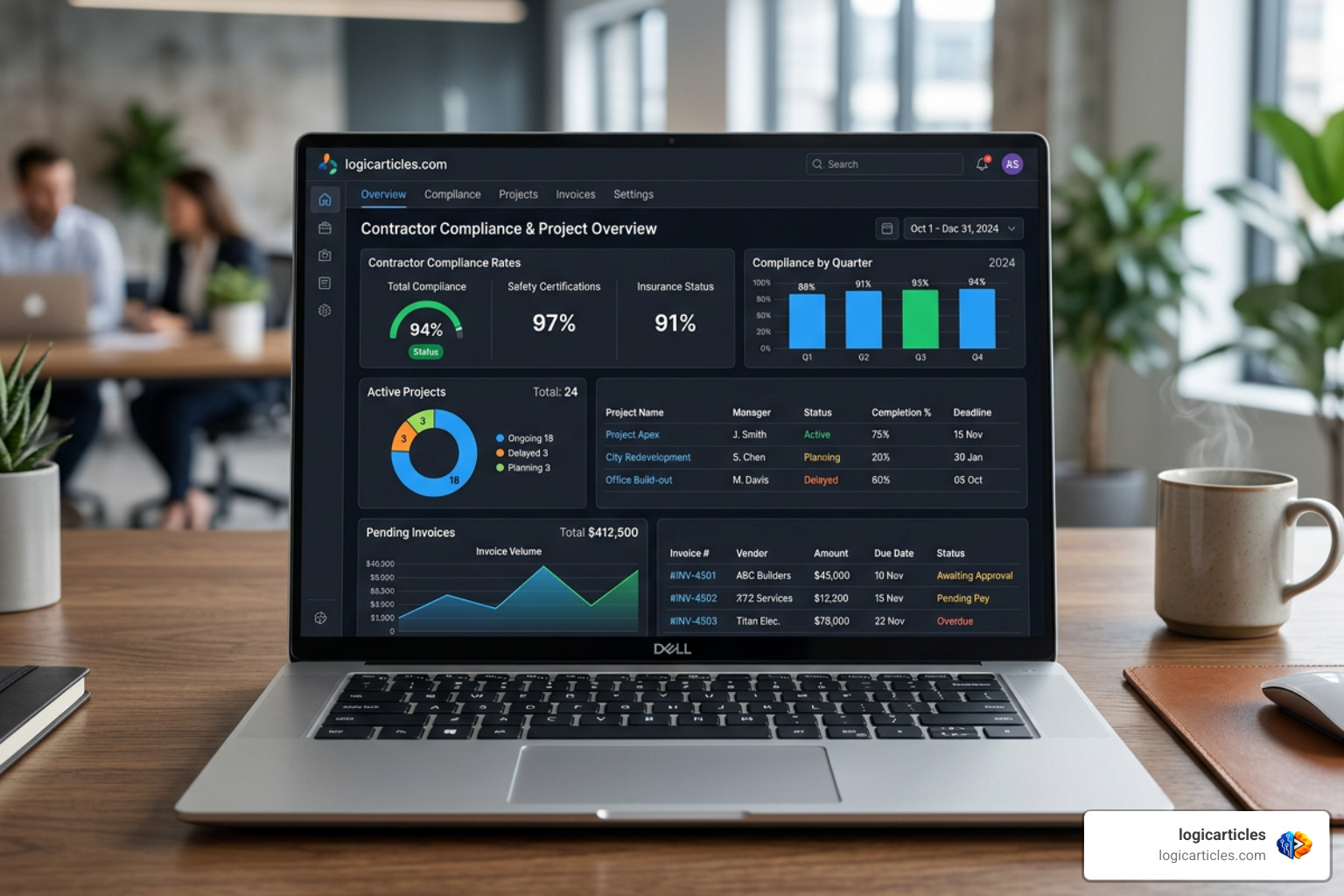
According to industry data, transitioning from manual processes to digital contractor management can increase compliance rates by up to 55% and reduce administrative costs by 25% to 30%. It also improves contract visibility, ensuring that your team always knows which vendors are active, what rates are agreed upon, and when renewals are due.
For businesses with field operations, combining centralized contractor dashboards with modern mobile tools is a game-changer. We’ve written extensively on how Mobile Workforce Management Software Features Benefits AI 2026 are revolutionizing field visibility, allowing off-site contractors to complete inductions, log hours, and report safety hazards directly from their smartphones.
Mitigating Compliance and Worker Misclassification Risks
Tax audits and misclassification lawsuits are incredibly costly. If a regulatory agency determines you have exercised too much behavioral or financial control over a contractor, they may reclassify them as an employee, demanding years of back taxes, unpaid benefits, and interest.
Contractor management software provides a vital layer of legal protection by maintaining a clear, auditable paper trail. The software ensures that:
- Customized, role-appropriate contracts are signed before work begins.
- 1099-NEC tax forms are generated and filed automatically at the end of the fiscal year.
- Work is structured around deliverables and milestones rather than employee-like schedules.
- Contractor insurance certificates (COIs) are continuously verified, protecting your business from liability.
Managing Global Contractors and International Payments
Hiring talent globally is easier than ever, but cross-border compliance is highly complex. Each country has its own labor laws, tax regulations, and required contract clauses.
Modern platforms solve this by offering:
- Localized Contracts: Automatically generating contracts that comply with the specific labor laws of over 150 jurisdictions, using tools like 38 Best Contractor Management Software Reviewed for 2026 to compare localized compliance features.
- Multi-Currency Payments: Allowing you to fund payments in your home currency while contractors withdraw funds in their local currency across 100+ countries.
- Global Tax Compliance: Collecting localized tax documents (such as W-8BEN forms) and managing international tax reporting requirements seamlessly.
For example, platforms like AI Contractor Management Platform | YunoJuno help businesses manage global freelance networks with built-in classification guardrails that automatically adjust based on the contractor’s location and role.
The Ultimate Selection Checklist for 2026
Choosing the right contractor management software requires balancing features, pricing models, and how well the tool integrates with your existing tech stack. Below is a quick comparison of the primary pricing models you will encounter in 2026:
| Pricing Model | Typical Cost Range | Best For | Key Features to Look For |
|---|---|---|---|
| Per-Contractor / Month | $8 – $99+ per active user | Growing businesses with fluctuating contractor counts | Pay-as-you-go flexibility, self-service portals, automated onboarding |
| Flat Monthly Base Fee | $49 – $199+ per month | Small to medium businesses (SMBs) with stable teams | Predictable budgeting, baseline integrations, core document storage |
| Transaction Percentage | 1% – 3% per payment run | High-volume payroll or global payment operations | Multi-currency payouts, automated invoicing, built-in tax filing |
| Enterprise Licensing | Custom annual contracts | Large organizations, construction, or EHS-heavy firms | Custom workflows, dedicated support, API access, advanced risk modeling |
Tip: Approximately 85% of professionals opt for a 30-day trial or a guided demo before purchasing contractor management software to test the platform with real-world workflows.
Essential Integrations with CRM, Accounting, and HRIS
A contractor management platform should never operate in a silo. To maximize efficiency, look for platforms that offer robust open APIs or native integrations with your core business software:
- Accounting Sync: Automatically sync approved contractor invoices with platforms like QuickBooks, Xero, or enterprise ERPs to ensure fast, accurate payments and prevent double data entry.
- CRM Integration: Connect field dispatch tools with customer relationship management platforms (like Salesforce or HubSpot) so that when a customer books a service, a qualified contractor is automatically recommended and assigned.
- HRIS Connection: Allow your HR team to view the entire blended workforce in one place by syncing contractor metadata directly to your core HR information system.
For those evaluating tools specifically for tracking and site access, resources like the Comparison of Top 5 Contractor Tracking Software Tools – Visitly can help you identify tools that integrate well with physical visitor and site management systems.
Evaluating Contractor Management Software for Safety and EHS
For industries like construction, manufacturing, utilities, and energy, managing contractor risk is just as important as managing their payments. Environmental Health and Safety (EHS) compliance requires rigorous oversight.

When safety is a priority, your software must go beyond basic document storage. Look for dedicated safety modules that offer:
- Risk-Based Prequalification: Scrutinizing contractors before they are hired based on their safety records, incident history, and industry accreditations.
- Digital Site Inductions: Allowing workers to complete safety training and read site rules on their mobile phones—even offline—before they arrive on-site.
- Digital Permit-to-Work: Automating the request, review, and approval of high-risk work permits.
- Incident Tracking & Performance Reviews: Standardizing how safety incidents, near-misses, and regular safety audits are logged and analyzed.
Platforms such as EHS&S Contractor Management Software | Evotix and Contractor Management Software | ecoPortal excel in this category by transforming complex safety compliance into simple, mobile-first workflows that protect workers and keep businesses audit-ready.
Industry Use Cases and Future Trends
The demand for specialized contractor software is skyrocketing across several major sectors:
- Construction & Infrastructure: Managing massive networks of subcontractors, tracking progress payments, and managing lien waivers.
- Field Services & Utilities: Dispatching technicians for HVAC, plumbing, or electrical work, where tracking real-time locations and certifications is critical.
- Global Tech & Marketing: Onboarding and paying freelance developers, designers, and writers across multiple countries and currencies.
A major driver of construction contractor activity in 2026 is the massive expansion of AI infrastructure. Global data center capacity demand is expected to triple between 2025 and 2030, requiring scaled contractor coordination for complex construction projects. Supported by these massive AI-related outlays, investment in structures has pivoted from a 2025 decline to modest growth of nearly 1.8% in 2026, making dedicated management tools essential for general contractors.
For those in the commercial and residential building sectors, platforms like Kontrak – Construction Business Management Software provide all-in-one estimation, scheduling, and project tracking. Similarly, platforms like Construction Management Software for General Contractors help automate AIA-style progress invoicing, lien waivers, and payment applications to keep complex projects on schedule.
To dive deeper into construction-specific financial tools, check out our guide on the Best Construction Financial Management Software.
Emerging Trends Shaping the Future of Contractor Platforms
As we move through 2026, several cutting-edge technologies are reshaping how software manages external workforces:
- Predictive Risk Modeling: Using AI to analyze millions of data points and rank contractors as standard, elevated, or high-risk based on leading safety indicators.
- Vision AI Document Verification: Utilizing advanced image recognition to instantly scan uploaded credentials and verify their authenticity and expiration dates, reducing manual admin review.
- Mobile-First Offline Access: Enabling field workers to complete safety checks, sign off on permits, and log hours on their mobile devices even when working in remote areas without cellular signal, syncing automatically once they reconnect.
- Intelligent Dispatching: AI-driven scheduling tools that automatically recommend the best contractor for a job based on their hourly rate, distance from the site, and historical performance scores.
Platforms like Contractor Management Software | Streamline Compliance & Safety and 15 Best Contractor Management Software: Scale Your Workforce are leading this charge, integrating collaborative tools and automated workflows directly into the daily lives of field workers.
Frequently Asked Questions about Contractor Management
What is the typical cost of contractor management systems?
Pricing varies based on your business size and requirements. For basic platforms, entry-level plans generally range from $8 to $99+ per contractor per month. Some platforms charge a flat monthly base fee (ranging from $49 to $199+) with optional add-ons, while others charge a small percentage per transaction for global payments. Many providers offer a 14-day or 30-day free trial to let you test the workflows before committing.
How does the software prevent worker misclassification?
The software acts as an automated compliance guardrail. It requires contractors to complete step-by-step classification questionnaires that assess the nature of their work. It then generates localized, legally vetted contracts tailored to their specific jurisdiction, ensuring that the relationship is clearly defined as independent from day one.
Can these platforms handle both domestic and international contractors?
Yes. Most modern contractor management platforms are designed for global workforces. They allow you to onboard domestic 1099 contractors alongside international freelancers, managing localized tax documentation, compliance checks, and cross-border currency exchanges within a single, unified system.
Conclusion
Managing an external workforce shouldn’t feel like a constant balancing act between administrative chaos and compliance risks. By implementing a dedicated contractor management software platform, your business can automate tedious onboarding tasks, secure payments, and maintain watertight compliance records.
Whether you are coordinating massive data center builds or scaling a global network of remote freelancers, centralizing your contractor operations is key to strategic scaling and long-term operational efficiency.
Ready to find the perfect tools to power your business growth? Explore the Best Software Categories at logicarticles to read our latest guides, software reviews, and exclusive tech deals.