Why Insurance Investment Accounting Software Is a Game-Changer for Insurers

Insurance investment accounting software is a specialized platform that helps insurers and asset managers track, value, and report on their investment portfolios — across multiple asset classes, currencies, and accounting standards — all in one place.
Quick answer: What does insurance investment accounting software do?
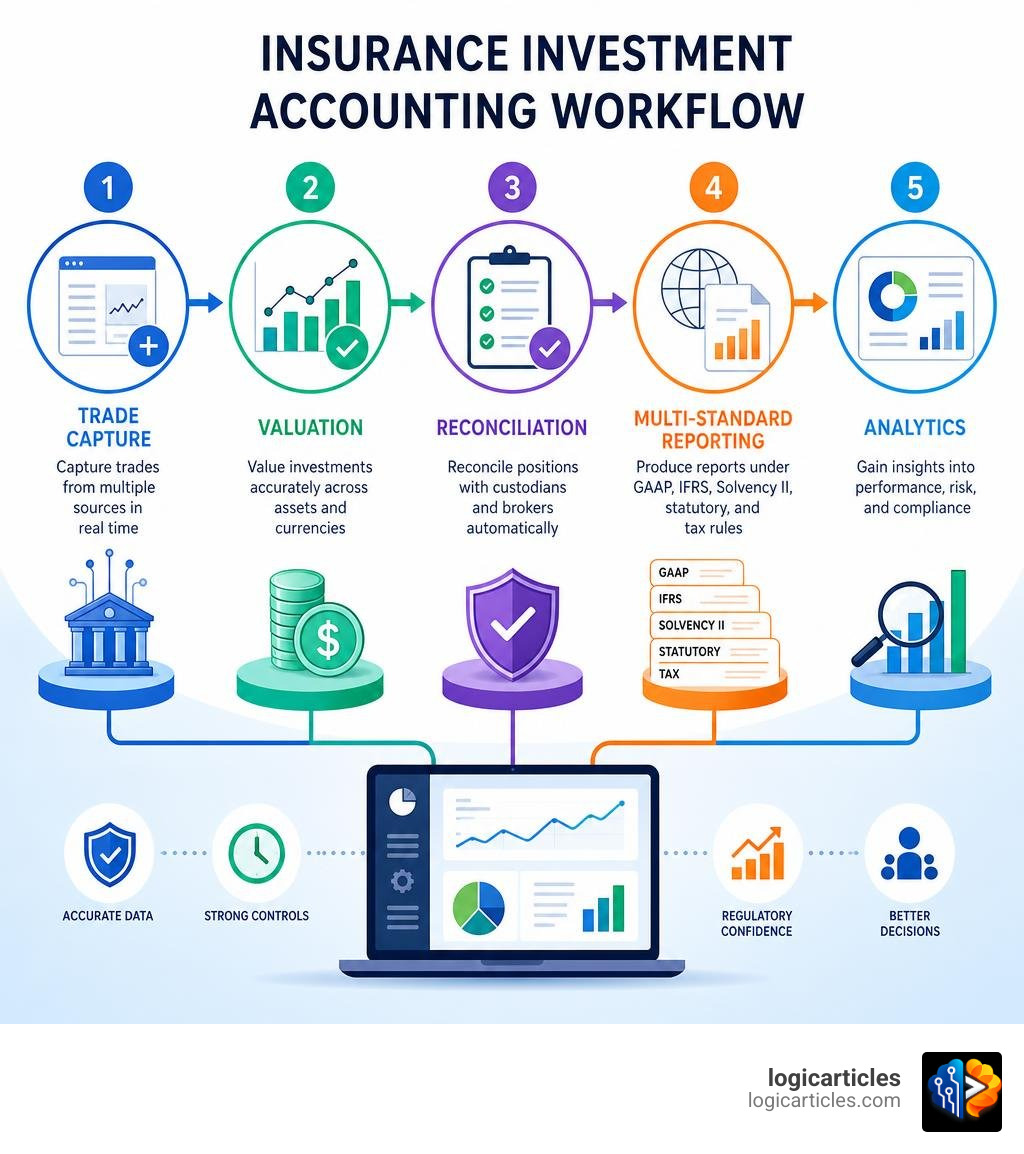
| Function | What It Means |
|---|---|
| Portfolio tracking | Records every transaction across all asset types in real time |
| Multi-standard accounting | Produces books under GAAP, IFRS, Solvency II, statutory, and tax rules simultaneously |
| Regulatory reporting | Automates filings and disclosures required by regulators |
| Reconciliation | Matches positions against custodians and brokers automatically |
| Analytics | Delivers performance, risk, and compliance reporting on demand |
Insurance companies hold enormous, complex investment portfolios. Managing them is not like running a standard accounting system.
Think about it: a single insurer might hold equities, derivatives, private loans, mortgages, and unit-linked products — all at once. Each asset class has different valuation rules. Each regulator wants different reports. And the numbers have to be exactly right, because errors can mean regulatory penalties or misreported capital positions.
That’s a lot to manage with spreadsheets. And yet, many finance teams still rely on them.
The stakes are high. As one finance director put it, the ability to get data into a system quickly and have reliable controls in place isn’t a nice-to-have — running the business.
Modern insurance investment accounting platforms solve this by centralizing the entire investment accounting lifecycle: from trade capture to valuation, reconciliation, regulatory reporting, and analytics.
The Evolution of Insurance Asset Management
The days of the simple “buy-and-hold” bond portfolio are long gone. In 2026, insurance asset management has evolved into a highly sophisticated operation. Historically, insurers could rely on stable, predictable fixed-income yields to match their long-term liabilities. However, years of shifting market dynamics, fluctuating interest rates, and inflation have forced insurance investment managers to diversify.
To achieve yield targets, modern insurance portfolios now include a complex mix of alternative assets: private equity, infrastructure debt, commercial mortgages, bank loans, and complex derivatives for hedging. While this diversification is excellent for returns, it creates a massive operational challenge for accounting teams.
At the same time, regulatory pressure has intensified globally. Insurers do not just report to one authority under a single set of rules. They must navigate a maze of multi-basis accounting requirements. A single transaction might need to be accounted for differently under US GAAP, International Financial Reporting Standards (IFRS 17), Solvency II, local statutory rules, and specific tax frameworks.
Keeping up with these changes manually is nearly impossible. This evolution is driving massive interest in modern Insurance Software Development to build and deploy platforms that can handle this multi-layered complexity without slowing down the business.
Why Modern Insurance Investment Accounting Software Is Critical
Without specialized software, insurance finance teams are forced to operate in silos. The front office uses an Order Management System (OMS) to trade, the middle office uses separate tools for risk analytics, and the back office struggles to reconcile the data into the general ledger.
This is where a modern insurance investment accounting software platform becomes critical. It establishes a single, real-time Investment Book of Record (IBOR). An IBOR acts as the definitive source of truth for all investment positions, updated continuously as trades occur.
With real-time valuation and embedded reconciliation, insurers gain absolute data integrity. They no longer have to wait days after the month-end close to understand their actual capital positions. Instead, they can make faster, more confident investment decisions backed by clean, audit-ready data. If you want to dive deeper into how these modern systems keep portfolios aligned, check out these modern investment accounting solutions.
Key Features of Insurance Investment Accounting Software
An enterprise-grade investment accounting platform must do far more than track debits and credits. It serves as the operational engine for the entire investment lifecycle.

Here are the core capabilities that leading platforms provide:
- Multi-Currency Support: Insurers investing globally must manage transactions, valuations, and foreign exchange (FX) conversions across dozens of currencies, applying configurable FX rules for different reporting bases.
- Automated Reconciliation: The system must automatically ingest data from custodians, brokers, and sub-ledgers, flag discrepancies, and resolve exceptions with minimal manual intervention.
- Transaction Tracking: Every event — from corporate actions and interest accruals to principal repayments — must be tracked at the lot level.
- General Ledger (GL) Integration: The platform should seamlessly post automated journal entries directly into your corporate ERP or general ledger system, preserving full data lineage.
Multi-Standard Accounting and Regulatory Compliance
One of the biggest headaches for insurance accountants is producing financial statements for different audiences. The board wants to see performance under GAAP or IFRS, regulators demand Solvency II or statutory filings, and tax authorities require a completely different set of calculations.
Modern platforms solve this by offering parallel processing. A single trade is entered once, and the software automatically generates the correct accounting entries for all required standards simultaneously.
For example, when evaluating own funds and capital adequacy, systems like Systemic’s RiskValue provide specialized modules to streamline these calculations. In fact, Systemic has completed over 30 implementations in XBRL reporting, enabling insurers to go live in as little as 8 to 10 weeks. To learn more about how these compliance engines operate, explore multi-standard accounting systems.
Complex Asset Class Processing
Traditional portfolio management tools often struggle with anything more complex than a standard stock or bond. But insurance portfolios are filled with complex instruments that require specialized calculations:
- Derivatives: Handling options, swaps, and futures requires real-time valuation, margin tracking, and hedge accounting capabilities.
- Private Assets & Bank Loans: These require tracking complex payment schedules, loan principal activity, and capital calls.
- Mortgages: Managing amortization schedules, prepayments, and escrow accounts requires a robust sub-ledger.
- Unit-Linked Products: Variable annuities and unit-linked funds require automated unit value pricing, trading, and specialized regulatory reporting.
Managing these complex assets requires the same level of precision found in the Best Family Office Accounting Software, where diverse, illiquid asset classes must be tracked alongside liquid portfolios.
Operational Efficiency Through Automation and Cloud Technology
The shift from legacy, on-premise systems to cloud-based Software as a Service (SaaS) is transforming insurance operations. In the past, upgrading an on-premise accounting system was a multi-year project fraught with risk. Today, SaaS platforms offer seamless, automatic updates that keep insurers compliant with the latest regulatory changes without interrupting daily operations.
Automation and machine learning are also playing a massive role. For instance, top-tier engines like FIS InvestOne process more than $25 trillion in assets across 24 countries, helping manage over 83,000 investment portfolios. Over 75% of their clients choose to access these tools via a hosted SaaS model because of the massive efficiency gains.
| Feature / Capability | Cloud SaaS Deployment | Traditional On-Premise |
|---|---|---|
| Upgrades & Maintenance | Automatic, continuous, and managed by the vendor | Manual, costly, and requires internal IT resources |
| Scalability | Instant; easily handles new portfolios and asset classes | Requires hardware procurement and setup |
| Data Accessibility | Real-time, web, and mobile access from anywhere | Often restricted to local corporate networks |
| Integration | Modern RESTful APIs for easy connection to third-party tools | Complex, custom-built batch file transfers |
Integration with Front- and Middle-Office Tools
No software platform exists in a vacuum. To maximize efficiency, your investment accounting system must integrate seamlessly with order management systems (OMS), execution management systems (EMS), and custodians.
For example, global custodians like Northern Trust manage massive insurance mandates — such as their partnership providing global custody and cash management for over $7 billion in Federated Mutual Insurance Company’s assets. When accounting software integrates directly with these custodians, trade confirmations, cash movements, and valuations flow back and forth automatically.
By utilizing open APIs, platforms like SS&C Singularity can connect directly to front-office tools to build a seamless pipeline, eliminating manual data entry and reducing operational risk. Discover how these integrations work by reading about automated accounting workflows.
Evaluation and Selection Criteria
Choosing the right partner for your insurance investment accounting is a decision that will impact your business for a decade or more. When evaluating providers, we recommend focusing on three core pillars:
- Asset Class Coverage: Does the software natively support your entire current portfolio, as well as the alternative assets you plan to add in the future?
- Regulatory Expertise: Does the vendor have a proven track rate of updating their software ahead of major regulatory shifts (like IFRS 17 or evolving Solvency II rules)?
- Implementation Timeline: Look for vendors with a structured, predictable onboarding process. While some enterprise installations can take a year, specialized modules can go live in a matter of weeks.
As you look to modernize your financial stack, it is also worth considering how your investment systems will talk to your broader revenue and billing platforms. For a wider look at enterprise financial tools, check out our guide on the Best Revenue Management Software in 2026.
Selecting the Right Insurance Investment Accounting Software
The best software is one that offers complete transparency and auditability. You need to be able to drill down into any journal entry to see the exact market data, transaction details, and accounting rules that generated it. This concept of “data lineage” is crucial for satisfying both internal auditors and external regulators.
Platforms like the FIS Insurance Accounting Suite excel here by providing a central repository of financial data, giving teams real-time access to both aggregated and highly detailed views of the business. You can explore how these enterprise suites tie everything together by visiting their page on comprehensive accounting suites.
Frequently Asked Questions about Insurance Investment Accounting
What is the difference between IBOR and MBOR?
An IBOR (Investment Book of Record) provides a single, real-time view of your active investment positions, typically focused on trade-date positions to help front-office managers make immediate decisions.
An MBOR (Multiple Books of Record) takes this a step further by allowing an organization to maintain up to 10 or more parallel, real-time views of the same portfolio. This means you can view your portfolio simultaneously through the lens of local GAAP, statutory accounting, tax values, and historic cost bases without duplicating data or creating separate spreadsheets. For a deeper look at how leading platforms manage these parallel books of record, read about real-time investment accounting.
How does the software handle IFRS 17 compliance?
IFRS 17 requires insurers to report financial data with absolute consistency, linking actuarial cash flow projections directly to accounting ledgers. Modern software handles this by acting as a unified bridge. It ingests actuarial results, automatically generates the necessary journal entries, and formats the required disclosures without manual intervention.
This eliminates the risk of inconsistencies between your actuarial models and your final financial statements. To see how specialized tools automate these rules-based calculations, explore integrated insurance accounting.
Why are spreadsheets risky for insurance investment accounting?
While spreadsheets are incredibly flexible, they lack the basic controls required for institutional investment accounting. They do not have automated audit trails, they are highly prone to manual copy-paste errors, and they struggle to scale when managing complex assets like derivatives or private loans.
Relying on spreadsheets creates “key person risk” (where only one person understands how a complex workbook is built) and leaves your firm vulnerable to costly reporting errors. Just as modern retail businesses have abandoned manual pricing for automated systems, insurers must move away from manual tracking. Learn more about the benefits of automation in our review of the Best Price Optimization Software.
Conclusion

As we navigate 2026, the complexity of insurance portfolios and the demands of global regulators will only continue to grow. Relying on legacy systems or manual workarounds is no longer a viable strategy for insurers who want to remain competitive.
By implementing a modern, cloud-based insurance investment accounting software platform, we can help our organizations automate tedious reconciliation tasks, support complex new asset classes, and generate multi-basis financial reports with the click of a button.
Investing in the right technology isn’t just about saving time in the back office — it’s about future-proofing your business, protecting your capital, and giving your investment teams the real-time insights they need to win.
Ready to optimize your business operations and explore more ways to drive efficiency? Explore our productivity software resources to find the tools and strategies that will take your team to the next level.