The Best DocuSign Alternatives in 2026 (Quick Answer)

The best DocuSign alternatives in 2026 offer more generous limits, lower prices, and — in many cases — unlimited e-signatures at a fraction of what DocuSign charges.
Here’s a quick overview to match you with the right tool:
| Tool | Best For | Starting Price |
|---|---|---|
| SignNow | Teams needing unlimited templates | $8/user/month |
| Dropbox Sign | Unlimited signature requests | $15/user/month |
| PandaDoc | Sales teams and document creation | $19/user/month |
| BoldSign | Growing businesses, best value | $15/user/month |
| OpenSign | Unlimited free cloud signatures | Free |
| DocuSeal | Developers and self-hosters | Free / open source |
| Inkless | Truly unlimited free PDF sends | Free |
| GoSign | Flat-rate unlimited envelopes | $9/month |
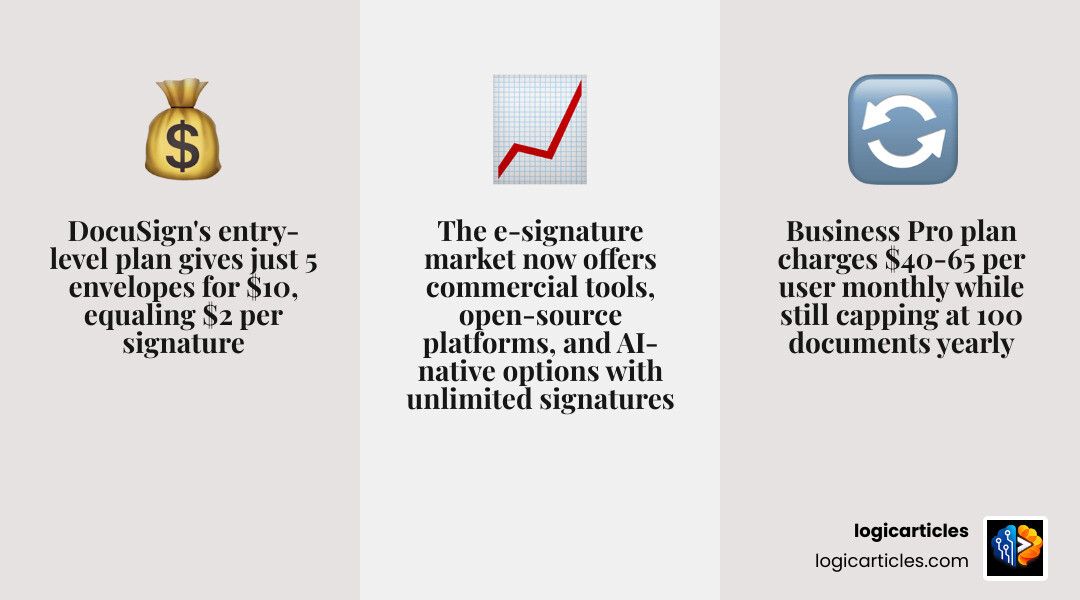
DocuSign’s Personal plan gives you just five envelopes per month for $10 — that’s $2 per signature. For a team closing ten or more deals a month, the math stops working fast.
The good news: the e-signature market has matured well beyond DocuSign’s dominance. You now have commercial tools, open-source platforms, and even AI-native options to choose from.
This guide covers the best alternatives across every use case — from solo freelancers to enterprise teams.
Why Businesses Are Switching to DocuSign Alternatives
While DocuSign remains the household name in electronic signatures, we are seeing a massive shift as businesses look for more flexible options. The primary driver? Pricing fatigue. DocuSign’s entry-level plans restrict you to incredibly low envelope counts, while its Business Pro plan costs $40 to $65 per user monthly and still caps standard accounts at 100 documents per year.
This “per-seat tax” combined with strict envelope limits creates constant anxiety for growing teams. If you run a high-volume business, hitting those limits means facing steep overage fees or being forced into expensive enterprise negotiations.
Furthermore, many teams do not just want to sign a static PDF; they want to build e-signatures directly into their broader software stack. When you are looking for the best startup growth tools for 2026, you need software that plays nicely with your entire ecosystem without locking your data behind paywalls.
Independent market reports, such as the comprehensive breakdown of DocuSign alternatives in 2026, show that newer competitors consistently score higher on ease of use and overall value. By moving away from legacy vendors, businesses can access modern features like automated document generation, native payment gateways, and self-hosted privacy controls without the premium price tag.
Top Commercial and Open-Source E-Signature Solutions

To help you find the perfect fit, we have broken down the top commercial and open-source platforms. Each of these tools addresses a specific gap left by DocuSign’s traditional pricing and feature structure.
Dropbox Sign and SignNow: Best for High-Volume Teams
If your team sends dozens of contracts, NDAs, or offer letters weekly, you need a platform that does not penalize your growth.
- SignNow is highly regarded as one of the most cost-effective options for collaborative teams. Its Business plan costs just $8 per user monthly (billed annually) and provides unlimited templates and workflow automation. If you are already managing customer relationships through a project management CRM software, SignNow integrates smoothly to trigger signing requests automatically when a deal changes stages.
- Dropbox Sign (formerly HelloSign) is another heavy hitter. Its Essentials plan starts at $15 per user monthly (billed annually) and provides unlimited signature requests. This is a massive upgrade from DocuSign’s lower tiers, allowing teams to send documents freely without keeping a nervous eye on an envelope counter.
PandaDoc and BoldSign: Best for Sales Workflows
For sales teams, a contract is not just a form to sign — it is the culmination of a relationship. You need proposal builders, interactive pricing tables, and CRM integrations.
- PandaDoc is a complete document-generation powerhouse. Its Starter plan is $19 per user monthly and comes with unlimited e-signatures. If you want to move away from boring, static PDFs, PandaDoc acts as some of the best content software on the market, allowing you to build beautiful, media-rich proposals that clients can sign right in their web browsers.
- BoldSign offers incredible value for growing companies. At $15 per user monthly for its Business plan, it matches DocuSign’s Business Pro features — including custom branding, bulk sending, and complex signing orders — at roughly one-third of the cost.
OpenSign and DocuSeal: Free Open-Source DocuSign Alternatives
For organizations that prioritize data sovereignty, developer flexibility, or zero recurring software fees, open-source is the way to go.
- OpenSign is a highly secure, open-source PDF e-signature solution. It offers unlimited free cloud signatures on its basic tier, making it an exceptional option for startups and individuals. Because it is open-source, you can easily inspect the code or contribute to its growing GitHub repository.
- DocuSeal has quickly become a favorite in the developer community, with over 177,500 businesses and individuals adopting it. It offers a fully featured, legally binding signing experience that supports PDF, DOCX, and even ZIP files up to 100MB. With native webhooks, a robust REST API, and pre-built SDKs, developers can embed signing forms directly into their web or mobile apps.
GoSign: Flat-Rate and Self-Hosted DocuSign Alternatives
If you want the convenience of a polished SaaS platform but hate the per-user subscription model, flat-rate tools offer a refreshing middle ground.
- GoSign operates on a simple philosophy: stop counting envelopes and stop paying a per-seat tax. They offer a DocuSign alternative with flat pricing that allows you to send unlimited documents for a flat annual rate. With plans starting at $9 per month (and a generous free tier of 10 envelopes per month), GoSign lets you host your signing workflows in the cloud or self-host the platform entirely on your own private cloud (AWS, GCP, or private servers), giving you absolute control over your documents.
Next-Gen Security: Blockchain Audits and AI-Native Signing

As electronic fraud and phishing attempts grow more sophisticated, the e-signature landscape is evolving beyond simple digital scribbles on a PDF. Next-generation platforms are leveraging blockchain technology and artificial intelligence to provide unassailable proof of security.
For teams looking for advanced security, Chaindoc stands out as an exceptional SignNow alternative with KYC, payments, and blockchain verification. Instead of relying on a standard PDF audit log that could theoretically be altered, Chaindoc anchors a SHA-256 hash of your completed document directly onto a public blockchain. This creates a permanent, tamper-proof record that any court of law can verify independently.
Chaindoc also serves as a brilliant Adobe Sign alternative because it completely bypasses the Acrobat ecosystem lock-in and the frustrating 150-transaction-per-user annual cap. It uses a flexible pay-per-signature model rather than charging you for inactive user seats, and it natively integrates Stripe, crypto payments, and identity verification (KYC) directly into the signing workflow.
On the AI front, SignForge is pioneering the space as an AI-native e-signature alternative. It features an AI assistant named Amanda that can draft 12+ legal document types from simple natural language prompts and automatically place signature fields where they belong.
More importantly, SignForge uses open W3C Verifiable Credentials and public Merkle transparency logs. This allows you to verify signed documents offline at any time without needing to contact the platform’s servers, ensuring your contracts remain secure, verifiable, and portable forever.
Frequently Asked Questions About DocuSign Alternatives
When you are looking for the right startup tools to scale fast in 2026, making the switch to a new e-signature provider can raise a few practical questions. Here are the answers to the most common queries we receive.
Which DocuSign alternatives offer truly unlimited free e-signatures?
If you want to sign documents without paying a dime, you have a few excellent options:
- Inkless is one of the very few platforms offering truly unlimited free PDF sends with absolutely no usage caps, watermarks, or credit cards required.
- OpenSign offers unlimited free cloud signatures with basic features, and you can self-host its open-source version for unlimited team collaboration.
- DocuSeal is completely free to self-host on your own infrastructure, allowing you to run unlimited signing workflows for an unlimited number of users.
Are self-hosted e-signature platforms legally binding?
Yes, absolutely. Self-hosted platforms like DocuSeal and GoSign generate electronic signatures that are fully compliant with major international frameworks, including the ESIGN Act and UETA in the United States, as well as eIDAS regulations in Europe (covering SES, AES, and QES standards).
The key to legal compliance is not where the software is hosted, but whether it maintains a secure, tamper-evident audit trail that records the signer’s IP address, email verification, timestamp, and document hash. If you do not want to handle the server setup yourself, services like eSignSetup will deploy a fully compliant, self-hosted DocuSeal instance for a one-time fee of $149, giving you complete ownership of your signing portal on a private VPS (which costs as little as $5 to $9 per month on Hetzner).
What are the hidden costs of switching from DocuSign?
While switching will almost certainly save you money, you should keep an eye out for three potential hidden costs:
- API Overage Fees: If you integrate signatures into your custom apps, check the API pricing. Some tools limit free API calls and charge high rates for extra envelopes.
- Template Limitations: Lower-tier plans on some commercial platforms cap the number of active templates you can save, forcing you to upgrade if you manage a wide variety of contracts.
- Self-Hosting Maintenance: While self-hosting eliminates software subscription costs, you must factor in the minor monthly cost of your virtual private server (VPS) and the occasional developer resources needed to update the software.
Conclusion
Finding the right DocuSign alternatives in 2026 comes down to understanding your team’s unique workflow. If you want a direct, cost-effective SaaS replacement, platforms like SignNow and BoldSign offer incredible value. If you need a powerful sales proposal engine, PandaDoc is tough to beat. For developers and privacy-conscious organizations, open-source solutions like DocuSeal or flat-rate options like GoSign provide unmatched control.
Optimizing your document signing workflow is just one step in building a highly productive business. We encourage you to check out our hands-on review of the best task management software in 2026 tested to keep your team running smoothly.
Ready to take your business productivity to the next level? Explore more productivity guides on LogicArticles to streamline your operations and scale fast this year!