Cloud Costs Are Out of Control — Here’s What Actually Helps

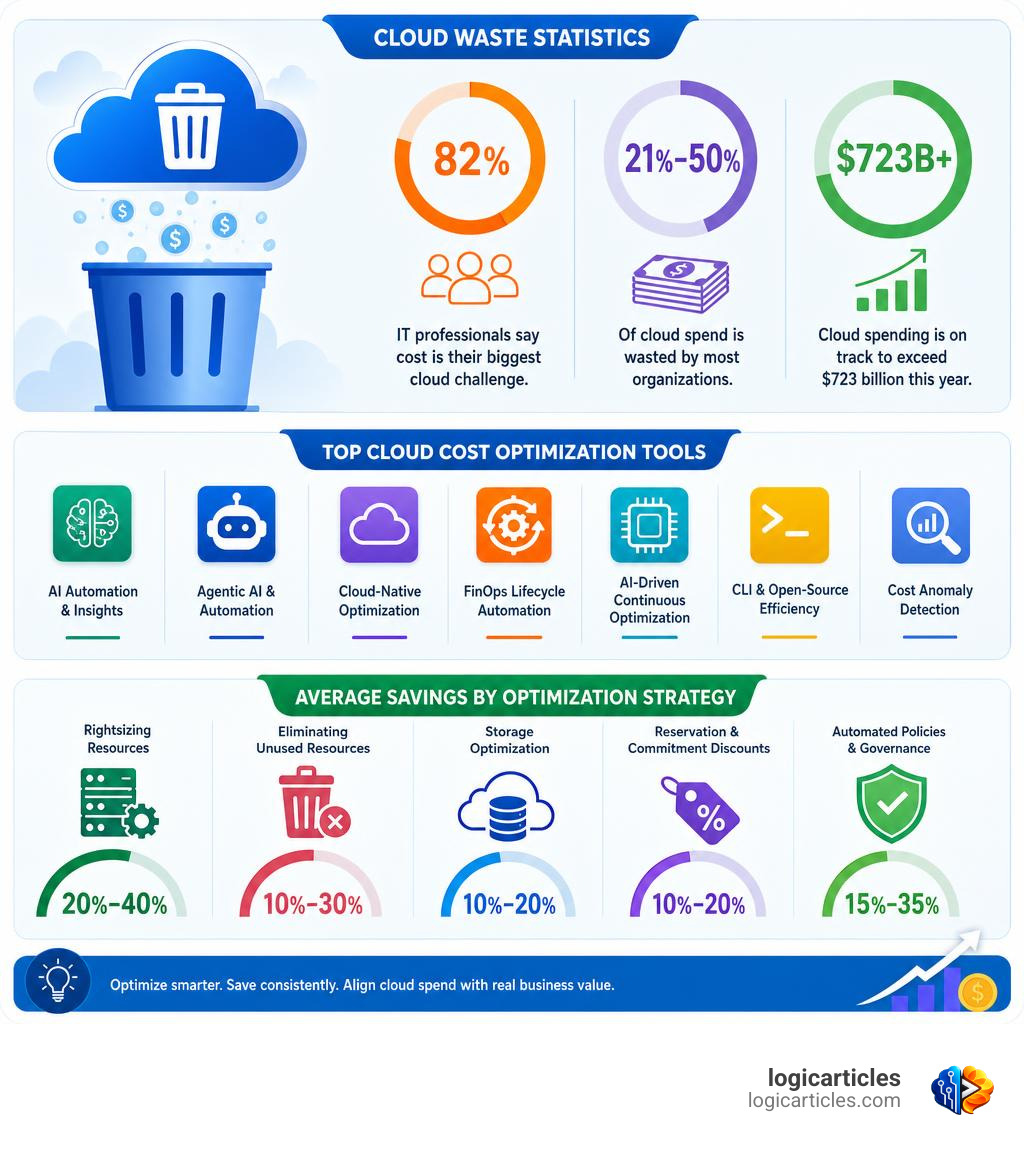
The best cloud cost optimization tools in 2026 can cut your cloud waste by 20–50%, often paying for themselves within months. Here’s a quick overview of the top picks:
| Tool | Best For | Key Strength |
|---|---|---|
| Cloudchipr | Multi-cloud teams | AI automation, $180k/mo avg savings |
| CostSage | Engineering teams | Agentic AI, one-click approvals |
| Ternary | GCP-heavy orgs | Purpose-built for Google Cloud |
| nOps | AWS teams | FinOps lifecycle automation |
| IBM Turbonomic | Enterprise hybrid cloud | AI-driven continuous optimization |
| Cloud-Cost-CLI | Developers / DevOps | Free, open-source, CI/CD-friendly |
| Ghosthunter | Cost spike investigation | Read-only, privacy-first AI analysis |
Cloud spending is on track to exceed $723 billion this year. Yet 82% of IT professionals say cost is their biggest cloud headache — and most organizations waste somewhere between 21% and 50% of what they spend.
That’s not a small rounding error. That’s a massive budget leak.
The problem isn’t that cloud is expensive by nature. It’s that cloud bills grow fast, spread across multiple providers, and become almost impossible to understand without the right tools. Unused resources pile up. Teams overprovision. Nobody owns the bill.
Cloud cost optimization is about more than cutting costs — it’s about aligning what you spend with what actually delivers business value.
That’s where cloud cost optimization tools come in. They give you visibility, automate cleanup, flag anomalies, and help finance and engineering teams finally speak the same language.
This guide covers the best options available right now — from enterprise FinOps platforms to free open-source CLI tools — so you can find the right fit for your team’s size, stack, and budget.
Understanding Cloud Cost Optimization and Key Features
To truly master your cloud budget, we must first understand what cloud financial management (CFM) or FinOps actually entails. According to Gartner, CFM tools collect, organize, display, optimize, and manage investments in cloud infrastructure (IaaS and PaaS). They leverage algorithms, statistical models, and AI/ML to turn millions of chaotic billing line items into actionable, human-readable dashboards.
But what makes a cloud cost tool actually useful? If you are evaluating platforms, we recommend looking for these mandatory features:
1. Cost Allocation and Tagging Compliance
If you don’t know who is spending what, you can’t optimize anything. The best platforms allow you to allocate costs dynamically by team, product, environment, or microservice. They also enforce tagging policies, flagging “untagged” or “mislabeled” resources so you can maintain strict cost hygiene. This is highly comparable to how modern financial teams use the Best CFO Software Tools for Small Business to categorize operational expenses.
2. Anomaly Detection and Incident Alerts
Waiting for the end-of-month invoice to discover a runaway database script is a recipe for a heart attack. You need near real-time anomaly detection that monitors daily billing exports and alerts your team via Slack, Teams, or email when spending spikes unexpectedly.
3. Automated Rightsizing and Idle Resource Detection
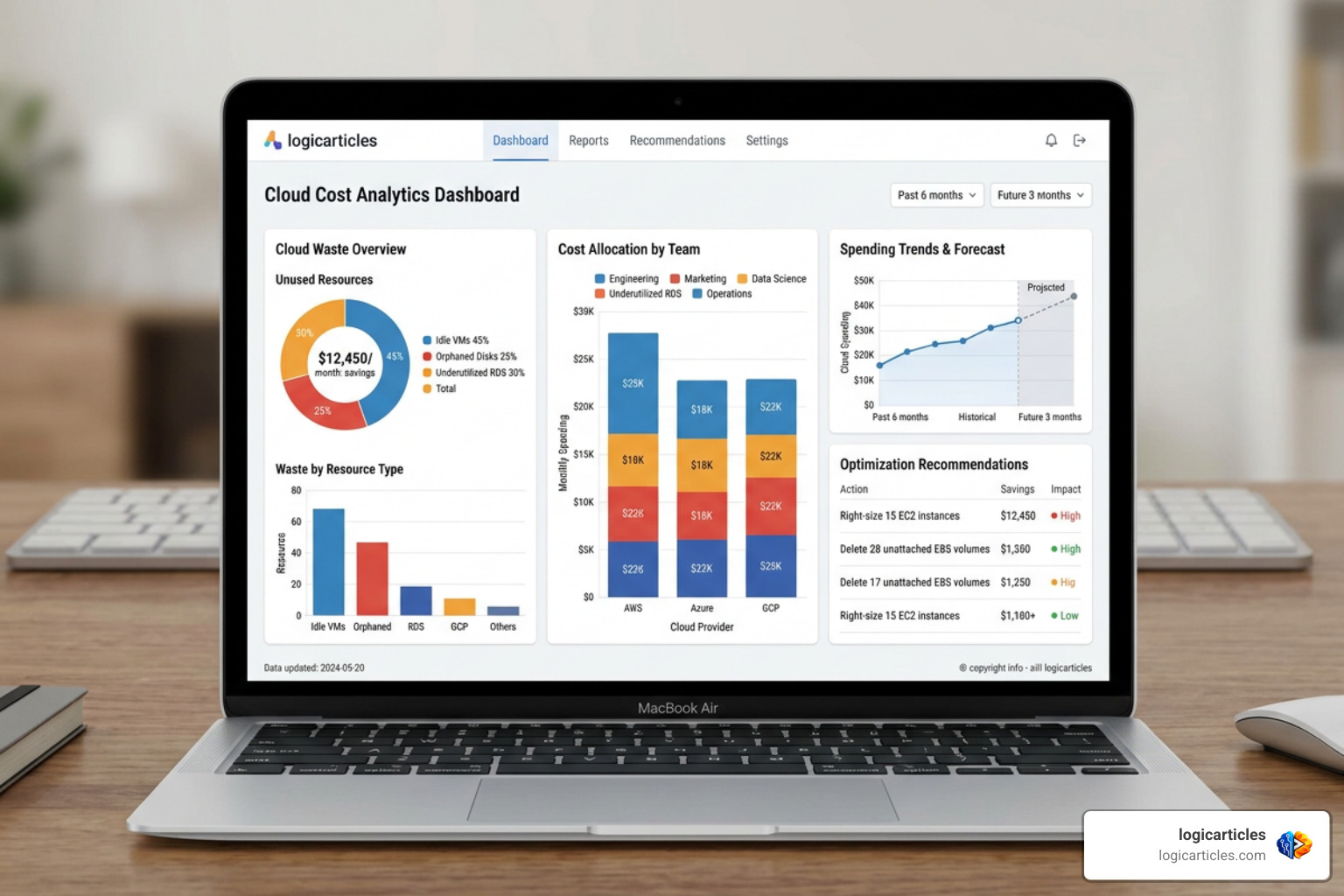
Do you have virtual machines running at 5% CPU utilization? Or “zombie” storage volumes detached from deleted servers but still racking up monthly fees? Optimization tools continuously scan your environment to recommend downsizing or terminating these resources.
4. Unit Economics and Business Alignment
Advanced FinOps practices go beyond simple cost-cutting. They calculate unit economics—such as cost per active user, cost per API transaction, or cost per customer. By feeding cloud spend data into the Best Big Data Analytics Tools in 2026 Ranked by Performance, organizations can correlate infrastructure costs directly with business revenue and growth cycles.
Native vs. Third-Party Best Cloud Cost Optimization Tools
Every major cloud provider offers its own built-in billing tools. AWS has Cost Explorer, Microsoft Azure provides Azure Cost Management, and Google Cloud offers Google Cloud Billing.
While these native tools are free and highly integrated, they often fall short for complex, modern architectures. Let’s compare native tools against third-party optimization platforms:
| Metric / Capability | Native Cloud Provider Tools | Third-Party FinOps Platforms |
|---|---|---|
| Cost | Free (or very low cost) | Subscription or savings-percentage based |
| Multi-Cloud Support | Extremely limited or non-existent | Excellent (unifies AWS, Azure, GCP, OCI) |
| Kubernetes Granularity | Poor (often struggles with pod-level costs) | Deep container, GKE, and EKS analysis |
| Automation Capabilities | Manual execution of recommendations | Autonomous workflows and auto-remediation |
| UX & Dashboarding | Functional but complex and siloed | Highly customizable, executive-ready |
| Data Update Frequency | Delayed (often 4 to 24+ hours) | Near real-time via event monitoring |
The Pros and Cons of Native Tools
Native tools are fantastic for single-cloud deployments and basic budgeting. They have deep, direct access to the provider’s underlying infrastructure and contract discounts. However, they lack a unified pane of glass. If your company runs on AWS but uses Google BigQuery for analytics, your finance team has to play “billing translator” between two entirely different invoice formats.
The Value of Third-Party Solutions
Third-party platforms normalize billing data across multiple clouds, mapping disparate terms into a single, standardized framework like FOCUS (FinOps Open Cost & Usage Specification). According to industry research on 10 Cloud Cost Optimization Tools That Actually Reduce the Bill, organizations can save an average of 22% simply by moving from native tools to a dedicated third-party FinOps platform that automates resource cleanup.
Top Cloud Cost Optimization Tools in 2026
The cloud cost management market has evolved rapidly. We are no longer in the era of passive dashboards that simply show you a graph of your spending. In 2026, the trend is heavily focused on agentic AI (autonomous systems that execute savings on your behalf) and deep engineering workflow integrations.
When searching for the best cloud cost optimization tools, you must consider how your team operates. Do you want a hands-off automated platform, a highly secure read-only investigator, or a developer-friendly command-line tool?
Let’s look at the top-performing platforms in detail, drawing insights from industry reviews like the 30+ Best Cloud Cost Management Tools In 2026 – nOps and the comprehensive 19 Best Cloud Cost Optimization Tools (2026 Comparison).
Why Cloudchipr is One of the Best Cloud Cost Optimization Tools
For organizations seeking a balance between deep visibility and automated execution, Cloudchipr | The #1 Actionable FinOps Platform has established itself as an industry leader. It speaks the language of engineering, finance, and leadership alike, helping teams reduce cloud and AI waste through a unified dashboard.
Key Features and Highlights:
- Massive Average Savings: Cloudchipr customers save an average of $180,000 per month, with some teams cutting their AWS bills by up to 40% and overall cloud spending by up to 60%.
- No-Code Automation Workflows: You can set up “if-then” automated policies to clean up orphaned resources, schedule non-production environments to shut down outside of working hours, and enforce tagging rules.
- AI Co-Pilot: Users can query their cloud infrastructure using natural language (e.g., “Show me all unattached EBS volumes in US-East-1” or “Explain our database cost increase last week”).
- Time Savings: By automating routine cloud hygiene tasks, Cloudchipr saves engineering teams an average of 200 hours per month.
How CostSage Uses Agentic AI as One of the Best Cloud Cost Optimization Tools
If your engineering team is tired of manually reviewing spreadsheets of cost recommendations, CostSage — Agentic AI for FinOps | Cut Cloud Bills by 35% represents the next generation of autonomous FinOps. Instead of acting as a passive dashboard, CostSage acts as an AI agent that reasons, plans, and executes optimizations.
Key Features and Highlights:
- Autonomous Rightsizing: CostSage analyzes 90-day CPU, memory, and network baselines (rather than simple averages) to make highly accurate rightsizing suggestions.
- One-Click Approvals: The AI prepares the exact infrastructure changes required. Engineers spend less than 15 minutes a week reviewing these proposals and can approve them with a single click.
- Paranoid Security & Safety: It operates with read-only permissions by default, features built-in rollback protection, and holds ISO 27001, 9001, and 42001 certifications.
- Proven ROI: Teams on a $50,000/month cloud bill typically waste around $583 per day. CostSage helps eliminate up to 35% of this waste almost immediately.
Ternary for Google Cloud and Multi-Cloud FinOps
For companies with a heavy footprint on Google Cloud Platform (GCP) or those running complex multi-cloud architectures, GCP FinOps Platform – Google Cloud Cost Optimization Tool is an exceptional choice. Named a Leader in the ISG Provider Lens for FinOps Platforms, Ternary was built on GCP using Google BigQuery, offering unmatched scalability.
Key Features and Highlights:
- Deep GCP Integration: Ternary has native, granular support for GCP billing models, Committed Use Discounts (CUDs), and GKE (Google Kubernetes Engine).
- Agentless Kubernetes Monitoring: It provides pod-level and service-level cost allocation inside Kubernetes clusters without requiring resource-heavy agents.
- Jira and DevOps Workflows: Ternary features bi-directional Jira integration, meaning cost anomalies and rightsizing tasks are automatically pushed directly into developer backlogs.
- Multi-Cloud Parity: While GCP-first, Ternary offers full feature parity for AWS, Azure, and Oracle Cloud Infrastructure (OCI).
Open-Source Alternatives: Cloud-Cost-CLI and Ghosthunter
Not every company wants to deploy a heavy enterprise SaaS tool. Startups, independent developers, and highly security-conscious teams often prefer open-source, self-hosted tools.
1. Cloud-Cost-CLI
For developers who live in the terminal, vuhp/cloud-cost-cli is a brilliant, lightweight utility. It is a privacy-focused CLI and web dashboard that scans AWS, Azure, and GCP environments to identify cost-saving opportunities in seconds.
- Multi-Metric Scanning: The
--detailed-metricsflag analyzes CPU, memory, disk, and network metrics to deliver highly accurate, high-confidence rightsizing recommendations. - Privacy-First AI: You can use OpenAI to explain your costs, or run the tool locally using Ollama so that no billing data ever leaves your machine.
- CI/CD Friendly: Easily integrates into deployment pipelines to block expensive pull requests.
2. Ghosthunter
If you need to investigate a sudden, massive cost spike without giving a third-party tool write-access to your cloud, avinash-matrixgard/ghosthunter is the ultimate open-source AI cost investigator.
- Dual-Model Reasoning: Uses Claude Opus for high-level hypothesis generation and Claude Sonnet for command execution to figure out why a cost spike occurred.
- Paranoid Mode: Never touches your live infrastructure. You simply feed it a billing CSV export, and it generates read-only command suggestions for you to run manually.
- Budget Control: Operates with a strict budget cap (e.g., 15 commands / $1 / 10 minutes) to prevent runaway API costs during an investigation.
Note: If you are looking for an enterprise-grade cloud-native alternative that deploys directly into your AWS account without data egress, you can also explore options like AWS Marketplace: CloudCADI – Cloud Cost Optimization Tool, which deploys an isolated PostgreSQL and EC2 architecture for secure multi-cloud governance.
Frequently Asked Questions about Cloud Cost Management
Managing cloud costs is a continuous process that involves technical, financial, and cultural shifts. Here are answers to some of the most common questions we receive.
How do cloud cost optimization tools integrate with DevOps pipelines?
Modern FinOps platforms do not operate in a vacuum; they integrate directly into existing engineering workflows to catch cost issues before they reach production.
- Infrastructure as Code (IaC) Integration: Tools can scan Terraform, CloudFormation, or Pulumi templates during pull requests to estimate the cost impact of infrastructure changes.
- CI/CD Gatekeeping: If a developer attempts to spin up an over-provisioned database or an expensive GPU instance, the CI/CD pipeline can trigger a warning or require administrative approval.
- ChatOps: Alerts and rightsizing recommendations are pushed directly into Slack or Microsoft Teams channels, allowing engineers to resolve issues without leaving their primary chat applications.
What is the average ROI of implementing a third-party FinOps platform?
While enterprise tools have a subscription fee, their ROI is usually swift and highly measurable.
- Payback Period: Most organizations achieve a positive ROI within 3 to 6 months of deploying a dedicated cost optimization tool.
- Average Savings: Companies typically reduce their overall cloud spend by 20% to 35% by automating resource cleanup and rightsizing.
- Resource Efficiency: Beyond direct cloud bill savings, these tools save engineering teams hundreds of hours per month in manual billing audits, allowing them to focus on building revenue-generating features.
Can these tools handle Kubernetes and containerized environments?
Yes, but capabilities vary. Traditional billing reports only show the total cost of a virtual machine (like an EC2 instance), even if that machine is hosting dozens of different microservices.
Advanced tools like Ternary, Kubecost, and Cloudchipr offer container-level granularity. They analyze Kubernetes API metrics to determine the exact CPU and memory allocated to specific namespaces, pods, and deployments. This allows finance teams to achieve accurate cost attribution and chargebacks, even in highly dynamic, shared container environments.
Conclusion
Managing cloud infrastructure doesn’t have to feel like trying to plug an avalanche of micro-transactions. By implementing the best cloud cost optimization tools in 2026, your business can gain complete visibility, automate wasteful spending, and align cloud resources with actual business growth.
Whether you opt for an autonomous agentic AI tool like CostSage, an enterprise multi-cloud powerhouse like Cloudchipr, or a lightweight open-source CLI, taking the first step toward cloud financial maturity will pay massive dividends.
Want to discover more insights on the top software shaping the digital landscape? Explore our curated guides on the best software to streamline your business operations today!