What Is Foxtpax Software? A Quick Answer Before We Dive In

If you’re looking for information about Foxtpax software, here’s what you need to know at a glance:
| Feature | Details |
|---|---|
| Primary Function | Business workflow automation, data centralization, and FX trading operations |
| Who It’s For | Small businesses, startups, mid-sized enterprises, financial institutions |
| Key Modules | CRM, workflow automation, FX trading, analytics, security, collaboration |
| Deployment Options | SaaS cloud, private cloud, on-premise, hybrid |
| Implementation Time | 4-8 weeks (vs. 12-18 months for traditional ERP) |
| Security | 256-bit encryption, MFA, SOC 2 Type II, GDPR and HIPAA compliance |
| Integrations | REST APIs, Python, Node.js, pre-built connectors |
Most businesses don’t struggle with a lack of software. They struggle with too many tools that don’t talk to each other.
Foxtpax is a unified business management platform designed to solve exactly that. It combines workflow automation, financial operations, team collaboration, and data security into one system — replacing the fragmented stack many teams rely on today.
It’s also a platform that means different things to different users. Some deploy it for foreign exchange trading compliance. Others use it to automate invoices and inventory updates. And some technical teams interact with it as a compiled binary called from Python scripts in industrial or IoT environments.
This guide covers all of it — clearly and without the hype.
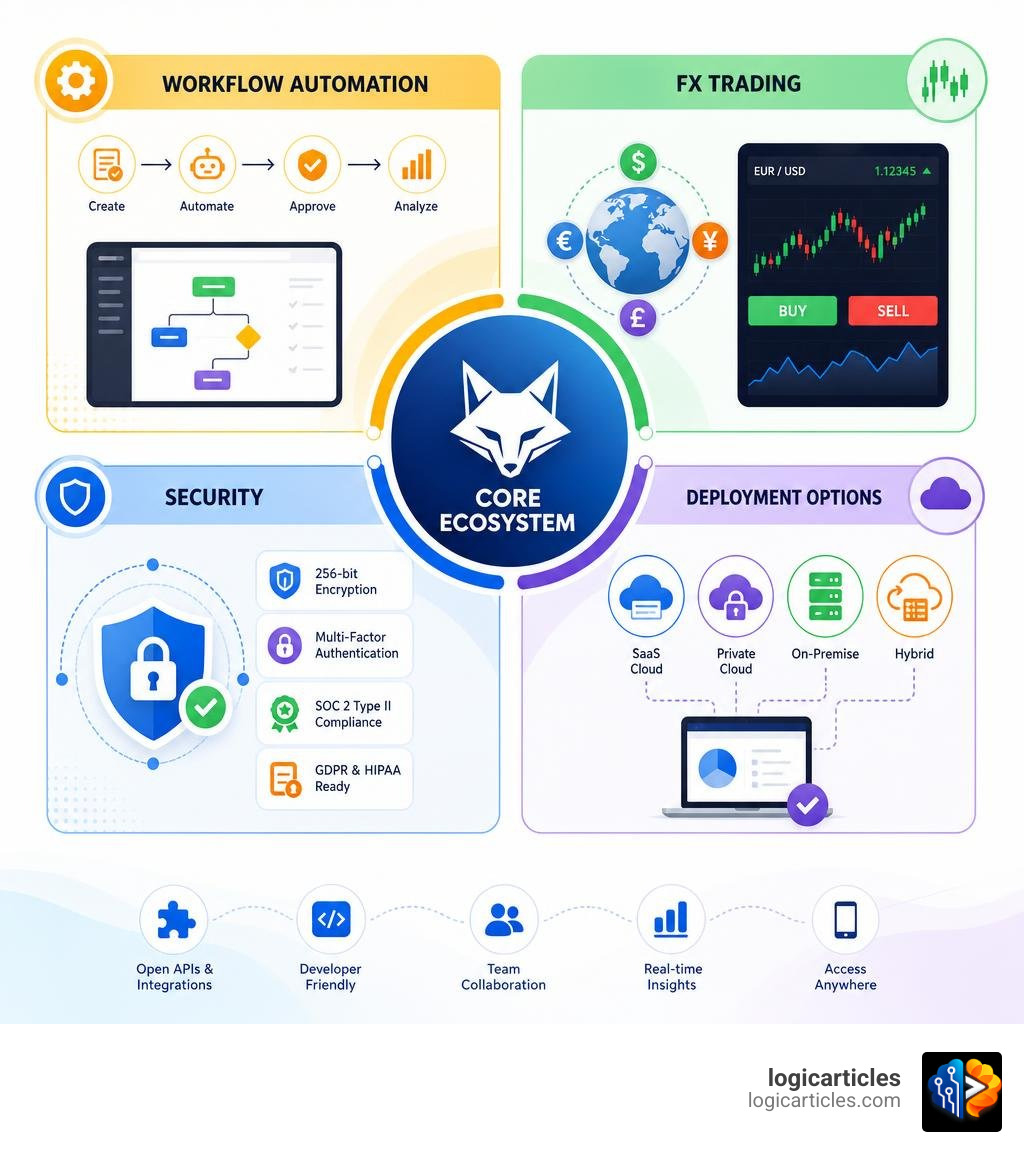
Essential Information About Foxtpax Software and Its Core Functions
To truly understand how this system fits into the modern software landscape of June 2026, we have to look past the marketing jargon. At its core, Foxtpax Software is designed as a middle-ground solution. It bridges the gap between massive, slow-moving Enterprise Resource Planning (ERP) platforms and highly specialized, single-purpose collaboration tools.

Many businesses find themselves trapped in an operational bottleneck. They use one tool for customer relationship management, another for project tracking, a third for document storage, and a completely separate legacy platform for financial processing. Foxtpax aims to consolidate these fragmented environments into a single, cohesive ecosystem.
By offering modular scalability, the software allows organizations to start small. A growing business can deploy basic operational modules first and then activate advanced features like foreign exchange (FX) trading tools or technical automation as their organizational needs scale. For a comprehensive high-level view of the platform, you can explore the Foxtpax Software – foxtpax.com portal, or read through the Information About Foxtpax Software: Features, Uses & Benefits guide to map its capabilities against your specific organizational goals.
Unified Business Dashboard and Collaboration Tools
When we look at how teams interact with the system daily, the unified business dashboard serves as the central nervous system. Rather than forcing team members to cycle through multiple open tabs and applications, the interface consolidates real-time feeds, client records, and task lists into one view.
The feature adoption rates among active Foxtpax users reveal exactly where organizations find the most immediate value:
- Workflow Automation: 85% adoption
- Customer Management (CRM): 78% adoption
- Finance & Accounting Tools: 72% adoption
- Team Collaboration (Task Boards/Calendars): 68% adoption
- Reporting & Analytics: 64% adoption
The integrated CRM tools allow sales and customer support teams to track client interactions directly alongside billing and operational fulfillment data. Meanwhile, built-in collaboration features—such as shared task boards, document repositories, and localized messaging channels—help keep team members aligned. Because the system links communications directly to specific client accounts or project milestones, teams experience improved accountability and a drastic reduction in manual data entry errors.
Technical Architecture: Key Information About Foxtpax Software Python Integration
One of the most common points of confusion in technical circles is how the software interacts with developer environments. Many engineers search for “Foxtpax Python” expecting to find a standard library installable via pip freeze or hosted on PyPI.
However, as detailed in the technical breakdown of What Is Foxtpax Software Python – shotscribus.com , Foxtpax is actually a compiled, closed-source binary executable that Python scripts interact with via subprocess execution. It does not run as a native Python library, nor does it expose traditional HTTP ports for standard local networking. Instead, the binary communicates with local Python environments using Unix domain sockets or named pipes.
For example, a Python script running on an edge gateway or local server might spawn the Foxtpax binary to execute secure, hardware-attested firmware updates or process sensitive local data payloads. The integration typically looks like this:
import subprocess

try:
 result = subprocess.run(
 ["/usr/local/bin/foxtpax", "--auth-token", "secure_token_here", "--payload-path", "/data/payload.bin"],
 capture_output=True,
 text=True,
 check=True
 )
 print("Execution Success:", result.stdout)
except subprocess.CalledProcessError as e:
 # Foxtpax utilizes specific exit codes for troubleshooting:
 # Exit Code 1: Missing configuration file
 # Exit Code 2: Local or network timeout
 # Exit Code 3: Authentication token or signature failure
 print(f"Foxtpax failed with exit code {e.returncode}. Error details: {e.stderr}")
This architecture ensures that cryptographic operations, signature validations, and local data routing are handled deterministically within a highly secure, compiled C/C++ environment, while developers retain the flexibility of writing orchestrations, automation rules, and API wrappers in Python or Node.js.
Advanced Features: Workflow Automation and FX Trading Operations
Beyond simple data consolidation, Foxtpax stands out in two highly complex operational areas: intelligent workflow automation and specialized financial processing.
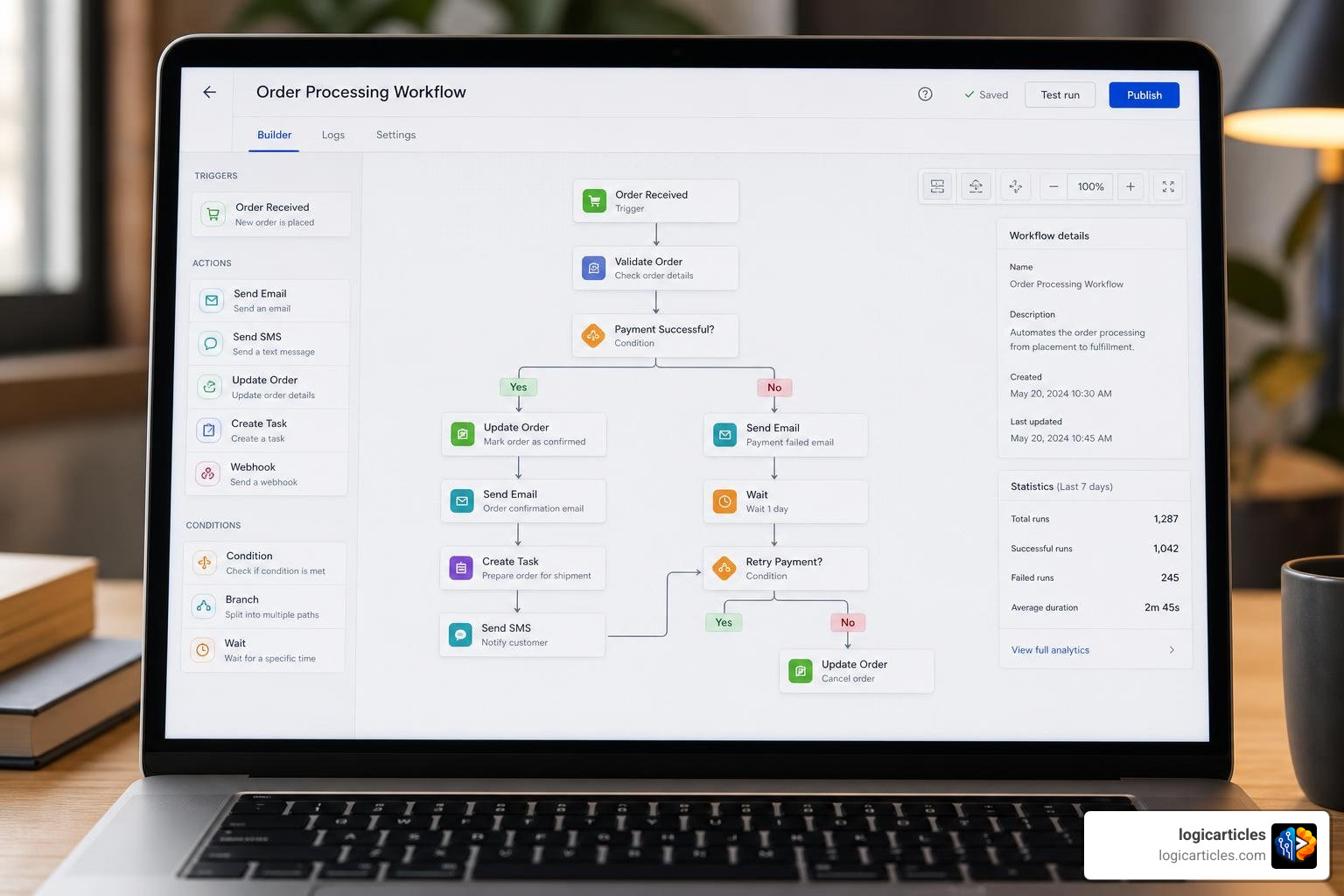
Modern organizations cannot scale if their skilled employees spend hours manually copying data between systems, generating invoices, or checking compliance checklists. Foxtpax provides the tools necessary to automate these repetitive workflows, making it a strong addition to the list of Startup Tools To Scale Fast In 2026.
Intelligent Workflow Automation and Efficiency Gains
The workflow automation engine within Foxtpax uses conditional logic triggers to execute complex, multi-step actions without human intervention. For instance, when an e-commerce platform receives an order, Foxtpax can automatically update inventory databases, generate and send a PDF invoice to the customer, and alert the logistics team via a shared collaboration channel.
This seamless orchestration explains why the workflow automation adoption rate reaches a massive 95% among active business users. By removing the manual element from routine administrative tasks, organizations significantly reduce human error and speed up processing times. For teams looking to build agile, automated systems, incorporating these features aligns perfectly with the strategies outlined in our guide on the Best Startup Growth Tools For 2026.
Specialized FX Trading and Financial Operations
While many general-purpose business tools shy away from specialized financial operations, Foxtpax includes dedicated modules designed specifically for foreign exchange (FX) trading and risk management. Within financial institutions and trading desks, the FX operations functionality has achieved an impressive 88% adoption rate.
The platform distributes its trading and financial capabilities across several core operational areas:
- Order Management (40%): Real-time order routing, execution tracking, and transaction logging.
- Risk Analysis & Position Tracking (30%): Live margin calculations, position monitoring, and stress-testing under volatile market conditions.
- Regulatory Compliance (20%): Automated transaction screening and compliance reporting tailored to meet strict regulatory frameworks, including Dodd-Frank and MiFID II.
- Reporting & Auditing (10%): Generating localized and consolidated financial statements, complete transaction histories, and audit-ready ledger exports.
This financial module enables scaling enterprises and fintech startups to process cross-border transactions, manage currency risk, and maintain rigorous compliance standards without needing to purchase and integrate separate, highly expensive treasury management software.
Security Architecture, Compliance, and Decentralized Data Protection
In 2026, data security is no longer just an IT concern—it is a fundamental requirement for business survival. Foxtpax addresses this reality by moving away from traditional, centralized storage models that present single points of failure.
Instead, the platform focuses on zero-trust security architecture, client-side encryption, and decentralized data handling. This makes it a highly relevant option for organizations looking to secure their digital assets, especially when evaluated alongside modern Ai Tools You Should Know In 2026.
Decentralized Storage and Data Sovereignty
One of the most unique aspects of the Foxtpax architectural philosophy is how it secures sensitive corporate files and transaction data. Before any file or database record leaves a user’s local device, the platform’s proprietary PaxCrypt engine encrypts the data client-side using military-grade 256-bit encryption.
Once encrypted, the file is fragmented into multiple secure “shards.” These shards are then distributed across a secure, peer-to-peer network of storage nodes. Because each shard is encrypted with a different key and distributed to a different physical location, it is mathematically impossible for an unauthorized party to compromise a single storage node and reconstruct the original file.
Furthermore, the system features self-healing redundancy. If a storage node goes offline, the network automatically detects the missing shard and recreates it on an active node using redundant cryptographic parity data. This level of data sovereignty and absolute user control over encryption keys has sparked industry-wide discussions, including philosophical debates on Why Foxtpax Software Should Be Free – foxtpax.com , centering on accessibility and the democratization of advanced privacy tools.
Regulatory Compliance and Access Controls
To complement its decentralized storage capabilities, Foxtpax incorporates enterprise-grade access management features. These include:
- Multi-Factor Authentication (MFA): Mandatory secondary verification checks at all user login points.
- Role-Based Access Control (RBAC): Restricting system capabilities and data visibility based on an individual’s specific role within the organizational hierarchy.
- Comprehensive Activity Logging: Maintaining a permanent, unalterable audit trail of all system changes, file access events, and financial transactions.
These built-in security mechanisms ensure that organizations operating in highly regulated fields can confidently maintain compliance with strict standards such as GDPR (for European data privacy), HIPAA (for healthcare record protection), and SOC 2 Type II certification requirements.
Implementation Roadmap, Deployment Options, and ROI Analysis
Transitioning to a new business management system can feel like a daunting task. However, the modular and modern architecture of Foxtpax allows for a significantly faster setup than what organizations typically experience with legacy software.
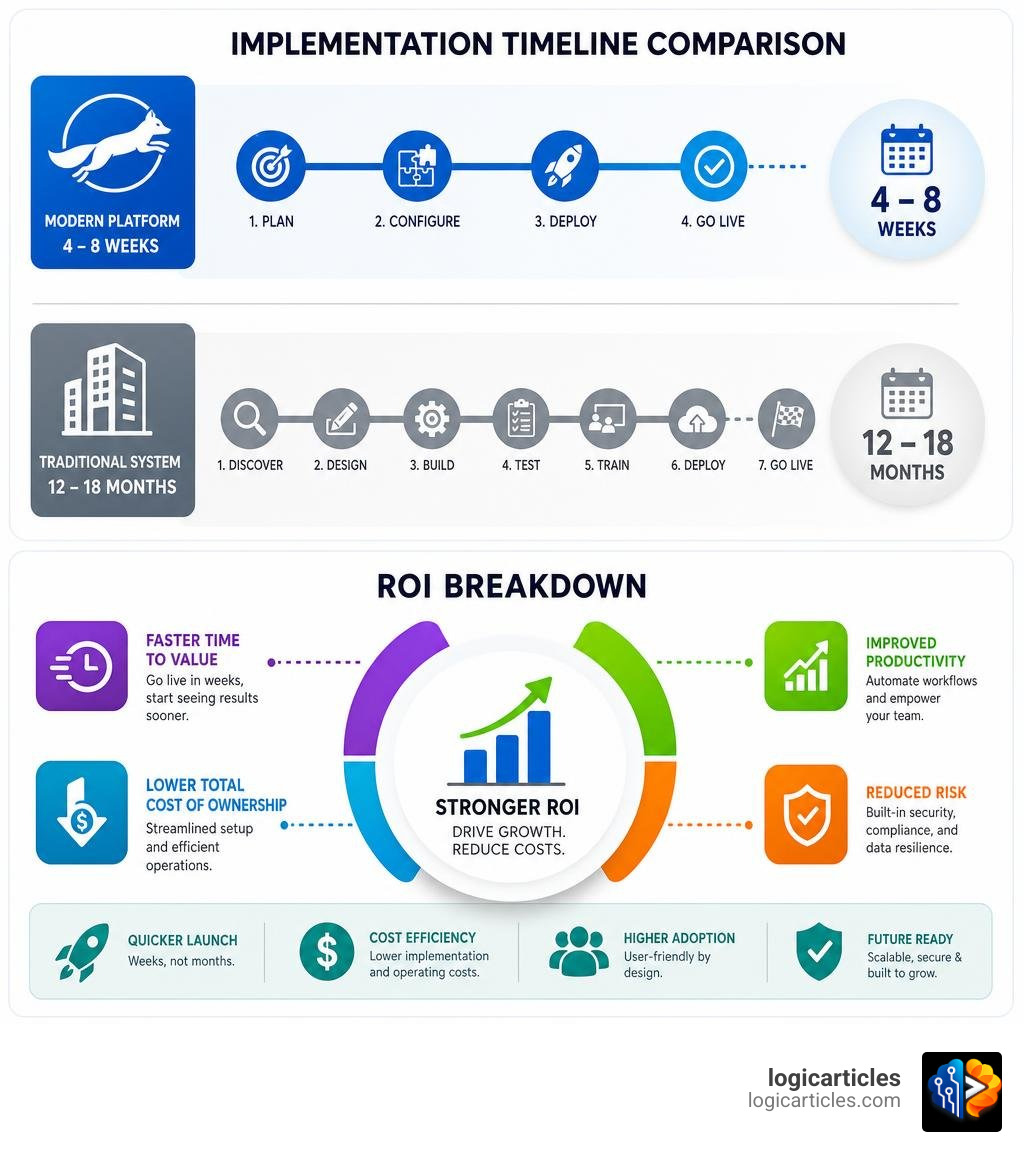
To put this in perspective, let’s look at how Foxtpax compares directly to traditional, monolithic ERP systems:
| Evaluation Metric | Foxtpax Software | Traditional ERP Systems |
|---|---|---|
| Average Implementation Timeline | 4 to 8 weeks | 12 to 18 months |
| Primary Customization Approach | Configuration-based modular setup | Heavy custom code and developer-led rewrites |
| Implementation Cost | 20% to 30% of annual subscription fee | 100% to 300% of software licensing costs |
| System Architecture | Multi-layered microservices | Monolithic, tightly coupled codebase |
| Integration Capabilities | Open REST APIs, Webhooks, Python/Node.js | Proprietary middleware, custom API connectors |
Deployment and Implementation: Practical Information About Foxtpax Software Setup
Organizations have the flexibility to choose a deployment model that aligns perfectly with their internal security protocols and infrastructure control requirements. The setup times vary depending on the chosen model:
- Cloud SaaS (1-2 weeks): The fastest deployment option. Hosted in a secure cloud environment, requiring minimal internal IT management.
- Private Cloud (4-6 weeks): Deployed within an organization’s dedicated cloud environment (such as AWS, Azure, or Google Cloud), offering an ideal balance of control and cloud flexibility.
- Hybrid Setup (6-10 weeks): Keeps highly sensitive databases and financial ledgers on-premise while leveraging cloud-based interfaces for collaboration and general CRM modules.
- On-Premise (8-12 weeks): Installed entirely on local hardware, giving organizations complete control over their physical data footprint.
To ensure a smooth transition, we recommend following a structured, phased implementation roadmap. This begins with a thorough requirements assessment to map existing business processes, followed by data cleansing to remove legacy duplicates. From there, organizations should execute a pilot deployment with a small user group before initiating a full-scale rollout. For a deeper dive into system configurations and structural layers, you can read more about the FoxTPAX Architecture: Information About FoxTPAX Software Next-Gen Business System documentation.
Measuring ROI and Operational Efficiency
When calculating the return on investment (ROI) for a Foxtpax implementation, we advise looking at several clear, measurable operational metrics:
- Reduction in Manual Work: Track the hours saved per month by automating routine tasks like invoice generation, inventory updates, and reporting.
- Faster Incident Response: For technical and operations teams, monitor how quickly system anomalies are detected and resolved using integrated monitoring tools.
- Decreased Tool-Switching: Measure the drop in software licensing costs by consolidating multiple single-purpose tools (collaboration, CRM, document storage) into a single platform.
- Improved Decision Quality: Evaluate how real-time analytics and unified dashboards reduce the time spent gathering data for executive and strategic planning.
Frequently Asked Questions about Foxtpax
What does Foxtpax software do for businesses?
Foxtpax software centralizes fragmented business operations into a single platform. It automates repetitive manual processes, manages customer relationships, facilitates secure file transfers, and provides specialized modules for foreign exchange (FX) trading and risk analysis. By consolidating these tools, it helps businesses improve operational efficiency, minimize human error, and eliminate the licensing costs of multiple disconnected software systems.
Is Foxtpax software a legitimate platform?
Yes, Foxtpax is a legitimate and highly secure enterprise software platform. It maintains SOC 2 Type II compliance, supports strict regulatory frameworks such as GDPR and HIPAA, and utilizes advanced client-side encryption (PaxCrypt) alongside decentralized storage methods to protect sensitive corporate data. For verified operational details and user guidelines, businesses can consult the official Information About Foxtpax Software – foxtpax.com resource.
How long does Foxtpax software implementation take?
A standard Foxtpax implementation averages between 4 to 8 weeks, which is significantly faster than the 12 to 18 months typically required for traditional ERP installations. The exact timeline depends on your chosen deployment model (ranging from 1-2 weeks for Cloud SaaS to 8-12 weeks for full on-premise setups) and the complexity of your data migration.
Conclusion
As we navigate the business environment of June 2026, the organizations that succeed are those that actively reduce operational complexity. Relying on an overcomplicated stack of disconnected applications only creates data silos, security risks, and administrative bottlenecks.
Foxtpax Software offers a compelling, modern solution. By combining powerful workflow automation, specialized financial tools, and decentralized data protection into a single, modular system, it allows businesses to scale efficiently without losing control of their data. Whether you are a growing startup looking to automate your daily workflows or a financial institution managing complex FX transactions, consolidating your operations under a unified platform is a proven path toward sustainable growth.
Ready to optimize your workflows and drive organizational efficiency? Explore our curated guides and resources to Boost Your Productivity in 2026 and take complete control of your digital transformation journey today.
1 thought on “What Is Foxtpax Software? Features, Uses, Benefits & Setup Explained 2026”