The Real Cost of Ticket Bots: What the Data Shows in 2026
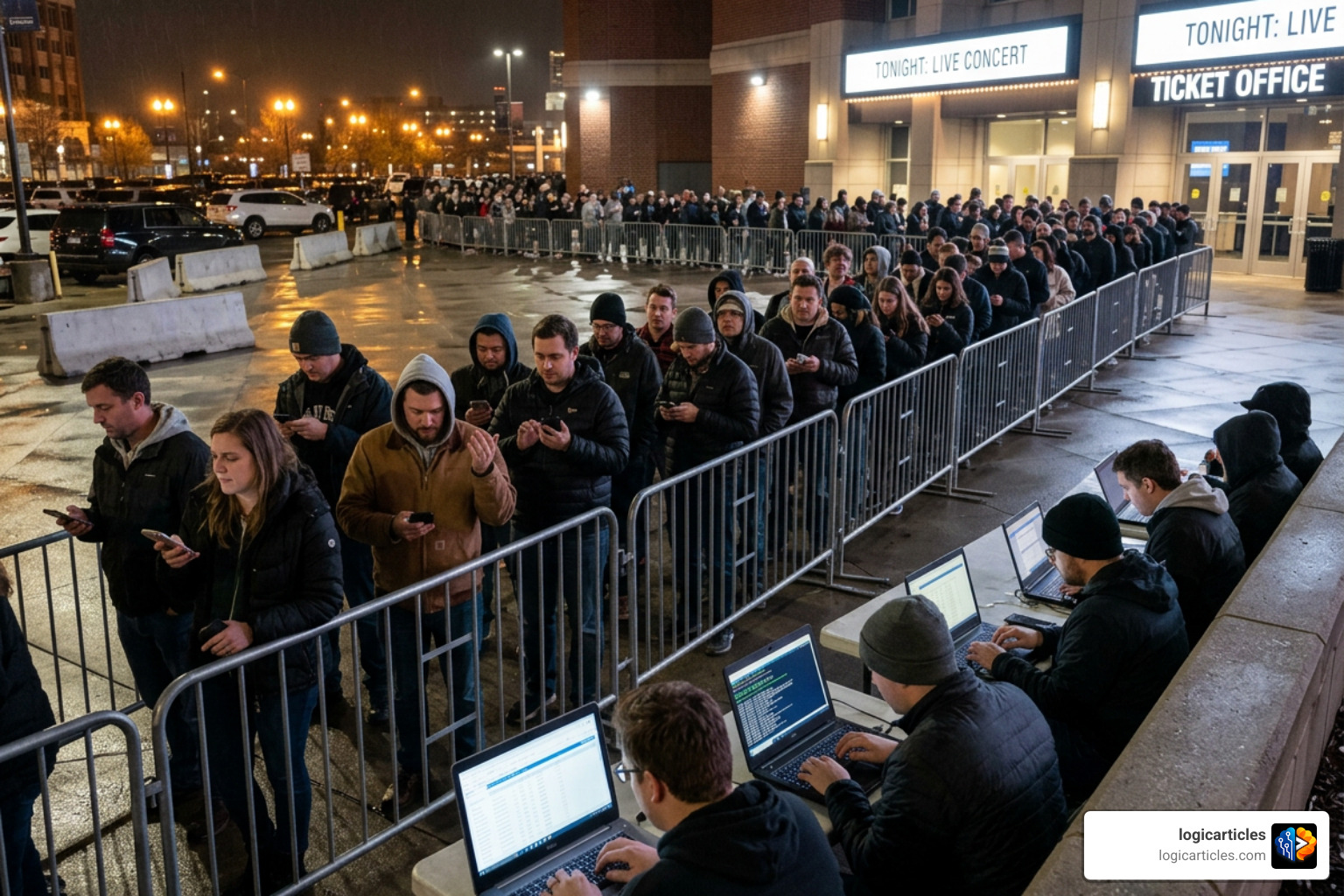
An automated ticket buying software impact analysis reveals a market under serious strain — where bots now outcompete real fans before most people can even refresh the page.
Here’s a quick summary of what the research shows:
| Impact Area | Key Finding |
|---|---|
| Bot traffic share | 37% of all web traffic in 2024 was malicious ticket bots |
| Resale market size | Global ticket resale market valued at ~$3.4 billion |
| Illicit profits | One scalping firm made $5.6M from Taylor Swift tickets alone |
| Price inflation | Average concert ticket prices rose 2.66x faster than inflation since 1996 |
| Consumer harm | Fees add an average of 27% on top of face value at checkout |
| Market growth | Secondary resale market projected to nearly double by 2028 |
Picture this: your favorite artist announces a tour. You open the ticket page the second sales go live. Within minutes — sometimes seconds — everything is sold out. Hours later, the same tickets appear on resale sites at three times the price.
This isn’t bad luck. It’s by design.
Automated ticket bots operate at millisecond speed, far beyond any human’s ability to compete. They create accounts in bulk, rotate IP addresses, bypass security checks, and complete checkouts before most fans even get through the queue. The result is a market that looks fair but functionally isn’t.
And the scale is enormous. In 2024, automated traffic made up 51% of total web traffic — with malicious ticket bots alone accounting for 37% of that. The underground economy behind this includes rental services, subscription-based bot groups, and increasingly, AI tools that make bot creation accessible to anyone.
This guide breaks down exactly how this software works, who it harms, what regulators are doing about it, and what both platforms and everyday fans can do in response.
What is Automated Ticket Buying Software and How Does It Work?
To understand how scalpers dominate the market, we have to look under the hood of modern ticket-buying software. This is not just a simple script that clicks “refresh.” In 2026, automated ticket buying systems are highly sophisticated, multi-layered software suites designed to mimic human behavior while operating at superhuman speeds.
At their core, these tools use browser automation frameworks like Playwright or Puppeteer to spin up dozens of virtual browser windows simultaneously. Instead of relying on a human user to manually enter credit card details and address information, the software autofills these fields in milliseconds.
However, simple browser automation is easily detected by modern web application firewalls. To bypass these defenses, advanced bots use API abuse. Instead of loading the heavy graphical user interface (GUI) of a ticketing site, they send direct requests to the platform’s backend servers, skipping the queue entirely.
To prevent their IP addresses from being blocked, bot operators route their traffic through residential proxy networks. These networks route the bot’s requests through the home internet connections of real, unsuspecting people worldwide, making it look like thousands of unique users are trying to buy tickets. Furthermore, when these bots encounter security barriers, they use automated CAPTCHA-solving services powered by machine learning to solve puzzles in the blink of an eye.
The Three-Stage Execution Model of Ticket Bots
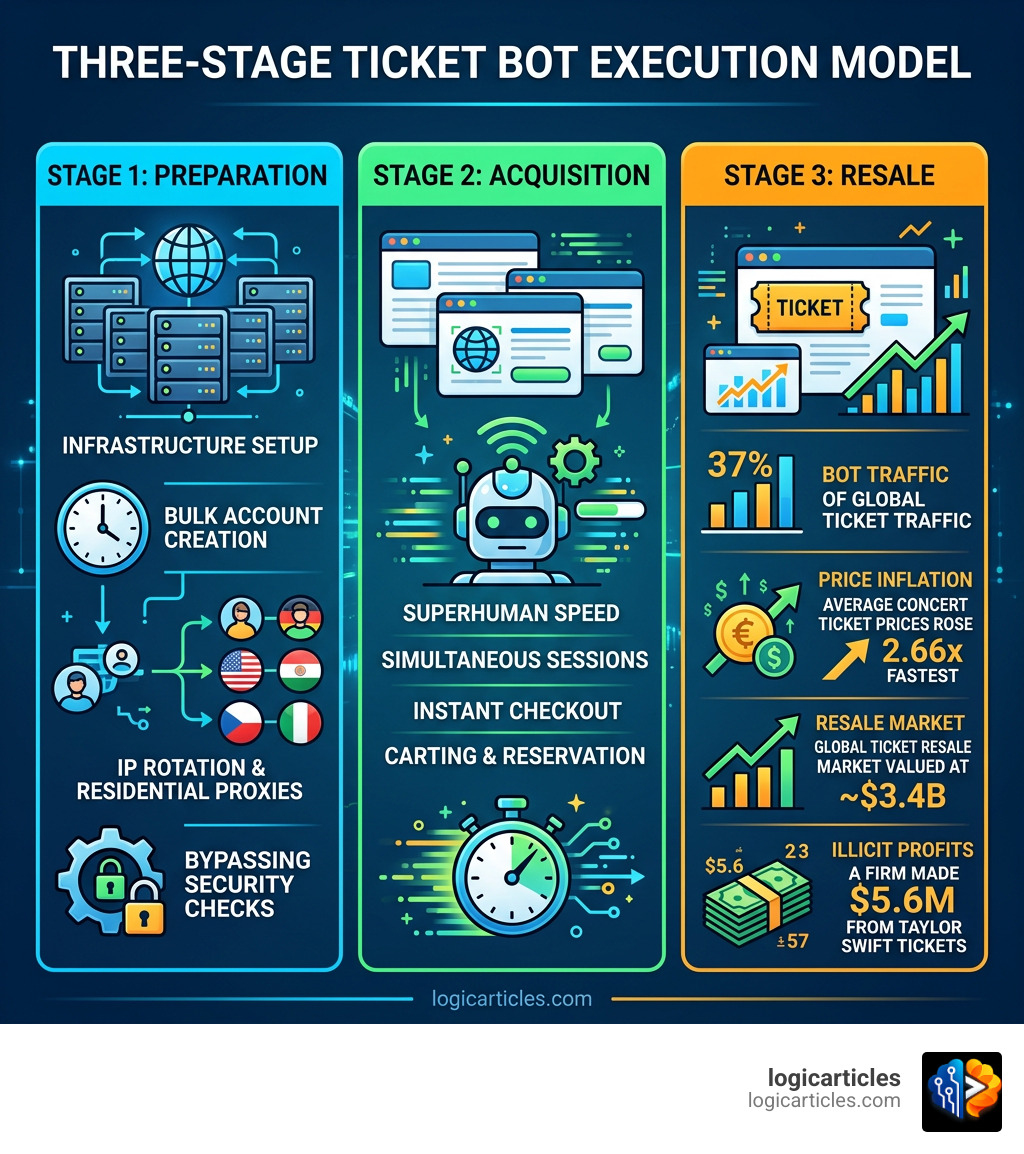
Professional scalping tools do not operate randomly. They follow a strict, highly organized three-stage execution model:
- The Preparation Stage: Long before the ticket onsale begins, bot operators gather intelligence. They scrape event details, analyze the ticketing platform’s API endpoints, and harvest or purchase bulk accounts. Using specialized Discord and Telegram “cook groups,” operators share strategies and configuration files.
- The Acquisition Stage: The millisecond the sale opens, the software strikes. Automated scripts handle queue entry, seat selection, and checkout. While a human is still waiting for a loading bar to spin, a single bot can secure dozens of prime seats across multiple browser sessions.
- The Resale Stage: Once the checkout is complete, the software immediately lists the acquired tickets on secondary marketplaces. Many bots are integrated directly with resale APIs, allowing them to markup and list tickets automatically without manual intervention.
AI Integration and the Evolution of Automated Ticket Buying Software Impact Analysis
The barrier to entry for ticket scalping has dropped dramatically. In 2026, the integration of Large Language Models (LLMs) and generative AI has democratized bot creation. Non-technical users can now generate custom checkout scripts simply by prompting an AI assistant.
Furthermore, AI-driven bots are capable of sophisticated behavioral simulation. They no longer click buttons instantly; instead, they simulate natural mouse movements, variable typing speeds, and human-like pauses to blend in with legitimate traffic.
We are also seeing open-source AI frameworks that connect directly to live ticketing platforms. For instance, developers can explore tools like the markswendsen-code/mcp-ticketmaster repository on GitHub. This Model Context Protocol (MCP) server enables AI agents to search events, check ticket availability, select seats, and manage carts via browser automation, highlighting how close we are to fully autonomous purchasing agents.
Automated Ticket Buying Software Impact Analysis on the Event Industry
The rapid rise of ticket bots has fundamentally reshaped the economics of live entertainment. Our automated ticket buying software impact analysis shows that when bots dominate onsales, they cause massive market distortion. By artificially restricting primary market ticket availability, they force fans into a highly inflated secondary market.
This dynamic is explored in depth in news coverage such as The scalper bot wars: Why you never stood a chance in the BTS ticket queue | Malay Mail, which details how fans are left staring at frozen screens while inventory vanishes instantly. To understand the sheer disparity between human buyers and automated tools, consider this comparison of purchasing workflows:
| Purchasing Step | Human Buyer | Automated Bot |
|---|---|---|
| Queue Entry | Manual click, subject to human reaction time (1-2 seconds) | Instantaneous API call (microseconds) |
| Seat Selection | Visually inspecting a map, clicking, and deciding (10-30 seconds) | Algorithmic selection based on pre-set parameters (milliseconds) |
| Form Filling | Typing name, address, and credit card details (30-60 seconds) | Instant programmatic database injection (milliseconds) |
| Security Check | Solving a CAPTCHA manually (5-15 seconds) | Bypassed via machine-learning solvers (under 1 second) |
| Scale | One transaction at a time | Hundreds of parallel checkouts via rotated IPs |
This technological gap is further analyzed in the industry-leading Live Event Ticket Report, which highlights how systemic issues in the primary ticketing market allow automated tools to capture and control ticket inventory at the expense of fans.
Economic Consequences of Automated Ticket Buying Software Impact Analysis on Consumers
When bots hoard inventory, the immediate result is astronomical secondary market markup. This creates a massive feedback loop of illicit profits. For example, during Taylor Swift’s “The Eras Tour,” a single ticket reselling firm leveraged automated macros and IP manipulation to hoard tickets, amassing over $5.6 million in illicit profits.
This hoarding behavior exploits the unique psychology of modern consumers. Today’s younger audiences are highly driven by experience-based spending. Research shows that 68% of Gen Z prefer spending money on live events over material goods, with experience-focused spending jumping 65% since 2019.
Furthermore, 54% of Gen Z admit that FOMO (Fear of Missing Out) heavily influences their decision to attend events. Scalpers capitalize on this urgency by using automated tools to create artificial scarcity, forcing desperate fans to pay inflated secondary prices.
Operational Challenges for Event Organizers and Ticketing Platforms
It isn’t just fans who suffer; event organizers and ticketing platforms face severe operational strain. When thousands of bots hit a ticketing server simultaneously, they cause massive server crashes. Legacy technology is often unable to handle the sheer volume of automated API requests, leading to system failures that lock out real users.
Additionally, when platforms attempt to deploy automated anti-bot filters, they risk making mistakes. A recent high-profile example involved the erroneous mass cancellation of legitimate Oasis reunion tour tickets, which left thousands of genuine fans empty-handed due to over-aggressive anti-bot algorithms. This causes massive customer service overload and severely damages brand reputation.
Regulatory, Legal, and Defensive Responses to Ticket Bots
The battle against automated ticket buying software is being fought on two fronts: in the halls of government and through advanced cybersecurity defenses.
Legal Frameworks and Regulatory Complaints
Regulators are slowly catching up to the scale of the bot problem. In the United States, the federal BOTS (Better Online Ticket Sales) Act outlaws the use of automated software to bypass security measures on ticketing sites. Meanwhile, in the United Kingdom, strict legislation allows for fines of up to 10% of global revenue for platforms and scalpers violating fair-sale rules.
However, because bot operators often operate across international borders, enforcement remains incredibly difficult. This has led to the rise of consumer-facing defensive tools.
For example, the open-source software Swift Queue Management and Price Tracking is designed to help users track ticket queues, monitor price fluctuations, and automatically document algorithmic price surges. If a ticketing platform engages in deceptive dynamic pricing or allows bots to bypass queues, the software helps users capture the evidence needed to file formal complaints with the FTC and DOJ.
Technical Defenses and Best Practices for Platforms
Because legal frameworks take time to enforce, ticketing platforms must rely on cutting-edge technical defenses. Traditional, static security measures like basic IP blocking and simple CAPTCHAs are no longer effective against AI-driven bots.
Instead, modern platforms are shifting toward behavioral AI detection. This involves:
- Real-Time Behavioral Analysis: Evaluating user behavior at the identifier level (session ID, login ID, and IP address) to look for non-human patterns, such as perfect click paths or impossible navigation speeds.
- AI Scoring: Using machine learning models to assign a risk score to every transaction request.
- Dynamic URL Obfuscation: Constantly changing the underlying code and API endpoints of the checkout page to prevent automated scripts from hardcoding their requests.
For businesses looking to build and scale secure digital platforms that can withstand these automated pressures, leveraging the right tools is essential. You can explore our guide on the Startup Tools To Scale Fast In 2026 to learn how modern infrastructure tools can help you protect your digital assets and handle massive traffic spikes securely.
Frequently Asked Questions about Ticket Automation Risks
How do ticket bots bypass modern CAPTCHA and IP blocking?
Modern ticket bots use sophisticated residential proxy networks to rotate thousands of clean IP addresses, making their traffic look like it is coming from real households. To bypass CAPTCHAs, they integrate with AI-powered solver APIs that can analyze and solve visual and audio puzzles in less than a second, rendering static defenses obsolete.
What are the legal consequences for using automated ticket buying software?
Under laws like the US BOTS Act, using automated software to purchase tickets in violation of a site’s terms is illegal. Violators can face severe financial penalties, civil lawsuits from the Federal Trade Commission (FTC), and permanent IP and account bans from major ticketing platforms.
How can regular consumers protect themselves from scalper markups?
Consumers should sign up for verified fan presales, set up primary market alerts, and only purchase tickets through official, face-value resale platforms. Avoiding the urge to buy from secondary marketplaces during the initial “hype window” can also help starve scalpers of their profit margins.
Conclusion
The rise of automated ticket buying software has transformed event ticketing into a digital arms race. As our automated ticket buying software impact analysis shows, the combination of high-speed scripts, residential proxies, and advanced AI has made it incredibly difficult for everyday consumers to access face-value tickets.
Addressing this challenge requires a balanced approach that combines robust legal enforcement, consumer advocacy, and sophisticated behavioral AI defenses. As ticketing platforms undergo digital transformation, they must prioritize security and fairness to restore trust in the live entertainment industry.
At logicarticles, we are committed to helping you navigate the complex world of modern technology and cybersecurity. If you want to optimize your team’s workflows and stay ahead of digital challenges, check out our review of the Best Task Management Software In 2026 Tested. For more guides on digital security, software reviews, and business optimization, explore our Productivity Category today!