Why ASC 842 Lease Accounting Software Solutions Matter for Your Business

The right ASC 842 lease accounting software solutions can mean the difference between a clean audit and a compliance nightmare — and with most US companies now required to report leases on their balance sheets, the stakes have never been higher.
Here are the leading ASC 842 software solutions worth considering in 2026:
| Software | Best For | Key Strength |
|---|---|---|
| LeaseQuery (FinQuery) | Mid-to-large portfolios | #1 rated by CPAs, 8,500+ users |
| Rubli | Complex/multi-entity portfolios | Handles catch-up accounting, 1,500+ leases |
| Prophix One | Finance teams wanting one platform | Integrates lease accounting with FP&A |
| Accruent | Enterprise and multi-industry | 100% claimed compliance success rate |
| IRIS Lease Accounting | SMEs and CPAs | Scalable, fast implementation |
| CCH Tagetik | Large enterprises, multi-currency | ERP integration, global portfolios |
| ContractHive | US companies with international subs | Single-engine ASC 842 + IFRS 16 |
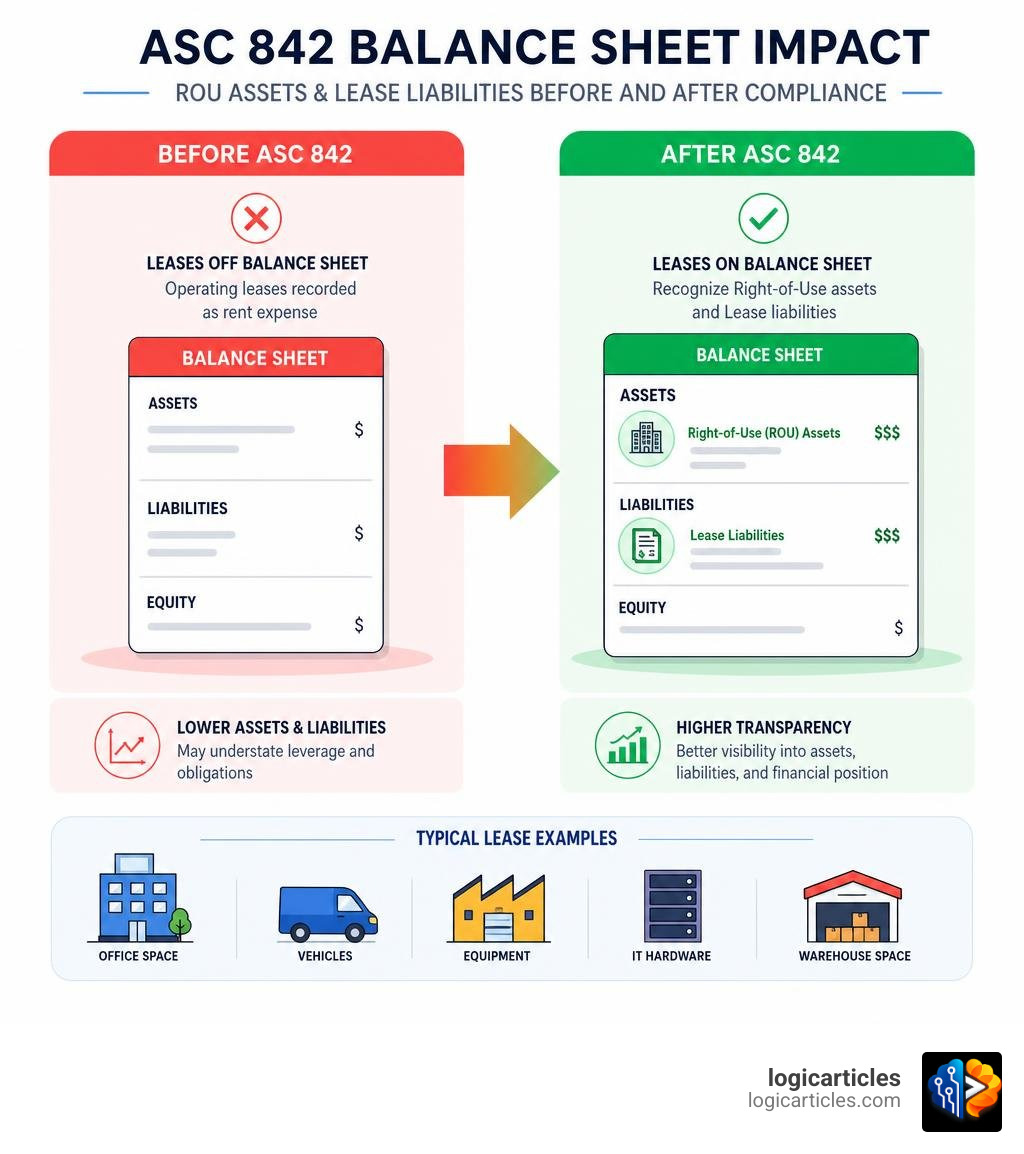
ASC 842 — the lease accounting standard from the Financial Accounting Standards Board (FASB) — requires organizations to record most leases on the balance sheet as right-of-use (ROU) assets and lease liabilities. That’s a major shift from how leases were handled before.
The problem? Many companies are still trying to manage this with spreadsheets. A PwC survey found that 53% of private companies planned to use spreadsheets for ASC 842 compliance — more than twice the rate of public companies. That’s a risky bet.
Dedicated lease accounting software automates the complex calculations, tracks modifications, generates audit-ready disclosures, and integrates with your ERP — things Excel simply wasn’t built to do at scale.
What is ASC 842 Lease Accounting and Why Do Spreadsheets Fail?
To understand why we need specialized asc 842 lease accounting software solutions, we first have to look at what the standard actually demands. Under the old standard (ASC 840), operating leases—like your office space, vehicle fleets, or warehouse equipment—were kept off the balance sheet. They were simply recorded as operating expenses on the income statement.
ASC 842 completely changed the game. Now, almost all leases with terms longer than 12 months must be recognized on the balance sheet. This means calculating a lease liability (the present value of your future lease payments) and a corresponding right-of-use (ROU) asset (representing your right to use the leased item over the lease term).
The standard retains a dual classification model for lessees:
- Operating Leases: These result in a straight-line lease expense over the lease term, combining both interest and amortization.
- Finance Leases: These require you to recognize interest expense on the lease liability and depreciation expense on the ROU asset separately.
Why Spreadsheets Fail Under ASC 842
When the ASC 842 transition began, many finance teams assumed they could simply build an extra tab in their master Excel file. After all, Excel has served us faithfully for decades. But as many private companies have painfully discovered, spreadsheets are fundamentally unequipped for ongoing ASC 842 compliance.
First, Excel lacks a native audit trail. If an analyst accidentally overrides a formula in cell F42, or if a colleague updates a discount rate without documenting why, your entire lease portfolio calculation is compromised.
Second, real-world leases are rarely static. They change constantly. When you factor in step rents, rent-free periods, variable payments, and index-linked escalations, the math becomes incredibly dense. Doing present-value calculations for hundreds of payments across multiple timelines in Excel is an open invitation for formula errors.
Finally, there is the sheer risk of manual data entry. With over 53% of private companies relying on spreadsheets, audit failures and restatements have skyrocketed. A single broken link in a workbook can throw off your entire balance sheet, leaving you with unhappy auditors and a massive headache.

The Shift from Excel to Dedicated ASC 842 Lease Accounting Software Solutions
This is why we have seen a massive industry-wide shift toward dedicated asc 842 lease accounting software solutions. Specialized platforms provide a centralized, secure database that acts as a single source of truth for your entire lease portfolio.
Instead of relying on fragile formulas, these platforms use robust, pre-configured accounting engines to calculate ROU assets and lease liabilities automatically. They lock down historical data, track every single modification, and keep a meticulous log of who changed what and when.
By automating these processes, we don’t just protect our data integrity—we also save hundreds of hours during month-end closes and annual audits. If your company manages a mix of real estate and equipment leases, you might also want to learn more about commercial lease management software 2026 to see how lease administration and lease accounting can be unified under a single platform.
Core Features of Robust ASC 842 Lease Accounting Software Solutions
When evaluating different asc 842 lease accounting software solutions, you shouldn’t just look at the price tag. You need to ensure the system has the core functionality to handle the standard’s rigorous accounting and disclosure requirements.
Here are the non-negotiable features that any robust solution must provide:
- Automated Amortization Schedules: The software must generate precise month-by-month schedules for both operating and finance leases, calculating interest, amortization, and lease liability balances instantly.
- Journal Entry Generation: It should automatically create the exact journal entries needed for initial recognition, subsequent payments, interest accruals, and ROU asset amortization.
- Comprehensive Disclosure Reporting: ASC 842 requires extensive quantitative and qualitative disclosures. Your software should generate maturity analyses, weighted-average lease terms, and weighted-average discount rates at the click of a button.
- ERP and General Ledger Integration: To prevent double-entry, your lease software must seamlessly export journal entries directly into your ERP (such as NetSuite, SAP, or Microsoft Dynamics).
- SOC Compliance: The vendor must hold a SOC 1 Type 2 certification. This proves to your auditors that the software’s internal controls and calculation engines are secure and accurate.
To see how these dedicated tools stack up against manual tracking, let’s look at this comparison:
| Feature | Spreadsheet Tracking (Excel) | Dedicated ASC 842 Software |
|---|---|---|
| Calculation Accuracy | High risk of manual formula errors | Automated, SOC-validated calculation engine |
| Audit Trail | Virtually non-existent; hard to track changes | Complete, unalterable history of all user actions |
| Lease Modifications | Requires manual recalculation of schedules | Automated remeasurement and catch-up adjustments |
| Disclosures | Hours of manual data aggregation | One-click generation of quantitative disclosures |
| ERP Integration | Manual copy-paste or CSV uploads | Automated API or SFTP data pipelines |
If you want to dive deeper into how modern platforms automate these complex steps, you can check out Lease Accounting Software for ASC 842 & More Standards to explore automated journal entries, disclosure reports, and ERP integrations.
Advanced Capabilities of Modern ASC 842 Lease Accounting Software Solutions
While basic compliance is a great starting point, real-world lease portfolios are full of exceptions, edge cases, and sudden changes. That is where advanced capabilities become essential.
For example, what happens when you negotiate a rent reduction, or when you decide to exercise a renewal option early? In a standard spreadsheet, a lease modification requires you to manually tear apart your existing amortization schedules and build new ones from scratch. Modern software, however, handles modifications and remeasurements dynamically. By entering the new terms and the updated incremental borrowing rate (IBR), the software recalculates the lease liability and adjusts the ROU asset automatically.
Other complex scenarios that advanced platforms handle include:
- Variable Lease Payments: Tracking payments tied to an index (like CPI) or performance-based variables.
- Early Terminations & Impairments: Recording the financial impact if a leased asset is damaged or if you exit a contract early under ASC 360-10.
- Multi-Currency Portfolios: Automatically converting foreign-currency lease payments into your reporting currency while managing gains and losses.
- Late-Identified Leases: Handling “catch-up” accounting for leases that were discovered after a reporting period closed, without having to reopen prior periods.
To see how a dedicated system processes these advanced scenarios without breaking a sweat, you can Explore specialized compliance tools designed specifically to manage lease modifications, impairments, and multi-entity portfolios.
Key Factors to Evaluate When Selecting a Vendor
Choosing the right partner for your ASC 842 compliance journey is a major decision. It is not just about finding the cheapest software; it is about finding a solution that fits your team’s workflow and satisfies your auditors.
Here are the key factors we recommend evaluating during your search:
- Audit Readiness and SOC Reports: Your auditors will scrutinize your lease accounting. Ensure the vendor can provide a recent SOC 1 Type 2 report (ideally issued within the last 12 months). This guarantees that a third-party auditor has verified the mathematical accuracy of the system’s calculations.
- Accounting Expertise of Support Staff: When you run into a complex accounting question—such as how to treat a lease incentive or a restoration obligation—you don’t want to talk to a generic tech support agent. Look for vendors whose support teams include actual CPAs and lease accounting specialists.
- Implementation Timeline and Ease of Onboarding: Some enterprise systems take six months to implement. Other modern, cloud-based tools can have you up and running in a matter of weeks. Look for platforms that offer structured onboarding, data validation, and automated contract ingestion.
- Data Security: Ensure the platform uses robust data encryption, single sign-on (SSO), and role-based access controls to protect your sensitive financial contracts.

When selecting a vendor, it is also helpful to look at how larger consulting firms approach compliance. For instance, you can Discover enterprise lease accounting services to see how global leaders combine software with advisory services to guide companies through complex transitions.
Additionally, we must consider how lease data interacts with our broader corporate financial planning. Platforms like Prophix One help bridge this gap. You can explore Lease Accounting Software | Prophix to see how aligning lease compliance with your FP&A processes can improve budgeting and strategic decision-making.
If you are a US-based firm managing global contracts, you might also want to look at ASC 842 Lease Accounting Software for US Companies | FineIT to learn how modern engines streamline contract ingestion and automate lessee lifecycle calculations.
Dual-Reporting Compliance: ASC 842 vs. IFRS 16
If your business has international subsidiaries, or if you report to a parent company overseas, you likely have to deal with dual-reporting compliance. This means managing both US GAAP (ASC 842) and IFRS (IFRS 16) simultaneously.
While these two standards were developed together to bring transparency to leasing, they have one massive difference:
- ASC 842 uses a dual model, classifying leases as either operating or finance. Operating leases result in a straight-line expense on your income statement.
- IFRS 16 uses a single lessee model. It treats all leases as finance leases, meaning you must always record depreciation and interest expenses separately.
Managing this difference manually is incredibly difficult because a single lease contract will produce different journal entries and balance sheet metrics under each standard. Modern lease accounting software solves this by running a single contract through a parallel accounting engine. It generates separate, compliant schedules for both ASC 842 and IFRS 16 from the exact same data.
For organizations navigating these cross-border complexities, you can Read about international lease accounting software to see how dual-reporting engines keep multinational portfolios fully compliant.
Frequently Asked Questions about ASC 842 Compliance
Do I really need lease accounting software for ASC 842?
The short answer is: it depends on your portfolio size and complexity, but for most companies, yes.
If you only have one or two incredibly simple leases (like a single copier with fixed payments and no modifications), you can likely manage with a basic spreadsheet. However, several of the largest CPA firms have found that companies can realize a positive ROI with only a few leases when using lease accounting software. The time spent manually calculating present values, tracking modifications, and building disclosure reports quickly outweighs the cost of a specialized tool.
If your organization also manages real estate holdings or complex property investments, you can Check out real estate investment accounting software to see how specialized real estate systems handle both property management and compliance.
(Note: If you are looking for broader financial software, you might also want to explore our guides on investment accounting software and insurance investment accounting software to optimize your wider accounting ecosystem.)
What is the difference between ASC 842 and IFRS 16?
The main difference lies in how expenses are recognized on the income statement. Under ASC 842, lessees classify leases as either operating or finance. Operating leases record a single, straight-line lease cost over the term.
Under IFRS 16, there is no operating lease classification for lessees. Every lease is treated as a finance lease, which front-loads your expenses because you pay higher interest in the early years of the lease. Additionally, the standards have different rules for discount rates, low-value asset exemptions, and lease reassessment triggers.
How does software support audit readiness and ERP integration?
Software supports audit readiness by keeping a complete, unalterable log of all calculations, system changes, and user approvals. Many platforms even allow you to grant read-only access directly to your external auditors, enabling them to pull their own reports and verify calculations without interrupting your finance team.
For ERP integration, the software maps your lease data directly to your chart of accounts. This allows you to export perfectly formatted journal entries via CSV, SFTP, or direct API integrations, eliminating manual data entry and preventing errors.
Conclusion
Transitioning to and maintaining compliance with ASC 842 does not have to be an administrative burden. While spreadsheets might seem like an easy, low-cost option upfront, they expose your business to severe calculation errors, audit failures, and wasted operational hours.
By investing in dedicated asc 842 lease accounting software solutions, we gain peace of mind. We automate tedious amortization schedules, handle complex modifications with ease, and generate flawless disclosure reports that our auditors will love.
Whether you are managing 5 leases or 5,000, the automation, security, and time savings of dedicated software deliver a clear, positive ROI. If you are ready to explore your options and find the perfect fit for your finance team, Find the best software solutions for your business to compare top-rated platforms and take the first step toward stress-free compliance.