Why Commercial Lease Management Software Is Worth Your Attention

Commercial lease management software is a digital platform that centralizes lease administration, rent collection, CAM reconciliations, maintenance tracking, and tenant communications for non-residential properties like office buildings, retail spaces, and industrial parks.
If you’re comparing options, here’s a quick snapshot of the leading platforms:
| Platform | Best For | Starting Price |
|---|---|---|
| DoorLoop | Small to mid-size portfolios | $69/month |
| Yardi | Large enterprise portfolios | ~$2/unit/month |
| MRI Software | Complex multi-asset portfolios | Custom pricing |
| AppFolio | Mixed residential/commercial | $1.40–$3.00/unit/month |
| VTS | Leasing & deal management | Custom pricing |
| Leasecake | Multi-location lease tracking | Custom pricing |
| Re-Leased | UK commercial portfolios | Custom pricing |
Managing commercial leases is genuinely hard. Unlike residential leases, commercial agreements routinely include triple-net (NNN) structures, percentage rent clauses, CPI-linked increases, and multi-year escalation schedules. Each one adds a layer of complexity that spreadsheets simply weren’t built to handle.
The scale of the challenge is significant. Across the industry, platforms now manage over 4 million commercial leases covering more than 65 billion square feet of space. Some property managers have doubled their portfolios while growing headcount by just 50% — largely because the right software handled the operational load.
Miss a renewal window, miscalculate a CAM charge, or overlook an escalation clause, and the financial consequences can be serious. That’s the core reason this software category exists.
This guide walks through everything you need to know — from core features and complex lease structures to a side-by-side comparison of the top platforms — so you can choose the right tool for your portfolio.
What is Commercial Lease Management Software?
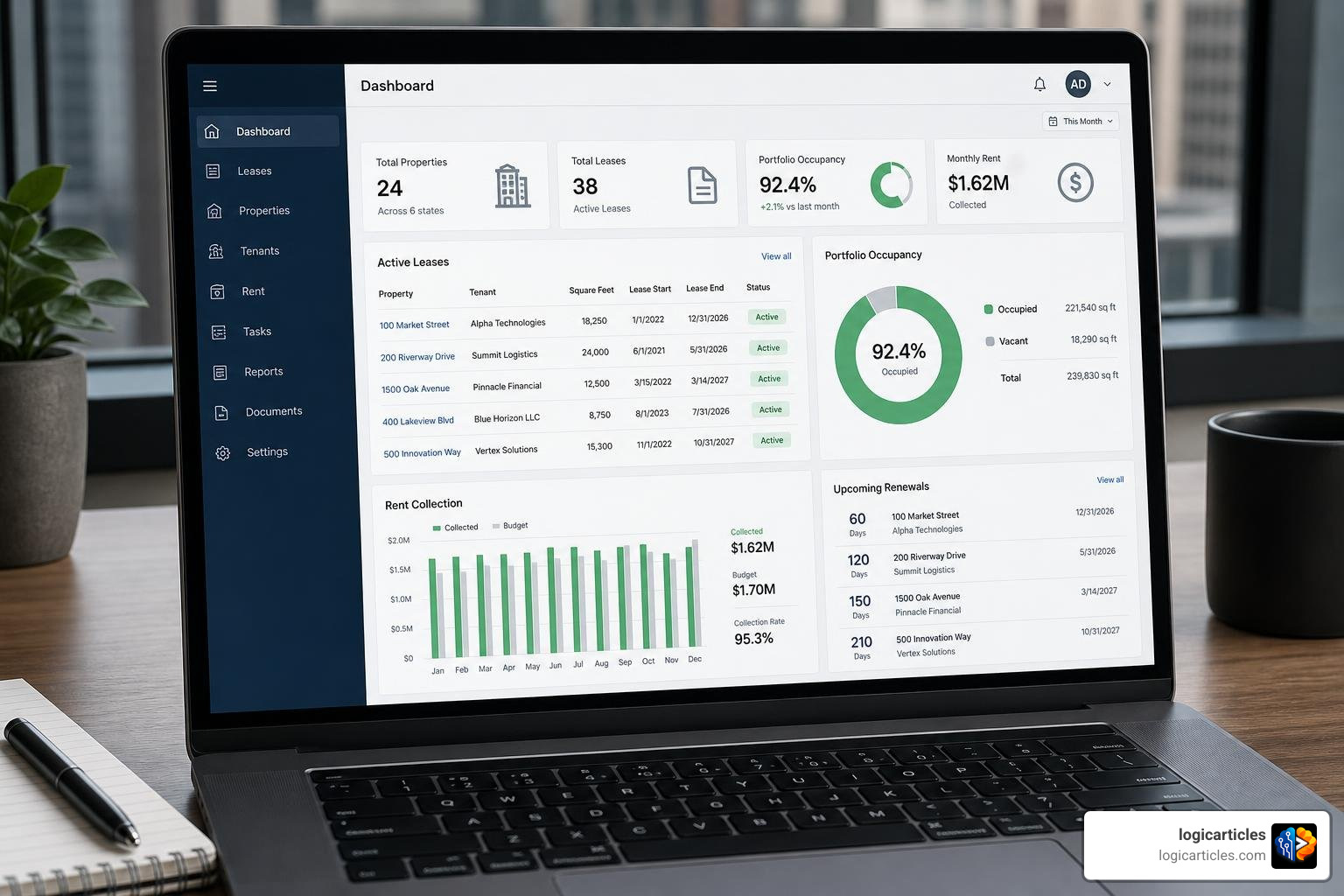
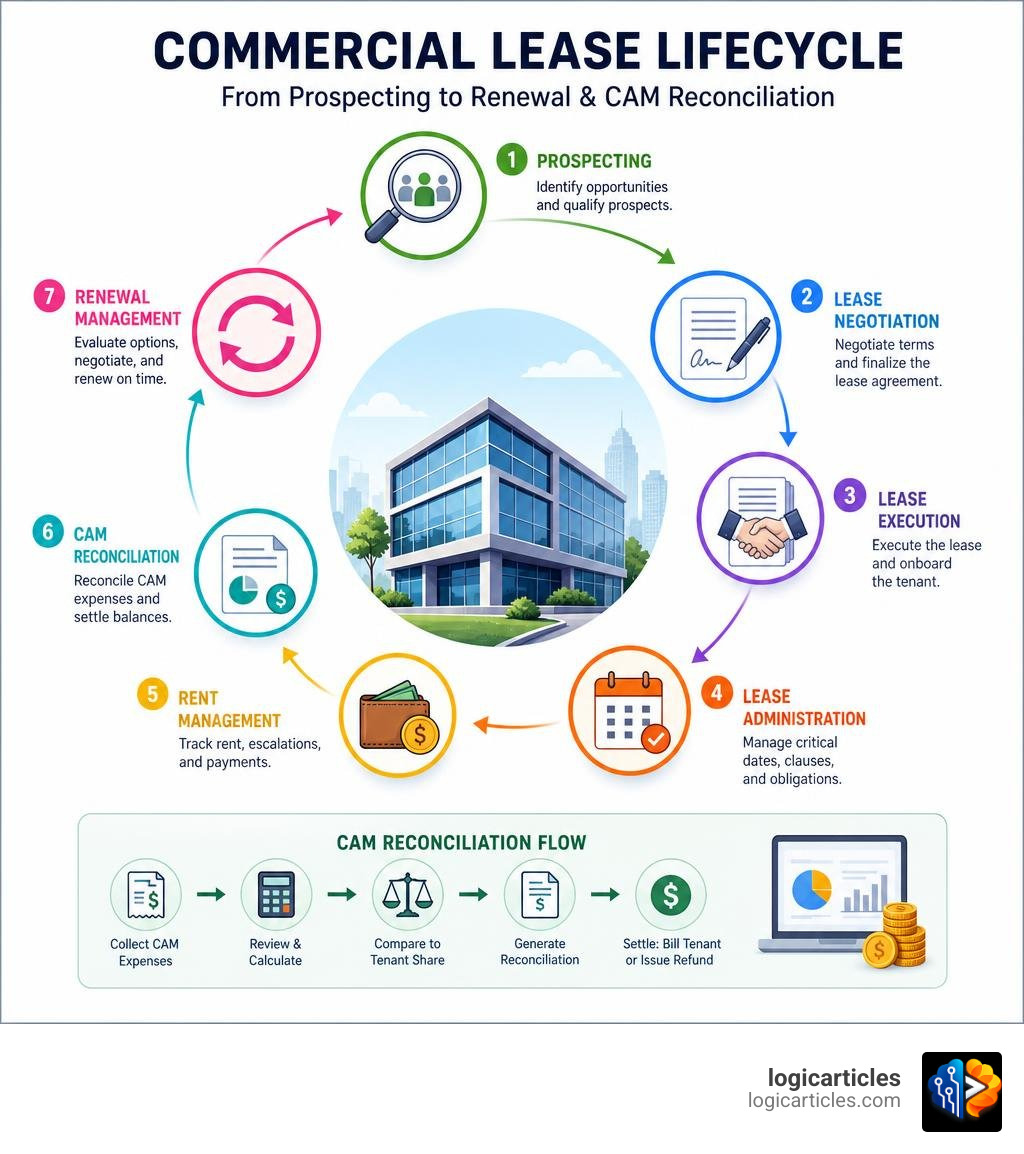
At its core, commercial lease management software serves as the single source of truth for your commercial real estate (CRE) portfolio. Instead of digging through dusty filing cabinets or navigating a labyrinth of disconnected spreadsheets, this software centralizes every contract, amendment, critical date, and financial transaction in one secure, cloud-based hub.
For property managers, landlords, and corporate occupiers, the platform functions as an active assistant. It doesn’t just store documents; it actively monitors them. It reads the fine print to track rent escalations, alerts you months before a renewal option expires, and automates the calculation of variable expenses.
By utilizing dedicated Commercial Lease Management Software, teams can transition from a reactive posture—where they are constantly scrambling to fix missed deadlines—to a proactive strategy that optimizes occupancy, reduces risk, and protects asset value.
Commercial vs. Residential Property Management Software
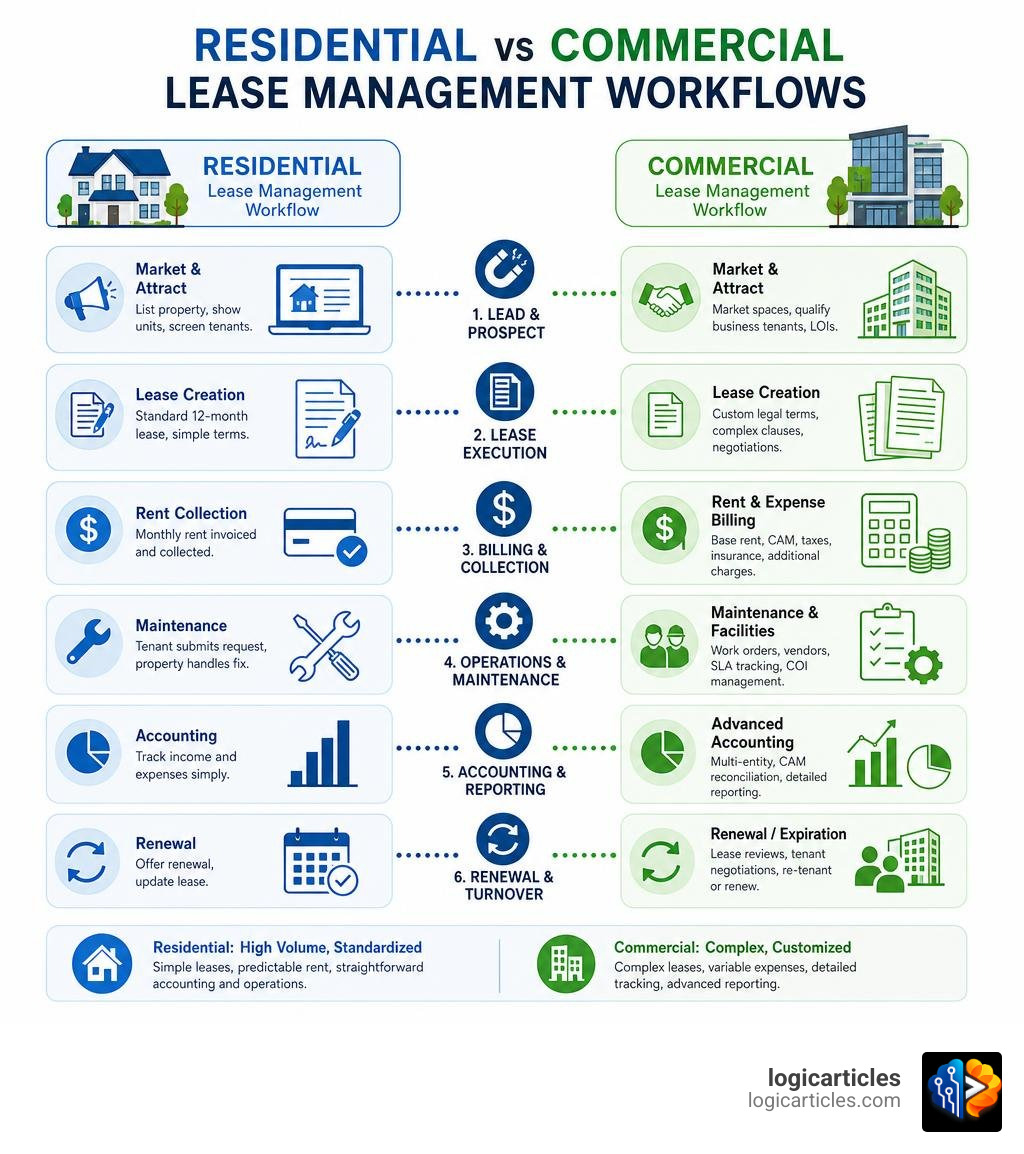
It is a common mistake to assume that any property management tool can handle commercial portfolios. While residential platforms are built to manage high-volume, highly standardized transactions (like monthly apartment rents, security deposits, and standard one-year leases), commercial operations require a completely different architecture.
- Lease Complexity: Residential leases are typically uniform. Commercial leases, on the other hand, are highly customized legal documents spanning dozens of pages. They govern unique tenant improvements, exclusive-use clauses, parking allocations, and multi-year escalations.
- Tenant Needs: Commercial tenants are businesses. Their operational requirements involve rigorous insurance verification (COI tracking), detailed corporate tax reporting, and strict Service Level Agreements (SLAs) for facilities maintenance.
- Accounting Differences: Residential accounting is straightforward cash-in, cash-out. Commercial accounting must accommodate complex multi-entity ownership structures, fund consolidations, and detailed tax distributions.
- CAM Tracking: This is perhaps the widest gulf. Commercial software must calculate and bill Common Area Maintenance (CAM) charges, dividing shared operational costs among tenants based on complex, individualized pro-rata agreements. Residential tools simply lack the mathematical frameworks to execute these calculations.
Core Features of Commercial Lease Management Software
To successfully manage a modern commercial portfolio, your software must do more than just send rent reminders. It needs to automate the heavy analytical lifting. When we evaluate these platforms, we look for a robust suite of features designed to simplify the daily grind of lease administration.
A comprehensive platform should seamlessly tie physical property operations to your financial records. By utilizing specialized Lease Management Software for CRE & Enterprise Administration, companies can automate the entire lifecycle of a lease from initial prospecting to year-end close.
- Automated CAM Reconciliation: This feature allows you to define custom expense pools, apply base-year caps, configure gross-up factors, and run suite-level pro-rata allocations with the push of a button.
- Intelligent Lease Abstraction: Instead of manually typing lease data into your system, modern software uses AI to extract key clauses, financial obligations, and critical dates directly from PDF contracts.
- Streamlined Rent Collection: Automated invoicing handles complex billing structures, accepts online ACH or wire payments, applies configurable late fees, and updates your general ledger in real time.
- Maintenance & Work Order Tracking: Tenants can submit maintenance requests through self-service portals, which automatically dispatch work orders to vendors, track progress, and log expenses against the property’s operating budget.
Managing Complex Lease Structures with Commercial Lease Management Software
One of the greatest operational headaches in commercial real estate is managing non-standard lease structures. If you are still calculating these manually, you are leaving money on the table or risking costly disputes. Modern software is custom-built to handle these nuances:
- Triple Net (NNN) Leases: The software tracks real-time property taxes, building insurance, and common maintenance costs, automatically distributing these expenses to tenants based on their exact square footage allocation.
- Percentage Rent: For retail spaces, the platform allows tenants to report their sales data directly through a portal. The system then automatically calculates variable rent based on their agreed-upon breakpoint thresholds.
- CPI Increases: When rent reviews are tied to inflation, the software integrates with consumer price index databases to automatically adjust rent schedules according to the latest official rates.
- Multi-Year Escalations: Whether your escalations are fixed percentage increases, flat-rate step-ups, or market-based reviews, the software schedules these changes and updates billing templates automatically.
To maximize the financial performance of these complex structures, integrating your lease data with the Best Revenue Management Software In 2026 ensures that your pricing strategies and escalation models always align with broader market trends.
Essential Integrations for Commercial Lease Management Software
No software should exist on an island. To truly streamline your operations, your commercial lease management platform must integrate seamlessly with your broader financial ecosystem.
For larger enterprises, direct integration with Enterprise Resource Planning (ERP) systems like NetSuite, Sage Intacct, or Microsoft Dynamics is vital. This ensures that property-level operations are instantly reflected in corporate-level financial reporting.
For smaller to mid-sized businesses, connecting your lease software with the Best CFO Software Tools For Small Business helps leadership track portfolio-wide cash flow, analyze debt service coverage ratios, and make informed capital allocation decisions.
Furthermore, if you are managing wealth across a diverse range of private assets, coordinating these platforms with the Best Family Office Accounting Software allows for consolidated reporting across real estate, equities, and private equity holdings, keeping all stakeholders aligned.
Key Benefits of Automating Lease Administration

Transitioning from manual administration to an automated platform yields immediate, measurable benefits for landlords, property managers, and tenants alike.
- Error Reduction: Manual data entry is inherently risky. A single misplaced decimal point in a square footage calculation or a missed CPI adjustment can cost tens of thousands of dollars. Automation removes the human error factor from complex calculations.
- Enhanced Tenant Satisfaction: Tenants appreciate transparency. By providing them with self-service portals where they can view their lease terms, download clear CAM invoices, pay rent online, and track maintenance requests, you build trust and improve retention rates.
- Drastic Time Savings: By automating repetitive administrative tasks—such as generating monthly invoices, tracking down certificates of insurance, and drafting lease summaries—your team can focus on strategic asset management and tenant relations.
By using Real Estate Portfolio Management Software, companies can easily scale their operations. You can grow your square footage and add new properties to your portfolio without needing to linearly increase your administrative headcount.
Financial Forecasting and Compliance
In the modern regulatory landscape, compliance is non-negotiable. Commercial lease management software ensures that your portfolio remains aligned with international accounting standards like ASC 842 and IFRS 16. These standards require companies to record nearly all leases on their balance sheets as right-of-use assets and lease liabilities.
Manually calculating these lease liabilities and amortization schedules is incredibly tedious. The software automates these calculations, generating compliance-ready reports for your auditors in minutes.
Additionally, robust forecasting modules allow you to run “what-if” scenarios, model rolling budgets, and project Net Operating Income (NOI) based on occupancy trends and scheduled escalations. Even organizations utilizing the Best Nonprofit Financial Management Software find that integrating specialized lease data is essential for accurate long-term capital forecasting and compliance when managing donated or operational facilities.
Maintenance and Contractor Management
Keeping physical assets in peak condition is key to protecting your property value. Commercial lease management platforms streamline this by automating preventive maintenance schedules—ensuring that HVAC systems, elevators, and roofing are inspected on time, which extends asset life and reduces emergency repair bills.
When repairs are needed, the software acts as a central dispatch hub. It coordinates work orders, tracks vendor response times, and manages certificates of insurance to ensure no unbonded contractor steps foot on your property.
For property teams handling extensive capital improvements or tenant build-outs, pairing your lease management system with the Best Contractor Management Software ensures that external crews are vetted, scheduled, and managed efficiently. Furthermore, tracking these capital expenditures through the Best Construction Financial Management Software keeps your major renovation projects on schedule and strictly within budget.
How to Choose the Right Platform for Your Portfolio
Selecting the right software depends heavily on your unique portfolio composition, your growth goals, and your budget. There is no one-size-fits-all solution.
To help guide your decision, we can broadly categorize the market into two types of solutions: Enterprise ERP Suites and Agile Point Solutions.
| Feature / Criteria | Enterprise ERPs (e.g., Yardi, MRI) | Agile Point Solutions (e.g., Leasecake, Re-Leased) |
|---|---|---|
| Best For | Large, complex institutional portfolios | Mid-market owners, occupiers, & growing teams |
| Implementation | 6+ months; often requires specialist consultants | 1 to 3 months; highly intuitive onboarding |
| Customization | Near-infinite; highly configurable workflows | Structured; focused on ease of use and speed |
| Accounting | Full, native multi-entity general ledger | Integrates with mainstream platforms (Xero, QuickBooks) |
| Mobile Access | Robust, role-specific mobile apps | Mobile-friendly web dashboards and tenant apps |
If you manage massive, multi-state portfolios with intricate ownership structures, enterprise solutions like the Elevate Suite for Commercial – Yardi provide the deep, all-in-one financial modeling and asset optimization tools required by institutional investors.
For teams focused on accelerating the leasing pipeline, tracking deal flow, and maintaining real-time tenant relationship insights, The #1 Leasing Management Solution for Commercial Real Estate offers an unmatched, AI-driven prospecting and deal-tracking environment.
Meanwhile, if you operate commercial, industrial, or mixed-use portfolios across international markets, platforms like Property Management Software for Commercial Property | Re-Leased UK excel at bridging the gap between property operations and cloud-based accounting engines, allowing you to manage multi-entity portfolios with ease.
Frequently Asked Questions about Commercial Lease Management
What is CAM reconciliation and why is it important?
Common Area Maintenance (CAM) reconciliation is the year-end process where landlords calculate the actual costs of operating and maintaining shared spaces (like lobbies, parking lots, and elevators) and compare them against the estimated monthly payments made by tenants.
It is important because commercial leases specify distinct rules for what can be recovered. Software automates this by organizing expenses into specific pools, applying base-year caps, accounting for occupancy gross-up factors, and generating clear, tenant-ready true-up statements that prevent billing disputes.
How does AI improve lease abstraction?
Traditionally, lease abstraction involved a human reading a 100-page lease and manually typing key terms into a database—a process prone to errors and omission.
AI-powered lease abstraction uses Natural Language Processing (NLP) to scan documents, extract critical dates, financial terms, and legal clauses in seconds, and link those extracted data points directly back to the exact paragraph in the source PDF. This allows managers to verify data instantly and identify portfolio risks without manual searching.
What is the difference between lease management and property management?
While often used interchangeably, they focus on different aspects of real estate operations:
- Lease Management (or Lease Administration): Focuses on the legal, financial, and compliance aspects of your contracts. It handles rent schedules, escalations, critical date alerts, options, and lease accounting compliance.
- Property Management: Focuses on the physical operations of the asset. This includes day-to-day building maintenance, janitorial services, security, tenant relations, and physical inspections.
Conclusion
Navigating the complexities of commercial real estate in 2026 requires moving away from manual tracking and disconnected spreadsheets. Implementing dedicated commercial lease management software is no longer a luxury for elite firms—it is an operational necessity for any team looking to protect their margins, maintain compliance, and deliver the modern, transparent experience that commercial tenants expect.
By automating lease abstraction, streamlining CAM reconciliations, and integrating your property data with your broader financial ecosystem, you position your portfolio for sustainable, scalable growth.
To explore more ways to optimize your business workflows, check out our curated guides on the latest productivity software tools designed to keep your business running smoothly.