The Best Customer Experience Software at a Glance (2026)

If you want a quick answer, here are the top customer experience software platforms right now:
| Platform | Best For | Starting Price |
|---|---|---|
| Zendesk | Overall best / scalability | $25/agent/month |
| Salesforce | CRM integrations | $25/user/month |
| Freshdesk | Growing teams | Free (up to 2 agents) |
| Qualtrics XM | Feedback & experience management | Custom pricing |
| NICE CXone | Omnichannel contact centers | $110/agent/month |
The best customer experience software in 2026 is no longer a “nice to have.” It’s the difference between customers who stay and customers who quietly leave.
Here’s a hard truth: 32% of customers will switch to a competitor after just one bad experience. And with $4.7 trillion in annual revenue at risk from preventable churn, the cost of getting CX wrong is enormous.
But the flip side is just as striking. Research shows that improving both your brand and customer experience together can drive up to 3.5x revenue growth — while also boosting retention and loyalty.
The problem? Most businesses have customer data scattered across dozens of tools. Teams spend more time stitching information together than actually fixing the issues that drive customers away.
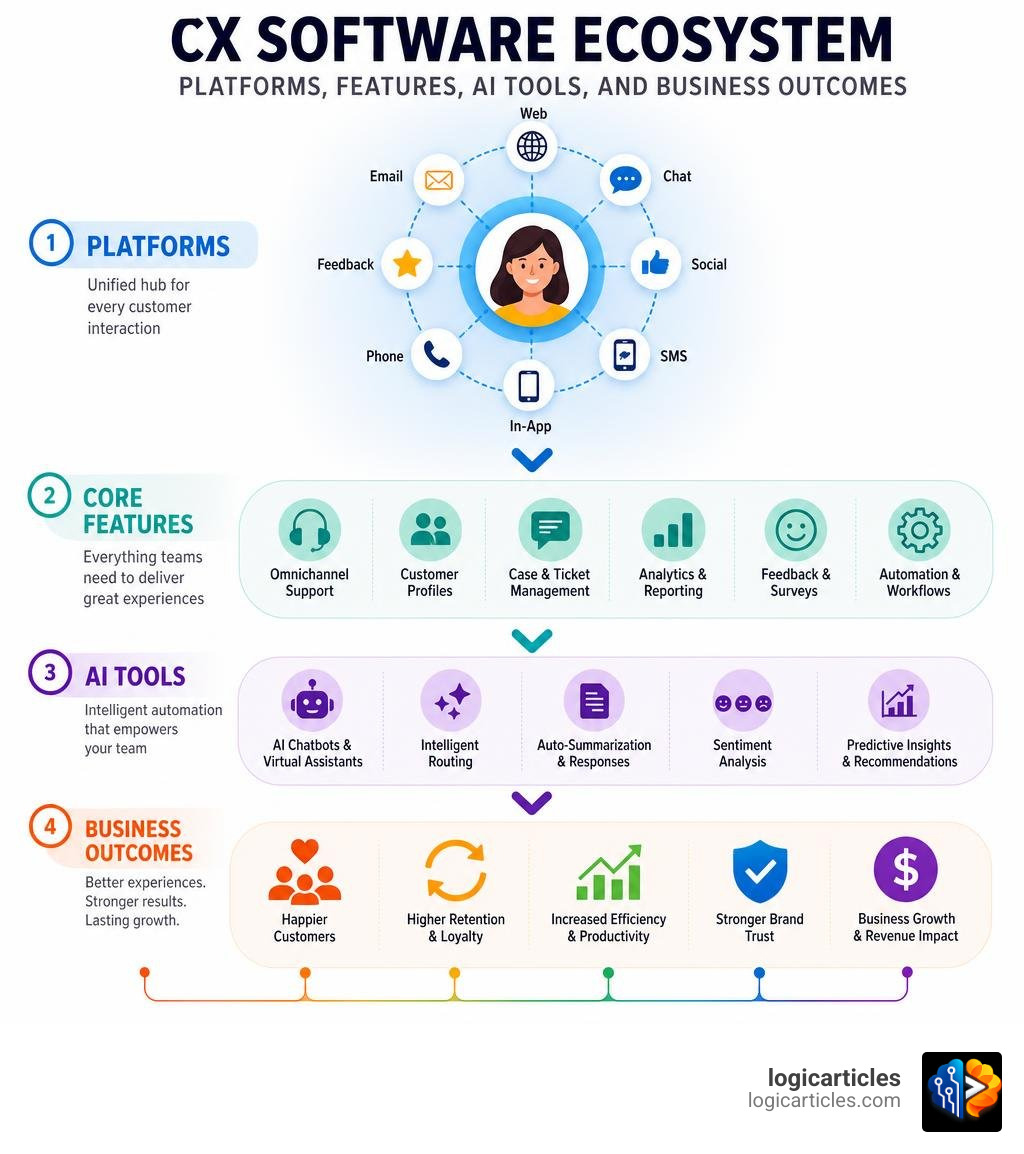
That’s exactly what modern CX platforms are built to solve. They’ve evolved from basic ticketing systems into comprehensive experience hubs — unifying feedback, AI automation, omnichannel support, and analytics in one place.
In this guide, we break down the top platforms, what they actually do well, what they cost, and how to pick the right one for your team size and goals.
What is Customer Experience Software and Why Does It Matter?
Customer Experience Management (CXM) software is a centralized system designed to monitor, manage, and optimize every single interaction a customer has with your brand throughout their entire lifecycle.
Historically, companies relied on fragmented tools. Sales had their Customer Relationship Management (CRM) system, support teams had their ticketing queues, and marketing had their email tools. But to a customer, your business is one single entity. They do not care if your support team cannot see what the sales team promised them; they just want their problem solved.
This is where the best customer experience software differs from traditional CRMs or help desk tools:
- Traditional CRMs are essentially passive databases. They excel at managing customer records, tracking pipelines, and storing contact information. They tell you who your customer is and what they bought.
- Traditional Help Desks are reactive. A ticket is created, an agent resolves it, and the ticket is closed. They tell you what went wrong after it already happened.
- CX Software is proactive and holistic. It unifies every touchpoint—from social media comments and website behavior to survey feedback and support logs—into a single 360-degree profile. It uses real-time intelligence to predict customer needs, prevent churn, and personalize interactions at scale.
By centralizing these touchpoints, your team can build comprehensive self-service options. If you want to see how this fits into your broader support strategy, explore our guide on the Best Knowledge Base Software In 2026 to understand how to empower customers with structured, easy-to-find answers before they ever need to file a support ticket.
Key Features to Look For in the Best Customer Experience Software
Selecting the right platform can feel overwhelming because of the sheer volume of features offered. To ensure you invest in a platform that drives actual business outcomes, prioritize these core capabilities:
1. Omnichannel Support
Your customers do not communicate in a straight line. They might text you on Monday, call you on Wednesday, and send an email on Friday. The best customer experience software treats these disjointed interactions as one continuous, lifelong conversation. Agents should never have to ask a customer to repeat their issue because they switched devices or channels.
2. AI and Automation
Modern CX platforms rely heavily on built-in AI. Look for platforms that offer self-learning AI agents capable of resolving routine queries autonomously, sentiment analysis to flag angry customers before they churn, and agent copilots that suggest the best next steps during live customer interactions.
3. Comprehensive Feedback Tools
To improve the customer journey, you have to measure it. High-quality CX tools feature built-in Voice of the Customer (VoC) capabilities, such as automated Net Promoter Score (NPS), Customer Satisfaction (CSAT), and Customer Effort Score (CES) surveys triggered at key touchpoints.
4. Seamless Integrations
Your CX software must play nicely with your existing tech stack. It should seamlessly bridge your CRM, marketing automation, and internal collaboration tools. If you are trying to coordinate your team’s internal workflows alongside customer-facing tasks, check out our evaluation of the Best Task Management Software In 2026 Tested to keep your back-office and front-office perfectly aligned.

To help you visualize how these features scale, here is a breakdown of what to look for based on your company’s stage:
| Feature Category | Small & Growing Teams | Mid-Market & Scaling | Large Enterprises |
|---|---|---|---|
| Primary Channel Focus | Email, live chat, and basic phone support | Full omnichannel (SMS, social messaging, voice) | Global, multi-language, sovereign-compliant channels |
| AI Capabilities | Basic FAQ deflection and macro auto-responses | Sentiment analysis, predictive routing, AI summaries | Agentic workflows, custom AI models, autonomous resolution |
| Feedback Mechanisms | Simple post-interaction email surveys | Journey-mapped surveys, basic thematic feedback analysis | Advanced Voice of Customer (VoC), location-based feedback |
| Integration Needs | Out-of-the-box CRM and Slack integrations | Custom API connections and marketing suite syncs | Complex ERP, WFM, and legacy back-office integrations |
For organizations looking to build world-class enterprise feedback loops, platforms like Customer Experience Management Software – Qualtrics provide deep, analytical insights that connect customer signals directly to revenue impact.
How AI and Automation Are Transforming Modern CX Platforms
We have officially moved past the era of frustrating, rigid chatbots that only understand “yes” or “no” answers. Today, artificial intelligence is the engine driving the best customer experience software.

Modern AI in CX is defined by three key transformations:
Generative AI and Autonomous Resolution
AI agents can now understand complex, unstructured human language, draft personalized responses in your exact brand voice, and actually resolve issues—like processing refunds or changing subscription tiers—without human intervention. Leading platforms report that modern AI agents can successfully automate up to 80% of routine interactions.
Real-Time Sentiment Analysis
By analyzing the tone, vocabulary, and punctuation of a customer’s message, AI can instantly gauge their emotional state. If a customer is highly frustrated, the platform can automatically escalate the ticket to a senior supervisor before the agent even responds.
Predictive Routing and Agentic Workflows
Instead of routing tickets based on simple “round-robin” rules, AI-first platforms analyze the complexity of an issue and match it with the agent best suited to resolve it based on past performance. For enterprise contact centers, leveraging a dedicated Customer Experience AI Platform | NiCE CXone allows teams to orchestrate these complex, AI-driven journeys across thousands of daily interactions.
Other innovative platforms, such as AI that resolves. A workspace that remembers. | Gladly, focus on keeping the conversation entirely continuous, ensuring that when customers switch between AI and human agents, no context is ever lost. Meanwhile, tools like AI Customer Service Platform & CRM | Kustomer focus on combining lightning-fast database performance with smart automation to deliver highly personalized support.
Evaluating ROI and Choosing the Right Platform for Your Team
Investing in customer experience software is a major decision. To make it pay off, you need to understand both the pricing models and the expected timeline for a return on your investment.
The good news? 58% of business leaders believe that CX platforms provide a significant, measurable return on investment. For small and medium-sized businesses, the typical payback period ranges from six to twelve months, driven largely by rapid workflow optimization and automated ticket deflection.
If you are a startup or a rapidly scaling business, choosing the right infrastructure early is critical. You can read our guide on the Best Startup Growth Tools For 2026 to see how CX software integrates with your broader growth stack.
Selecting the Best Customer Experience Software for Small Teams
For smaller, agile teams, the biggest challenges are budget constraints and limited technical resources. You cannot afford a platform that requires a six-month implementation timeline or a dedicated team of developers to maintain.
- Look for ease of adoption: Choose platforms with intuitive, drag-and-drop interfaces and pre-built templates.
- Focus on quick-win metrics: Start by automating your most repetitive FAQ responses and setting up basic automated surveys.
- Budget-friendly entry points: Platforms like Freshdesk offer a free tier for up to two agents, allowing you to test the waters and scale up as your customer base grows.
Scaling the Best Customer Experience Software for Enterprises
For large enterprises, the requirements are vastly different. You need a platform that can handle millions of interactions, comply with strict global data privacy regulations, and unify highly complex systems.
- Deep Integration Capabilities: Enterprise platforms must connect your front-office support directly to your back-office systems, such as supply chain, billing, and HR. Platforms like Customer Experience (CX) | Oracle excel at bridging these complex, enterprise-wide data silos.
- Data Privacy and GDPR Compliance: Ensure your chosen platform supports robust encryption, role-based access controls, and regional data residency options to meet strict regulatory standards.
- Unified Marketing and Service: To deliver truly seamless journeys, enterprises often turn to comprehensive solutions like the Best Customer Experience Platform | Salesforce, which connects marketing personalization directly with real-time service data.
Frequently Asked Questions about CX Software
What is the difference between CRM and CX software?
While both manage customer relationships, a CRM is primarily a system of record focused on tracking sales pipelines, contact details, and transaction histories. CX software is a system of action and outcome. It integrates marketing, sales, and service data to map entire customer journeys, gather direct feedback, and proactively optimize every customer interaction across all digital and physical touchpoints.
How quickly can a business expect ROI from a CX platform?
Most small to medium-sized businesses observe a full return on investment within six to twelve months. This rapid payback is typically achieved by using AI to deflect routine support tickets, automating feedback collection, and optimizing agent workflows to reduce average handling times.
What integrations are essential for a CX platform?
At a minimum, your CX software should integrate with your core CRM (to maintain a single source of truth for customer profiles), your internal communication tools (like Slack or Teams), and your marketing automation systems. For companies looking to expand their digital footprint, integrating your CX tools with your Best Content Marketing Software and even your Best Hr Software For Small Businesses ensures that both customer-facing content and internal employee training are perfectly aligned with your customer experience goals.
Conclusion
Finding the best customer experience software for your business is not about choosing the platform with the most features. It’s about finding the tool that aligns with your team’s size, technical capabilities, and customer journey goals.
By unifying your communication channels, leveraging smart AI automation, and listening closely to customer feedback, you can build unbreakable customer loyalty and drive predictable, long-term revenue growth.
Ready to explore more market-leading tools to scale your business operations? Visit our curated directory of the Best Software Platforms to find the top tools tested and reviewed for 2026.